DRONERESPONDERS Warns: Public Safety Drones and Delivery Fleets Are on a Collision Course in Low-Altitude Airspace
DRONERESPONDERS Executive Director Charles Werner has issued a warning that the U.S. lacks any agreed-upon mechanism for resolving airspace conflicts between public safety drones and commercial delivery fleets. With DFR authorizations surging twentyfold in six months, nearly one million registered drones on FAA rolls, and Part 108 rulemaking still unfinished, the low-altitude airspace management crisis is arriving faster than regulation can respond.
Highlights
- The U.S. has nearly 1 million registered drones versus approximately 230,000 traditional civil aircraft on FAA rolls, with the gap widening every month.
- DFR exemptions surged from roughly 50 over six years to more than 1,000 in six months after the FAA streamlined BVLOS approvals in May 2025, with ~125 new exemptions approved monthly.
- The FAA missed its February 1, 2026 deadline for the Part 108 final rule; more than half of 3,100 substantive comments targeted a single right-of-way provision.
- Amazon Prime Air withdrew from the Commercial Drone Alliance in March 2026, partly over direct disagreement on whether mandatory UTM would stifle delivery growth.
- DRONERESPONDERS warns that no agreed conflict-resolution mechanism exists for public safety vs. delivery drones, and UTM systems remain largely absent outside test environments at the national scale.
The United States now has roughly four registered drones for every manned aircraft on the FAA's civil aircraft registry — yet a senior public safety official warns that no mutually accepted mechanism exists to determine who yields when the two meet.
In an article published June 24 in Homeland Security Today, Charles Werner, Executive Director of the DRONERESPONDERS Public Safety Alliance, laid out the numbers plainly: approximately 230,000 traditional aircraft appear on FAA's civil registry, compared to nearly one million registered drones — and the gap between manned and unmanned aviation widens every month.
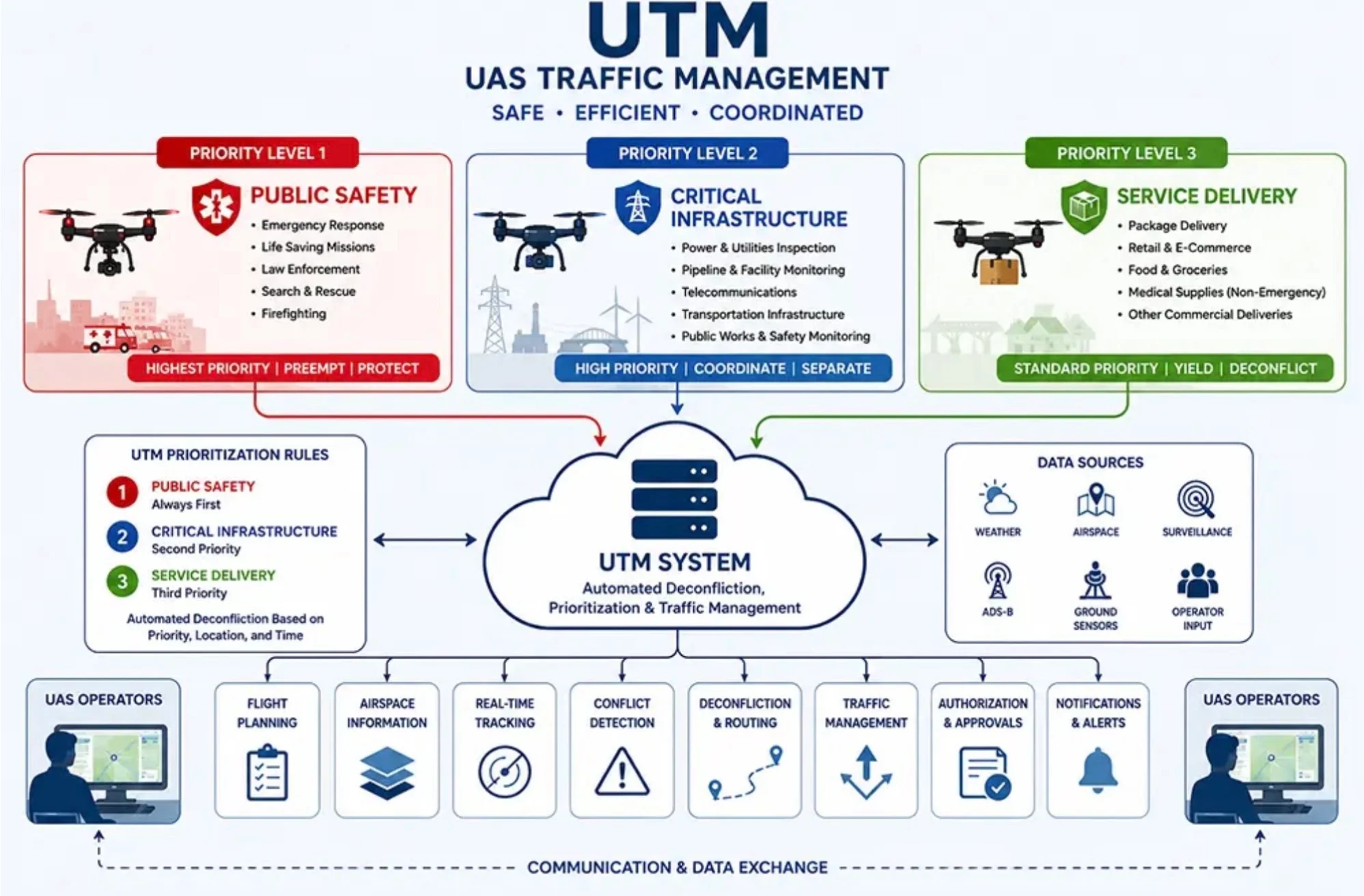
The concern Werner raises is not drones colliding with airliners — the FAA estimates that collision risk at roughly one in ten million. The real hazard is drone-on-drone encounters. Drone as a First Responder (DFR) programs are launching weekly across U.S. cities, while commercial delivery operations are approaching the one-million-successful-delivery milestone domestically. Both sectors are beginning to compete for the same low-altitude airspace over the same communities. The UAS Traffic Management (UTM) systems designed to keep them separated remain largely non-existent outside of test environments.
Werner's argument comes from the public safety community, not the delivery industry. His core point: airspace conflict resolution must be addressed before new regulations that could triple traffic volumes take effect.
Drone Registrations Have Far Outpaced Manned Aviation
The scale of this shift is the story much aviation reporting has missed. The U.S. currently has around 300 traditional public safety aviation programs operating manned helicopters and fixed-wing aircraft. There are now more than 10,000 public safety drone programs. This is not incremental growth — it represents an entirely new aviation category that materialized in under a decade.
Pilot figures tell the same story. 2025 FAA data show approximately 900,000 certificated manned pilots and nearly 500,000 certificated remote pilots, with remote pilot certifications still outpacing traditional ones. The unmanned side of U.S. aviation is catching up at a pace that started from zero in the early 2010s.
DFR Authorizations Surge Twentyfold in Six Months
The fastest-growing element is the DFR program — a staged drone that launches immediately upon a 911 call and streams live video to commanders before patrol cars arrive. Since the FAA streamlined its BVLOS review process in May 2025, the number of approved DFR exemptions has surged from roughly 50 over the prior six years to more than 1,000 in just six months. The FAA is currently approving approximately 125 new DFR exemptions per month.
This acceleration is visible at the city level. Newport News, Virginia, can now deploy a drone to a 911 scene within 90 seconds from four launch points. Orlando approved a $6.83 million Skydio program after a pilot showed drones arrived before officers in one-third of incidents. The FAA has also opened a streamlined pathway allowing a single remote pilot to simultaneously operate up to four drones — removing the staffing bottleneck that had limited program scale. Every one of these approvals adds more aircraft to airspace that delivery operators are also targeting.
Drone-on-Drone Conflicts: The Problem Nobody Has Solved
Two fast-growing aviation categories are converging on the same low-altitude airspace with no mature mechanism to determine right-of-way when they meet. Werner is direct: drone-to-manned-aircraft conflicts remain rare, but drone-to-drone interactions represent the emerging challenge — and testing on who yields when public safety and delivery drones compete for the same airspace remains extremely limited.
According to FAA data, commercial drone delivery is approaching one million successful deliveries in the United States, while public safety agencies are pushing DFR into urban, suburban, and rural airspace alike. The conflict-resolution tools intended to manage this overlap — UTM systems with automated strategic deconfliction — remain in early development, with the governance frameworks, technology, and business models required for nationwide operation still under construction.
This is not a hypothetical conflict waiting to happen. It already exists in the regulatory record. In March 2026, Amazon Prime Air withdrew from the Commercial Drone Alliance, in part over direct disagreement about whether mandating UTM is the right path forward or an overreach that would stifle delivery growth. The industry has been unable to reach consensus on whether UTM should be universal or selective — and that divide is now public.
Part 108 Will Multiply Traffic Before Rules Are Set
The coordination gap is set to worsen when long-anticipated new rules arrive. Part 108 is the FAA's framework for legalizing routine BVLOS flight without case-by-case exemptions. When finalized, it is expected to push a large new wave of commercial, industrial, and public safety aircraft into the National Airspace System simultaneously — more traffic, with the priority question still unresolved.
The rule has also been delayed, and for exactly the reason Werner describes. A June 2025 executive order set a deadline of February 1, 2026, for the Part 108 final rule — a deadline the FAA missed. The agency twice reopened comment periods; the second closed February 11, 2026, specifically targeting the rule's most contested provision: a right-of-way clause that would grant Part 108 drones presumptive priority over manned aircraft not broadcasting electronic position information. More than half of the 3,100 substantive comments received targeted that single provision. The FAA is still working out who yields in the air — and has not yet found an answer.
What Public Safety Programs Can Control Today
With national rulemaking stalled, Werner advises agencies to focus on what they can control: building genuine aviation safety culture rather than waiting for airspace to sort itself out. This is the most actionable part of his argument, because it does not depend on the FAA completing anything on schedule.
His checklist for every public safety drone program:
- Remote pilot certification compliance
- Regular recurrent training programs
- Crew Resource Management (CRM) procedures
- Aircraft maintenance and airworthiness plans
- Operational risk assessments
- Standard operating procedures
- Thorough recordkeeping and documentation
For national-level progress, DRONERESPONDERS has engaged a Service Delivery Cohort — including major drone delivery companies and the FAA — with the goal of producing a formal roadmap for emergency response drones and commercial fleets to safely share airspace. The organization is also actively recruiting agencies to its Advanced Air Mobility Working Group to shape how integration is built.
DroneXL Analysis
Werner's diagnosis is correct, but his description of the cause is somewhat diplomatic. "Collaboration is the path forward" works as a closing line in a public safety press release, but it is not the actual reason answers have not emerged. The real reason is that the FAA attempted — within a 240-day political timeline — to resolve the most consequential question in low-altitude aviation: who yields when a drone meets a manned aircraft. It failed. More than half of 3,100 comments targeted a single clause. That is not a coordination failure any working group can fix. It is a genuine, unresolved conflict over who owns this slice of sky.
Public safety advocates need to be honest about the following: Werner's UTM framework diagram places public safety at the top tier, above critical infrastructure and delivery services. That is unsurprising, given it was drawn by a public safety alliance. Delivery companies are drawing their own diagrams — ones in which drones equipped with detect-and-avoid systems fly without requesting permission from a central UTM system. Amazon has already left one industry organization over a version of this dispute. When the people responsible for 911 drones and the people responsible for delivery drones both believe they have right-of-way, the problem does not get resolved because everyone agrees to collaborate. The FAA has to make a choice — and it has spent the better part of a year demonstrating how difficult that choice is.
An uncomfortable observation must be stated plainly: a life-saving DFR drone responding to a shooting and a drone delivering a sandwich are not morally equivalent uses of airspace, and regulation should say so explicitly. If a public safety aircraft must yield to a delivery drone that filed for airspace first while racing to a shooting scene, the system is broken. Werner's instinct to prioritize public safety is correct. The problem is that "priority" is a regulatory decision that produces losers — and no one at the FAA wants to be the person who tells the delivery industry it is second in line.
Watch whether the final Part 108 rule — whenever it is published — explicitly encodes a public safety priority tier, or whether it defers that question to UTM systems that do not yet exist. That single choice will reveal whether anyone in Washington is genuinely willing to sequence these flights, or whether they will continue calling a sequencing problem a collaboration problem until two drones meet above a rooftop and make the decision for everyone.
Source: Homeland Security Today
原文來源: 查看原文
FAQ
Reviewed and published by the LAETimes editorial desk ·


