Exail and KNDS Sign New Framework Agreement to Strengthen France's Autonomous Mine Countermeasures Industrial Ecosystem
French companies Exail and KNDS have signed a new framework agreement covering the supply of hundreds of warhead-equipped charges for the K-Ster mine neutralization system. Building on a partnership launched in 2008 with over 15 years of operational feedback, the deal marks a pivotal shift from technology demonstration to large-scale production of autonomous mine countermeasures capabilities for global naval customers.
Highlights
- Exail and KNDS signed a new framework agreement to supply hundreds of shaped-charge warhead units dedicated to the K-Ster autonomous mine neutralization system.
- The Exail–KNDS partnership was established in 2008 and has accumulated over 15 years of real-world operational feedback from naval deployments.
- The K-Ster mine neutralization drone is now a series-produced operational system, no longer a prototype, reflecting a broader industry shift to large-scale MCM production.
- The agreement consolidates a fully French, end-to-end value chain covering autonomous underwater vehicles through to warhead manufacturing, supporting national supply chain sovereignty.
- Exail Procurement Director Cyril Hammer stated the deal strengthens industrial capacity to support expanding naval programmes and meet growing demand from navies worldwide.
As navies worldwide accelerate the modernization of their mine countermeasures (MCM) capabilities, French firms Exail and KNDS are deepening their industrial cooperation. The two companies have signed a new framework agreement covering the supply of hundreds of shaped-charge warheads dedicated to the K-Ster mine neutralization system.
From Technology Demonstration to High-Intensity Operations
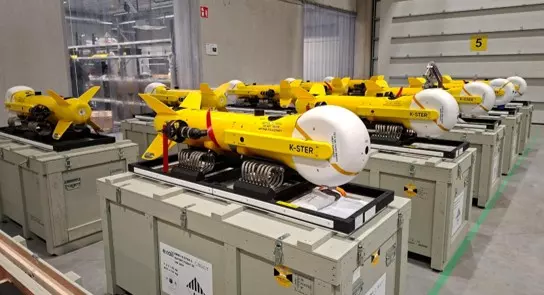
K-Ster vehicles are produced at the Ostend factory in Belgium. (Image: Exail)
For the past two decades, the robotization of mine warfare remained largely at the technology-demonstration stage, with navies procuring only small numbers of systems to validate concepts. That era is now over. The return of high-intensity conflict and growing vulnerability across global maritime domains have made large-scale deployment an urgent priority. Threats continue to evolve — with an accelerating trend toward insensitive munitions — and the protection of critical infrastructure demands a persistent underwater presence. For navies, the challenge is no longer simply possessing the most advanced technology, but having sufficient operational systems available in quantity.
Supply Chain Challenges: Scaling Production and Delivery
Image: Exail
The transition from craft-based manufacturing to industrial-scale production is the defining challenge facing the naval robotics sector today. Mine neutralization drones such as the K-Ster are no longer prototypes — they are series-produced operational systems. Their high operational tempo demands that navies, including NATO member states, maintain substantial strategic stockpiles.
For industrial partners, the focus is increasingly shifting to overall supply chain performance:
- Ensuring a steady supply of critical components
- Sustaining high-volume production efficiency
- Guaranteeing absolute reliability in international delivery
This is precisely the rationale behind the renewed framework agreement between Exail and KNDS. By committing to supply and integrate hundreds of shaped-charge warheads, the two companies are demonstrating their ability to fulfill large-volume orders.
Over 15 Years of Operational Feedback Serving Global Navies
This large-scale delivery capability is grounded in a long-term partnership launched in 2008. Exail's expertise in autonomous robotic systems, combined with KNDS's industrial strength in warhead manufacturing, has allowed the two companies to accumulate more than 15 years of real-world operational feedback.
In practice, the system remotely projects a shaped charge via a water jet to trigger a controlled detonation of the mine, keeping the mother vessel or deploying ship and its crew at a safe standoff distance throughout the operation.
Reliability and Supply Chain Sovereignty in Service of National Security
Beyond technical performance, renewing this partnership helps secure an integrated value chain with full sovereignty over all core competencies — from autonomous underwater vehicles to warheads.
"In the current strategic environment, the challenge is not only to have the best mine countermeasures capability, but also to be able to produce, deliver, and sustain it at the scale required for operations. The agreement between Exail and KNDS strengthens our industrial capacity by consolidating an end-to-end French value chain, enabling it to support the expansion of naval programmes and continuously meet the growing demands of navies worldwide."
— Cyril Hammer, Director of Procurement, Exail
This article was originally published by Naval News.
原文來源: 查看原文
FAQ
Reviewed and published by the LAETimes editorial desk ·