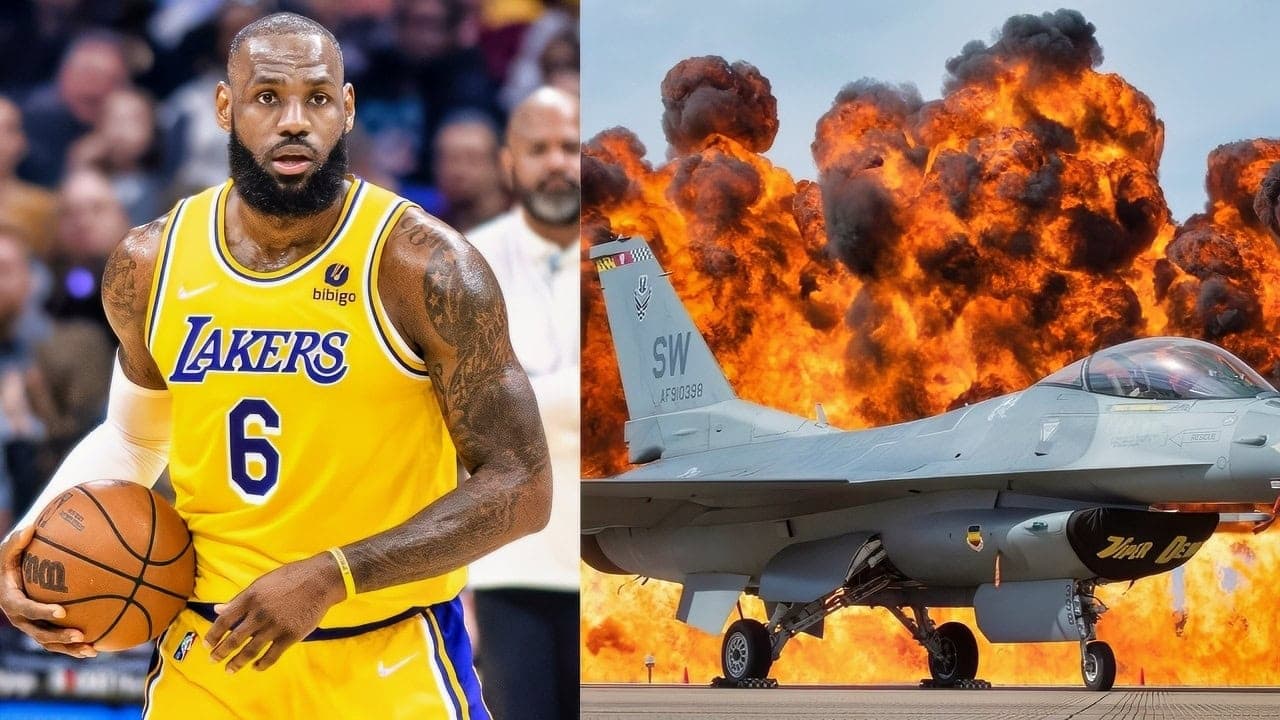
The F-16 Is the LeBron James of Fighter Jets: Still an All-Star at 50, and Peru Just Signed It for $1.5 Billion
First flown in 1974, the F-16 Fighting Falcon remains in high demand in 2026: a backlog of over 110 aircraft, a potential pipeline of 300 more sales, and a brand-new customer in Peru, which signed a roughly $1.5 billion contract for 12 jets — beating out France's Rafale and Sweden's Gripen. This feature uses the LeBron James analogy to explain why the F-16 remains the world's most sought-after Western fighter jet after half a century.
Highlights
- Peru signed a contract worth approximately $1.5 billion in spring 2025 for 12 new F-16 Block 70 jets, defeating France's Rafale and Sweden's Gripen in an 18-month competition.
- The F-16's confirmed production backlog stands at over 110 aircraft, with Lockheed Martin tracking a potential additional pipeline of up to 300 sales across multiple countries.
- More than 4,600 F-16s have been produced since 1974, with over 3,100 still in active service across 26 nations, including 700+ in Europe.
- The Greenville, South Carolina production line delivered its first Block 70 aircraft to Slovakia and Bulgaria in December 2024, replacing Soviet-era MiG-29s.
- The F-16's service life has been extended from 8,000 to 12,000 flight hours, with an upgrade roadmap — including AESA radar integration — extending to the 2040s.
The F-16 and LeBron James: A Natural Analogy
This week, a 41-year-old free agent is deciding which team to join for an unprecedented 24th season, with a third of the league's franchises lining up at his door. That is the quintessential LeBron James situation — and the aerospace equivalent has been playing out for years.
The F-16 Fighting Falcon first flew in 1974. By 2026, it carries a production backlog of more than 100 aircraft, a potential sales pipeline of 300 more, and has just welcomed a new customer who signed on for $1.5 billion. Every air-power debate has its Jordan-vs.-LeBron argument. In the world of American fighter jets, the F-16 is LeBron: never the purest specialist, but unquestionably the most complete package — and still signing contracts at age 50.
Enter the Disruptor
Like the kid from Akron, the F-16's very origin was a challenge to the established order. It grew out of the Lightweight Fighter program, championed by a group of Pentagon dissenters known as the Fighter Mafia. They believed the Air Force's beloved heavy fighter, the F-15, was too large and too expensive to be procured in the numbers a real war would require. Their answer was a small, cheap, superbly agile daytime dogfighter. The institutional compromise was a "high-low mix": a handful of expensive Eagles at the top, a large fleet of affordable lightweights below.
On 20 January 1974, during a high-speed taxi test at Edwards Air Force Base, the YF-16 prototype's hypersensitive fly-by-wire system caused the aircraft to rock violently, scraping a wingtip along the runway. Test pilot Phil Oestricher decided the only safe direction was up. He flew one circuit and landed six minutes later — an accidental first flight that came 13 days ahead of schedule.
In the early-1975 fly-off, the YF-16 defeated Northrop's YF-17 for the contract (the losing YF-17 later reinvented itself as the Navy's Hornet — a story in its own right). Months later, four NATO nations signed a purchase agreement for 348 aircraft in what became known as the "deal of the century." The disruptor hadn't even finished his rookie season before landing a max contract.
Playing All Five Positions
The LeBron argument rests on positional versatility: he can play positions one through five while serving as the primary offensive option for two decades. The F-16's résumé reads the same way.
It started out as a point guard — a lightweight, daytime air-superiority fighter, nothing more. In April 1981, it downed its first enemy aircraft, a Syrian helicopter. Two months later, eight Israeli F-16s conducted the Osirak raid, destroying Iraq's nuclear reactor with unguided bombs using only the jet's own bombing computer — accomplishing what other air forces would have needed laser guidance to achieve.
The following year over Lebanon's Bekaa Valley, Israeli F-16s went 44-0 against Syrian MiGs without a single loss. From there, the position changes came steadily: taking over the Wild Weasel suppression-of-enemy-air-defenses role from the F-4G in 1996; absorbing Europe's nuclear delivery mission; flying close air support over Iraq and Afghanistan for more than two decades; serving as the face of the Thunderbirds demonstration team; and acting as an adversary trainer for the Navy. Today it flies over Ukraine, where one pilot became a national hero by shooting down six Russian cruise missiles in a single sortie. One airframe, every position on the field, roles rotating for fifty years.
Statistics and Evolution
The versatility argument ultimately comes back to numbers: more than 4,600 aircraft built, operated by the United States and 25 other nations, with over 3,100 still in service globally — including more than 700 in Europe, more than any contemporary Western fighter by a wide margin.
Just as LeBron has continually reinvented his game, the F-16 has transformed itself with each generational shift: from an analogue daytime fighter in 1978, to a precision night-strike platform in the LANTIRN era, to a radar-hunting Wild Weasel, and now to the Block 70 variant equipped with an Active Electronically Scanned Array (AESA) radar. Airframe service life has been extended from 8,000 to 12,000 flight hours, the cockpit has absorbed fifth-generation sensor technology, and the Automatic Ground Collision Avoidance System (AGCAS) continues to save pilots' lives. The upgrade roadmap stretches into the 2040s. Even the arrival of the F-35 did not replace it — if anything, it freed the F-16 to return to the roles it does best.
The Free-Agent Market at 50
This week, the analogy moved from metaphor to reality. LeBron James announced he will play a 24th NBA season at age 41, with roughly ten teams waiting on his decision.
Consider the F-16's 2025: Peru signed a contract worth approximately $1.5 billion this spring for 12 new jets, winning an 18-month competition against France's Rafale and Sweden's Gripen. A brand-new customer paid a premium for the oldest star on the market; deliveries are expected in the 55th year since the design first flew.
Beyond Peru, the current backlog stands at around 110 new aircraft — Taiwan (66), Morocco (24), Jordan (12), and Bulgaria's second batch — with Lockheed Martin tracking a potential pipeline of up to 300 additional sales, including 40 aircraft already approved for Turkey and 32 for the Philippines, both awaiting formal contracts. Last December, the production line completed first deliveries to Slovakia and Bulgaria, making them the first European air forces to operate the latest variant, replacing Soviet-era MiG-29s with an American design older than the aircraft it replaced.
LeBron has ten suitors this week. The F-16's list is longer, its age is double, and it has never truly entered the open market — because it has never needed to.
The Supporting Cast
Every LeBron needs a context, and the allocation of roles across the American fighter lineup is almost too neat:
-
The F-15 Eagle is Michael Jordan: the purist's choice, an undeniable peak, an air-to-air combat record of 104 wins and zero losses — the fighter that never loses a championship. The F-16-vs.-F-15 debate is the LeBron-vs.-Jordan debate: unimpeachable dominance versus overwhelming completeness.
-
The F-22 Raptor is the generational talent gone too soon: the most gifted airframe ever built, its production line closed in 2011 at just 187 aircraft — the league's eternal "what if."
-
The F-35 is the popular counter-argument — which is also the limit of its case as an answer. The weight of expectation, the ability to make every aircraft around it better, more than 1,100 built — all true, and it is only in its tenth year of service. That is LeBron in 2013. The award being given here requires one thing the F-35 cannot yet demonstrate: sustaining elite performance for another twenty years. Reassess in 2040.
Counterarguments Worth Taking Seriously
Honest criticism deserves to be heard. The purist case is real: the F-16 was never the supreme air-superiority king — that crown belongs to the F-15, just as LeBron was never the league's purest shooter. Both points are correct, and neither is the core of the argument. Versatility is the argument, not perfection in a single skill.
The second criticism is more pointed: minutes management for an aging star. The Greenville, South Carolina plant produced only 16 aircraft last year, targeting close to two dozen; Taiwan's 66-jet order has slipped to 2027, and Taipei has publicly considered legal action; the first Bulgarian aircraft was briefly grounded due to a fuel leak. Demand is multigenerational; the production line is finite. Managing that line is the load-management problem of a 50-year-old franchise player.
There is even a possible new contract on the table: the proposed Block 80 would represent the fighter's final evolution — but it remains a concept, and faces a significant obstacle: no one has yet funded it.
Finally, one limit of the analogy is worth naming explicitly, because it is actually a compliment to the aircraft: LeBron James's body will eventually make the decision for him. A fighter jet's "body" can be rebuilt, re-skinned, and re-winged as long as someone is willing to pay for it. That is why the F-16's 24th season has no scheduled end date.
This week, the two careers converge at the same moment in time. Somewhere in America, a 41-year-old is choosing his next team while the sports world holds its breath. In Greenville, South Carolina, a production line is building fighters for an air force about to become the 26th operator, with deliveries extending into the 55th year since this design first flew — and almost no one outside the industry has noticed how extraordinary that is.
Two legends, both arriving ahead of schedule — one on a magazine cover at 17, the other trailing sparks on a California runway rather than stay on the ground. Half a century later, both are still accepting new contracts. The Chosen One should consider the comparison a compliment.
原文來源: 查看原文
FAQ
Newsletter
Subscribe to our Low-Altitude Industry Newsletter
Daily curated news on low-altitude economy and drone industry, delivered to your inbox.
Reviewed and published by the LAETimes editorial desk ·


