HeadCount Uses DJI Drones to Count $4,000 Cattle Across Kansas Feedlots
HeadCount Inventory, a drone division of Kansas-based agricultural consultancy Crop Quest, is deploying DJI Mavic 3 Enterprise drones to autonomously count cattle at feedlots, achieving a claimed 99.997% accuracy rate. With U.S. cattle prices at historic highs—averaging $3,888 per head—the system completes a full-feedlot inventory in as little as 40 minutes, dramatically reducing reliance on manual headcounts.
Highlights
- HeadCount Inventory deploys a single DJI Mavic 3 Enterprise drone to complete a full feedlot headcount in as little as 40 minutes, with a claimed accuracy rate of 99.997%.
- Irsik & Doll Feed Services operates seven Kansas feedlots with a combined one-time capacity of 280,000 head—valued at over $1 billion at current prices—all requiring regular inventory counts.
- USDA data for the week ending July 5, 2025 shows fed steers averaging $255.12/cwt at 1,524 lbs, equating to roughly $3,888 per head, with heavier lots exceeding $4,300—all-time record levels.
- HeadCount's full-audit service involves three independent human QC reviews per pen on top of the AI-generated count, and integrates with Accu Trac feedlot management software.
- DJI models account for an estimated 96% of detected agricultural drone activity in the U.S., placing the feedlot inventory business directly in the crosshairs of ongoing Congressional debate over Chinese-made drone hardware.
HeadCount Uses DJI Drones to Count $4,000 Cattle Across Kansas Feedlots
The most expensive cattle in U.S. history are now being counted from the air. HeadCount Inventory, the drone division of Kansas agricultural consultancy Crop Quest, is operating DJI autonomous aircraft over feedlots and delivering inventory results with a claimed accuracy rate of 99.997%.
"There's nothing impossible about it, but completing a full-yard count is about as close to impossible as you can get," said Brandon Depenbusch, Vice President of Cattle Operations at Irsik & Doll Feed Services. "With drones, we can now conduct an accurate count of an entire feedlot in 40 minutes."
Irsik & Doll operates seven feedlots across south-central Kansas with a one-time capacity of 280,000 head of cattle. At current market prices, that represents more than one billion dollars in live assets—and every single animal needs to be accounted for.
One Drone, One Portal, Three Human Reviews
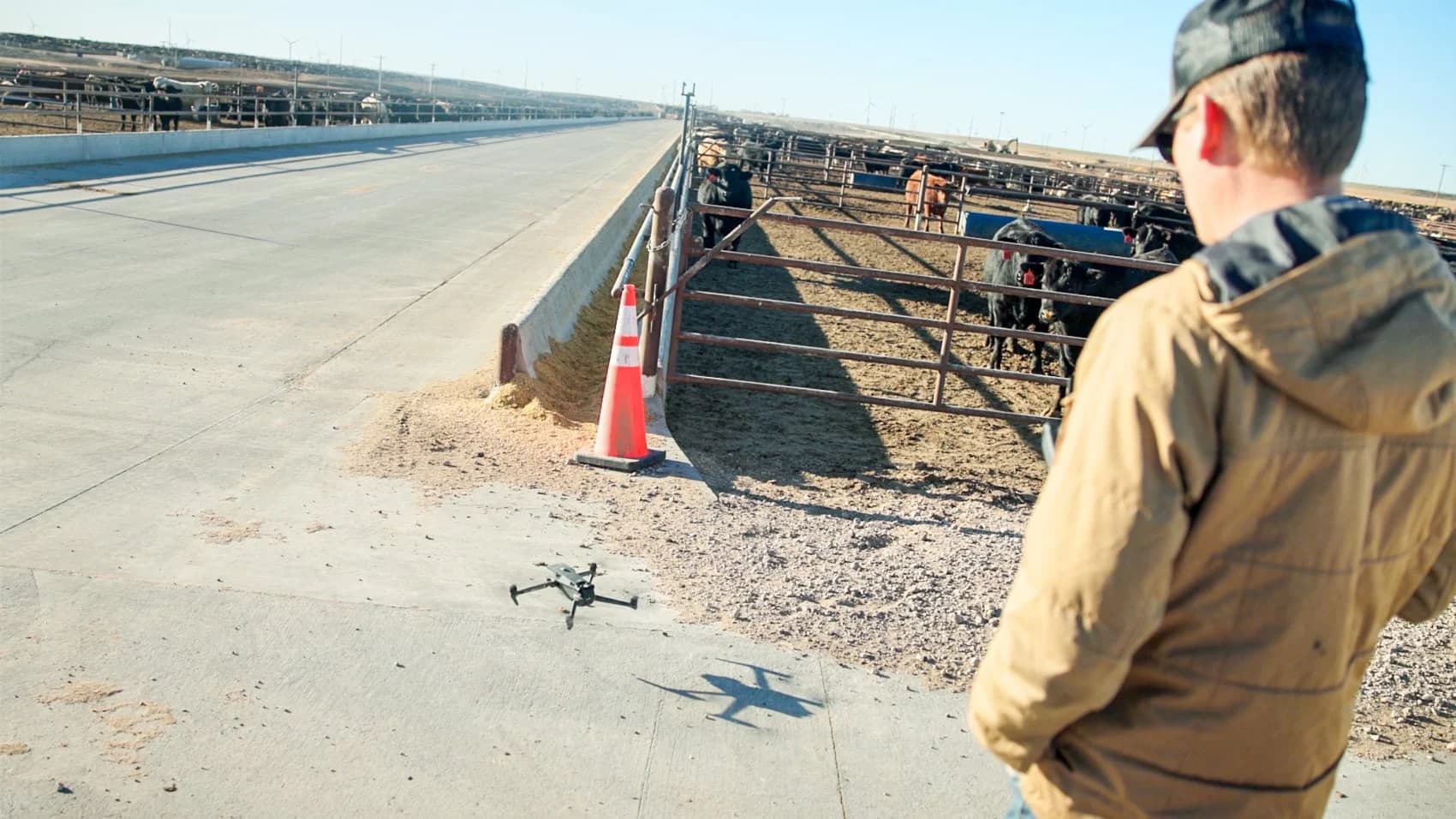
HeadCount offers two service tiers, neither of which resembles a cinematic drone swarm. Actual operations, as documented, involve a single DJI Mavic 3 Enterprise flying a pre-planned route over pens while animal movement on the lot is temporarily paused.
For its full-yard audit service, HeadCount's trained pilots bring their own equipment and run the entire operation over two to three hours, during which the feedlot halts cattle movement. An algorithm performs the initial count, followed by three independent human quality-control reviews of each pen. Final reports are delivered within 48 hours.
The subscription-based service restructures the labor. HeadCount pilots first build a high-resolution, georeferenced model of the feedlot. Thereafter, feedlot staff select the pens they want counted via an online portal, receive an automated flight plan to a dedicated remote controller, execute the flight themselves, and upload footage for post-processing.
"We make something verifiable that previously could not be verified beyond a human's word," HeadCount partner Tyson Johnston told Drovers magazine. He likens the drone to a horse—a tool for the same job, with a human still responsible for confirming the results.
The company says the system can also inventory feed commodity stockpiles and integrates with Accu Trac, the feedlot management software developed by Micro Technologies that serves as the accounting backbone for a large number of U.S. feedlot operations.
The Aircraft Is DJI—and That Detail Matters
The drone performing the inventory work is the DJI Mavic 3 Enterprise, and HeadCount makes no effort to obscure that fact. The company sells a $4,700 package on its website that includes the aircraft, an RC Pro remote controller, four batteries, and a one-year DJI Care Refresh protection plan.
This places one of American agriculture's most unassuming corners on a potential collision course with the direction of policy in Washington. As this publication reported in March, DJI models account for approximately 96% of detected agricultural drone activity in the United States, while the ongoing controversy surrounding the FCC's Covered List continues to threaten the supply chain underpinning those aircraft.
For operators who need to trust an aircraft to execute an autonomous flight plan reliably, the Mavic series is the default choice. For higher levels of automation, operators can step up to the Matrice platform paired with a DJI Dock. This class of aircraft is built for demanding, repetitive work and has been validated in real-world conditions over many years.
The result: a hardware supply chain that a faction of Congress wants to prohibit is quietly underpinning the core business of inventorying the highest-value livestock assets in American history.
A $3,900 Cow Turns Headcounts Into Accounting
The numbers explain why feedlots are willing to pay for accuracy. According to the USDA five-area report for the week ending July 5, fed steers averaged $255.12 per hundredweight (cwt), with an average live weight of 1,524 lbs (691 kg)—working out to approximately $3,888 per head, with heavier lots exceeding $4,300.
These are all-time records. Cash cattle prices broke the historic $250/cwt threshold for the first time in April of this year, and weekly averages have continued to set new highs since, approaching $256 by late June.
Scaled nationally, the stakes are significant. USDA's June 1 count placed 11.68 million head on feed in yards with 1,000-head-or-greater capacity—worth roughly $40 billion at current prices, with Kansas alone accounting for 2.42 million head. A 1% counting error translates to more than $400 million in potentially misattributed assets.
"If there are any inventory or accounting issues, we need to find out quickly, because the dollar amount per animal is just so high," Depenbusch said.
The labor-saving argument, however, predates the price argument. Feedlot magazine reported in 2022 that Kirkland Feedyard's adoption of the system reduced weekly inventory labor from 12 person-hours down to approximately 8 person-hours per month. Depenbusch also offered a straightforward explanation for why static drone imagery outperforms live manual counting: it is far easier to count something that is not moving.
From Research Paper to Feedlot Routine
Counting animals from the air has been an active area of academic research for years. DroneXL previously covered the LSNET automated animal counting study in June 2025 and reported on a Missouri farmer's small-scale cattle-monitoring use case in 2024. HeadCount began developing its technology in 2018 and commercialized it in 2021—a direct translation of that research tradition into real commercial invoices.
The company has built its business quietly, with minimal media coverage. The Drovers feature marks the first major mainstream livestock press profile HeadCount has received in roughly three and a half years. In the interim, its drones have continued operating—including a demonstration flight for the next generation of feedlot operators at Irsik & Doll's Ingalls, Kansas yard this past April.
DroneXL's Take
What stays in the pen is the most grounded commercial drone case study I have covered this year: a $3,888 animal inventoried by a $4,700 aircraft, with three rounds of human review—because at this price point, no one is willing to trust the machine alone.
A single premium steak nearly recoups the cost of the drone, and that drone will keep working long after the steer is gone. At these valuations, it is difficult to imagine a compelling alternative to DJI for this particular task. This one is not even close.
While Congress continues debating restrictions, these aircraft keep clocking in. Cattle headcounts may not go viral, but they clear the books every month—and DJI continues quietly picking up the unglamorous work that Skydio walked away from at the commercial end of the market.
Image credits: HeadCount, DJI
原文來源: 查看原文
FAQ
Newsletter
Subscribe to our Low-Altitude Industry Newsletter
Daily curated news on low-altitude economy and drone industry, delivered to your inbox.
Reviewed and published by the LAETimes editorial desk ·