ILA Berlin Air Show 2026: Defense Dominates as Commercial Aviation's Future Hangs in the Balance
The 2026 ILA Berlin Air Show (June 10–14) drew over 110,000 visitors and 765 exhibitors from 37 countries, with European defense sovereignty dominating the agenda. The Franco-German FCAS fighter program was officially cancelled. On the commercial side, Airbus's Next Generation Single Aisle (NGSA) program drew political attention as German Chancellor Friedrich Merz publicly lobbied for Hamburg to lead development. A looming concern: surging defense budgets — Germany's rose ~24% last year — risk crowding out commercial aerospace talent and resources.
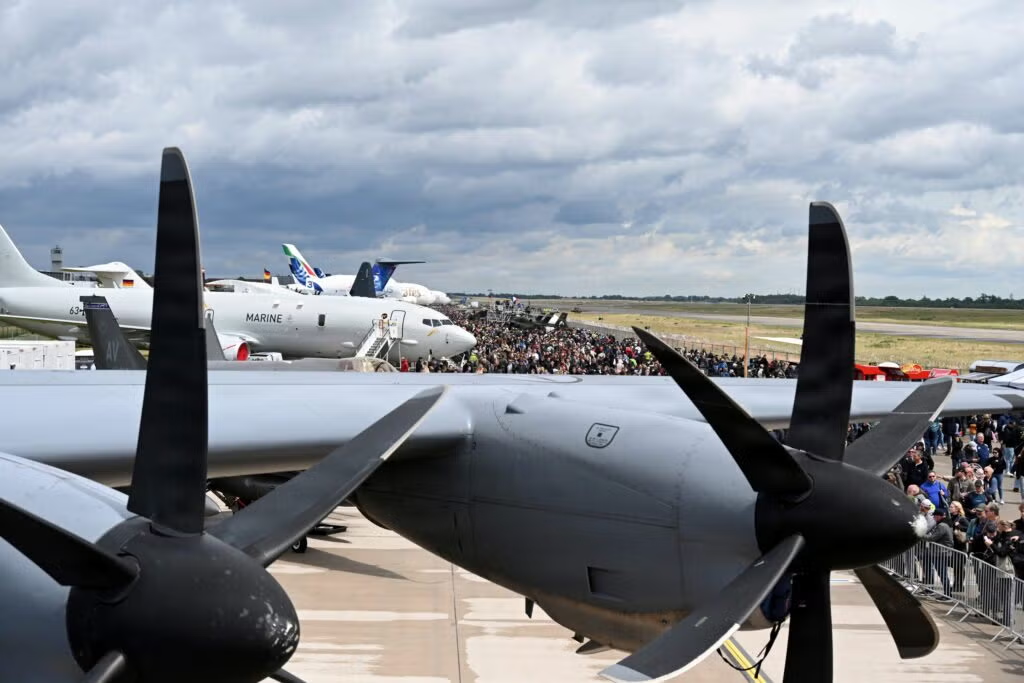
Highlights
- ILA Berlin 2026 (June 10–14) attracted 110,000 visitors and 765 exhibitors from 37 countries, up significantly from 95,000 visitors in 2024.
- The fighter aircraft component of the Franco-German FCAS/SCAF program was officially cancelled at ILA 2026 after years of disputes between Paris and Berlin over program leadership.
- German Chancellor Friedrich Merz publicly lobbied at ILA for Airbus to locate NGSA next-generation narrowbody design leadership in Hamburg rather than Toulouse.
- Germany's defense spending increased approximately 24% last year, and the broader surge in European military budgets is creating resource competition that threatens to crowd out commercial aerospace manufacturing.
- European sovereignty — reducing reliance on U.S. defense and intelligence infrastructure under the Trump administration — was the dominant theme across surveillance, satellite communications, and space infrastructure exhibits at ILA 2026.
This article is adapted from a conversation between John Persinos, editor of Aircraft Value Intelligence (AVN), and analysts at AeroDynamic Advisory, including Managing Director Richard Aboulafia, Senior Advisor Klaus Mueller, and Researcher Kevin Klempner.
The 2026 ILA Berlin Air Show ran from June 10 to 14 at Berlin Brandenburg Airport, and as widely anticipated, military hardware, defense contractors, and geopolitical themes dominated the atmosphere. Beneath that martial surface, however, two significant commercial aviation storylines quietly emerged — each with far-reaching implications.
Overall, the show attracted approximately 110,000 visitors, a notable increase from the 95,000 recorded at the 2024 edition. A total of 765 exhibitors from 37 countries participated, underscoring the event's continued growth as a global aviation platform.
European Sovereignty: The Show's Defining Theme
One word defined the defense halls: sovereignty. Russia's ongoing threat to Europe and NATO provided the obvious backdrop, but European policymakers are equally anxious about whether the United States — under a second Trump administration — remains a reliable security partner.
Trump's assertive rhetoric on Greenland, Canada, and other issues, combined with speculation over potential U.S. restrictions on intelligence sharing, surveillance cooperation, and possible "kill switches" embedded in American-made weapons systems, has accelerated European efforts to build more autonomous defense capabilities.
This shift was visible at every turn on the show floor. Booth after booth emphasized "European solutions," "strategic autonomy," and "sovereignty" across surveillance, satellite communications, reconnaissance, cyber, and space infrastructure — reflecting a continent determined to reduce dependence on external partners.
Yet the show's most significant military development simultaneously highlighted just how difficult European defense cooperation remains.
The fighter aircraft component of the Franco-German Future Combat Air System (FCAS/SCAF) program was officially declared dead, following years of very public disputes between Paris and Berlin. The immediate question: what replaces it, and will France and Germany now go their separate ways?
Commercial Aviation Takes a Back Seat
Compared with defense's high-profile presence, commercial aviation kept a noticeably lower profile at this year's ILA. Beyond Airbus's familiar lineup of commercial jets and Deutsche Aircraft's D328eco regional turboprop program, major commercial announcements were sparse.
Engine manufacturers were broadly represented, but next-generation propulsion technology was largely absent — with Rolls-Royce's large-scale UltraFan concept model serving as a reminder that the industry's long-term future is still very much under construction.
Nevertheless, several important commercial threads were playing out behind the scenes. The most closely watched is Airbus's Next Generation Single Aisle (NGSA) program — the successor to the A320 family and the single most consequential commercial aircraft program in the industry today.
Because the NGSA involves hundreds of billions of dollars in future revenues and tens of thousands of jobs, where Airbus chooses to anchor the program's leadership carries enormous industrial and political weight.
Historically, Airbus has been centered on Toulouse, France, for engineering and design, with final assembly distributed across multiple sites. In recent years, however, Hamburg, Germany has grown in stature, driven by the expanding production volumes of the highly popular A321.
Against this backdrop, German Chancellor Friedrich Merz used the ILA platform to publicly call on Airbus to locate the NGSA's design and engineering leadership in Hamburg rather than Toulouse.
This was far from a symbolic gesture. Germany has long felt that, despite Airbus being a multinational consortium, France has retained a disproportionate share of strategic influence. Given Hamburg's growing production role and Germany's expanding industrial footprint, Berlin believes it now has a compelling case — whether Paris agrees is another matter entirely.
The issue has all the hallmarks of a classic "Airbus balancing act," where engineering decisions and national politics reliably share the same cockpit.
The Hidden Cost of the Defense Spending Surge
Another theme that surfaced repeatedly in conversations with suppliers and contractors on the show floor: the explosive growth in defense spending is beginning to crowd out commercial aerospace.
European military budgets are climbing rapidly — Germany's defense expenditure alone surged by approximately 24% last year — and export demand is rising in tandem.
The challenge is straightforward: aerospace manufacturing draws on a finite pool of engineers, technicians, skilled tradespeople, production capacity, and specialized suppliers. As defense programs continue to absorb these resources, commercial manufacturers will face rising labor costs, tighter supply chains, and heightened execution risk.
Given that elevated defense spending is expected to persist for years, there is little near-term relief in sight.
The pressure is most acute for systems suppliers — companies that drive much of the industry's most important innovation and that typically serve both civil and military customers. Faced with booming defense demand, rising engineering costs, and government contracts that often offer more predictable margins, how much incentive remains for these firms to prioritize commercial R&D investment? The question hung over the ILA show floor, even if it didn't appear on any exhibition banner.
The core unresolved question is this: will Europe's defense renaissance ultimately come at the cost of its commercial aviation leadership? Success in one sector does not automatically guarantee success in the other.
John Persinos is Editor-in-Chief of Aircraft Value Intelligence. This article was originally published in Aviation Tech Today.
原文來源: 查看原文
FAQ
Reviewed and published by the LAETimes editorial desk ·