LMT Defence and Thales Italia Join Forces on Network-Based Drone Detection
Latvia’s LMT Defence and Thales Italia have agreed to cooperate on technologies that use mobile communications infrastructure for drone detection and counter-uncrewed aerial vehicle applications. The companies have not disclosed technical specifications, funding, deployment locations, or a development timetable. The initiative reflects growing industry interest in combining telecommunications networks with dedicated counter-UAS sensors and command systems.
LMT Defence and Thales Italia will explore mobile communications-based drone detection technologies, potentially expanding the options available for integrated counter-UAS systems.
Key points
- LMT Defence and Thales Italia agree to cooperate
- The collaboration targets mobile network-based drone detection
- The technologies will support counter-UAS applications
- Technical specifications and testing schedules remain undisclosed
- The initiative links telecommunications with airspace security
Highlights
- Latvia’s LMT Defence and Thales Italia agreed to cooperate on mobile communications-based drone detection technologies.
- The planned technologies are intended to support counter-uncrewed aerial vehicle applications.
- The companies did not disclose technical specifications, funding arrangements, trial locations, or a deployment timetable.
- The announcement did not identify a specific mobile communications standard or commercial product.
- Operational use would require integration with classification, tracking, command-and-control, and legally authorized response processes.
Latvia’s LMT Defence and Thales Italia have agreed to cooperate on the development of mobile communications-based technologies for drone detection and counter-uncrewed aerial vehicle applications. The initiative brings together telecommunications capabilities and counter-UAS requirements as governments and critical infrastructure operators seek more scalable ways to monitor low-altitude airspace.
Neither company has disclosed the technical architecture, funding arrangements, trial locations, participating customers, or expected deployment schedule. It is therefore not yet clear whether the work will produce a standalone detection product, a software layer for existing mobile networks, or technology intended for integration with broader counter-UAS systems.
Mobile networks as a detection layer
Conventional drone detection commonly relies on combinations of radar, radio-frequency sensors, electro-optical cameras, acoustic systems, and Remote ID receivers. Each sensor type has operational limits. Radar performance can be affected by terrain and background clutter, while radio-frequency monitoring depends on the signals transmitted by a drone and its controller. Cameras can support identification but generally require a prior detection cue and a clear line of sight.
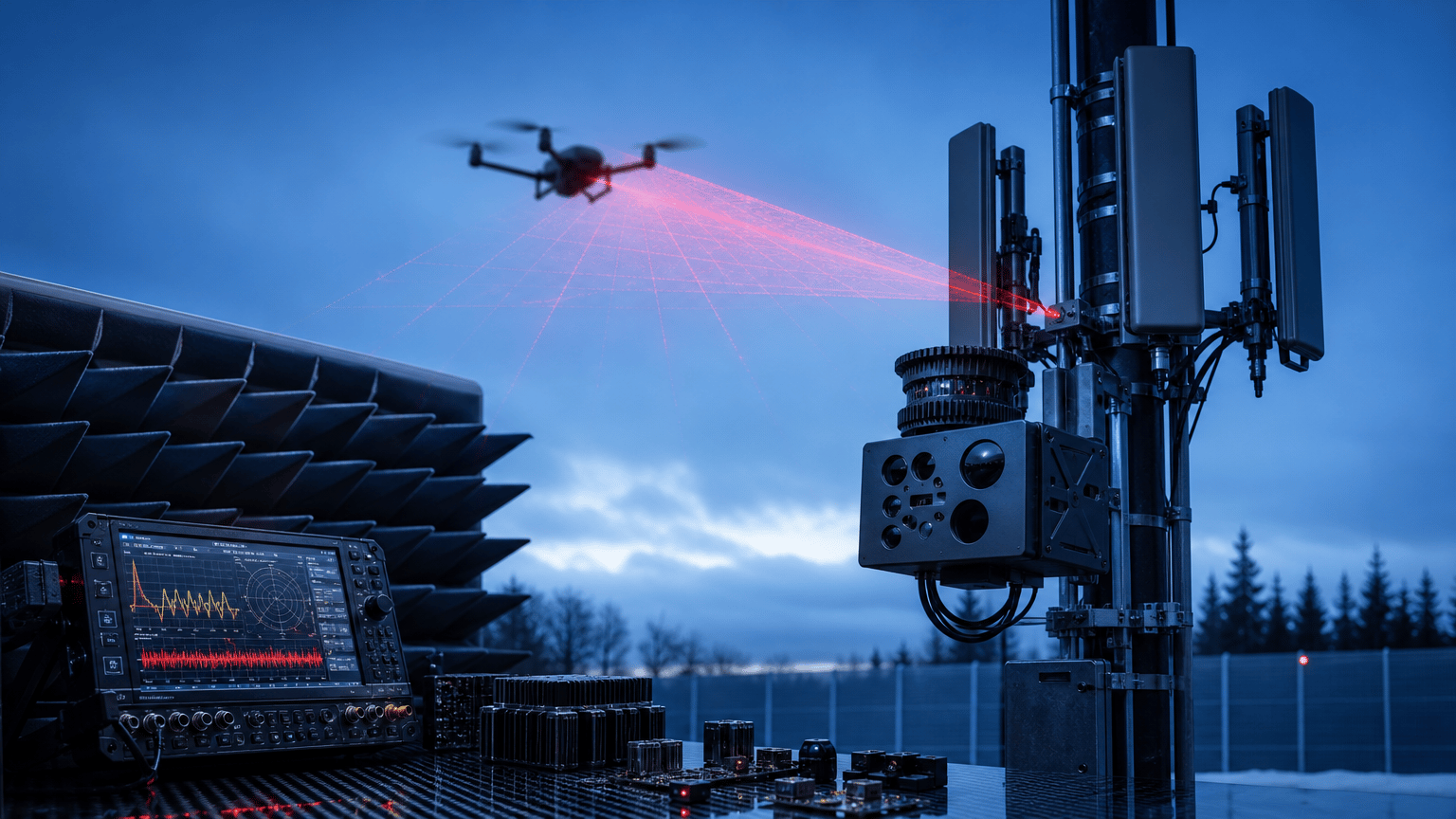
Mobile communications infrastructure could add another layer to this sensor mix. Depending on the final design, network-based technologies may help identify unusual airborne communications activity, support the exchange of detection data, or connect distributed sensors with command-and-control platforms. The announcement does not specify which of these approaches LMT Defence and Thales Italia intend to pursue.
The practical value will depend on detection range, accuracy, latency, false-alarm rates, network coverage, and compatibility with other security systems. Any operational solution would also need to distinguish drones from other connected devices and manage data in accordance with applicable privacy, telecommunications, and security rules.
From detection to counter-UAS operations
Detection is only one part of a counter-UAS workflow. Operators must also classify a suspected aircraft, assess whether it presents a threat, track its movement, and determine an authorized response. In many jurisdictions, the use of jamming, spoofing, interception, or kinetic mitigation is restricted to designated government or security bodies.
For that reason, mobile communications-based detection is more likely to function as part of a layered architecture than as a complete counter-UAS capability on its own. Such an architecture could combine telecommunications data with radar tracks, Remote ID information, imagery, and other sensor inputs. Human operators or automated software could then use the combined information to build a more reliable air picture.
Integration will be a central challenge. Customers typically require standard interfaces, secure data exchange, traceable alerts, and compatibility with existing command systems. Field testing will also be necessary to establish performance against different aircraft, communications links, weather conditions, terrain, and levels of network availability.
Wider industry significance
The cooperation reflects a broader convergence between telecommunications and drone security. Mobile networks already provide connectivity for some commercial drone operations, particularly where operators require long-range command links, live video transmission, or fleet management. Applying related infrastructure to detection could allow security systems to use assets already distributed across populated and industrial areas.
However, the limited announcement leaves important questions unanswered. LMT Defence and Thales Italia have not identified a specific mobile standard, named a product, announced a pilot customer, or provided a commercialization date. The next meaningful milestones will be evidence of field trials, measurable detection performance, integration with other sensors, and confirmation of the regulatory framework governing access to network-derived information.
What it means for Taiwan
For Taiwan, the cooperation is relevant to telecom operators, counter-UAS developers, defense suppliers, and manufacturers of radio-frequency modules, antennas, edge computing hardware, and secure networking equipment. Local companies should monitor whether the partners publish interfaces or begin European field trials, as those steps could create supply-chain or system-integration opportunities. For inspection, exterior cleaning, and agricultural spraying operators, network-based detection may eventually increase scrutiny around sensitive sites and critical infrastructure. Before purchasing connected fleets, operators should confirm Remote ID support, communications compatibility, flight-log retention, and cybersecurity controls. Because no deployment schedule has been announced, the immediate priority is standards monitoring rather than equipment replacement, followed by pilot validation once technical requirements become available.
FAQ
Reviewed and published by the LAETimes editorial desk ·