Graduate Student Gives NASA Robots the Skill to Assemble in Space — Sarah Downs's Path to Space Robotics
Texas A&M University electrical engineering PhD student Sarah Downs, inspired by NASA Mars rovers since childhood, developed an algorithm enabling robots to assemble satellite antennas in space without any vision system. Her work, conducted in collaboration with NASA and the U.S. Air Force during her master's program, solves the classic 'peg-in-hole problem' in robotics. She continues this research at a larger scale at Texas A&M.
Highlights
- Sarah Downs, a PhD student at Texas A&M University, developed a vision-free force-feedback algorithm in collaboration with NASA and the U.S. Air Force that enables robots to assemble satellite antennas in space without cameras.
- Her algorithm solves the classic 'peg-in-hole problem' by using torque sensors on the robot gripper to detect position and orientation, while also accounting for zero-gravity reaction forces to prevent satellites from drifting.
- Downs is continuing her research in the Robotic Space Simulator project at Texas A&M's RAD Lab, supervised by NASA veteran Robert Ambrose, who founded the lab in 2022.
- As IEEE student branch president at the University of Tulsa (2022–2024), Downs grew the executive committee from 5 to 25 members and organized a soldering workshop attended by approximately 80 students.
- After earning her PhD, Downs aims to work at NASA developing Mars sample-return rovers or robotic arms for space station operations.
Graduate Student Gives NASA Robots the Skill to Assemble in Space
Like many engineers, Sarah Downs says she knew from an early age that she wanted a career in STEM. As a teenager growing up in Tulsa, Oklahoma, she was introduced to robotics through her middle school's First Lego League team and quickly fell in love with the field. Downs participated in the international robotics competition program from 2014 to 2016.
Watching a PBS special about NASA's Mars rovers Spirit and Opportunity — and witnessing the live launch of the Curiosity rover in 2011 — inspired the young Downs to dream of one day working for NASA.
Sarah Downs
- Member Grade: Graduate Student Member
- Institution: Texas A&M University, College Station
- Field of Study: Electrical Engineering
This year, the IEEE Graduate Student Member made that dream a reality. For the capstone project of her master's degree in electrical engineering at the University of Tulsa, she collaborated with NASA and the U.S. Air Force to develop an algorithm that enables a space-based robot to insert a satellite antenna into the correct position — solving the classic robotics challenge known as the peg-in-hole problem.
Now a PhD student in electrical engineering at Texas A&M University, Downs is continuing her research into satellite assembly and manipulation, "but at a much larger scale," she says.
Following a Childhood Passion
Downs grew up in the Tulsa area. Her father, a safety consultant in the oil and gas industry, passed away from heart disease in 2015 when she was just 13. Her mother, who had been a stay-at-home caregiver for Downs's younger brother with autism, returned to school after her husband's death to earn a bachelor's degree in business to support the family.
"We didn't have a lot of money, and my mom was always stressed about finances," Downs says. "That made me more aware of how important it is to have a successful career — financially speaking."
From that point on, financial stability was a primary consideration whenever she thought about her future. She says that pursuing robotics has allowed her to follow her passion while also achieving financial security.
In high school, Downs joined a FIRST Robotics team, where she discovered a particular fascination with the electronic components inside machines. During her last two years of high school, she enrolled in an extended program at Tulsa Tech, splitting her time between her regular high school classes and engineering coursework at the vocational school.
After graduating in 2020, she earned a scholarship to attend the University of Tulsa. She says she entered as a freshman unsure whether to major in electrical or mechanical engineering, but her love of small-scale systems ultimately led her to choose electrical engineering.
For her undergraduate senior capstone, she and two classmates designed a lunar landing exhibit for the Tulsa Air and Space Museum — an interactive game simulating surface missions on the Moon and Mars. Three computer monitors displayed four celestial bodies: the Moon, Venus, Mars, and Titan. Museum visitors could use a game controller to explore the virtual surface of each body. The exhibit remains on display today.
Downs earned her bachelor's degree in electrical engineering in 2024 and continued at the University of Tulsa to pursue her master's degree.
More Complex and Simpler Than People Think
When Downs began her graduate studies, she had expected to join a two-year NASA robotics project. Government funding delays pushed the project back, so in her first year she joined the university's newly established Institute for Robotics and Autonomy, whose primary goal is to develop robots that assist people with mobility impairments.
Inspired by her grandmother, who uses a wheelchair due to severe arthritis, Downs developed a robotic arm to help elderly people and wheelchair users live more independently. The arm can identify objects and place them in appropriate locations around the home — for example, taking specific items out of a shopping bag and placing them on a shelf or sorting them into containers.
Before her second year of the master's program in 2025, the NASA project finally secured government funding. Downs developed a robot capable of completing peg-in-hole tasks without any vision system. Cameras are typically used to guide robots during satellite assembly operations. But in the harsh and remote environment of space, cameras can malfunction or suffer from signal latency.
"Don't stop asking questions. Especially in engineering, don't pretend you know everything, because the nature of science is a constant desire to learn and to listen."
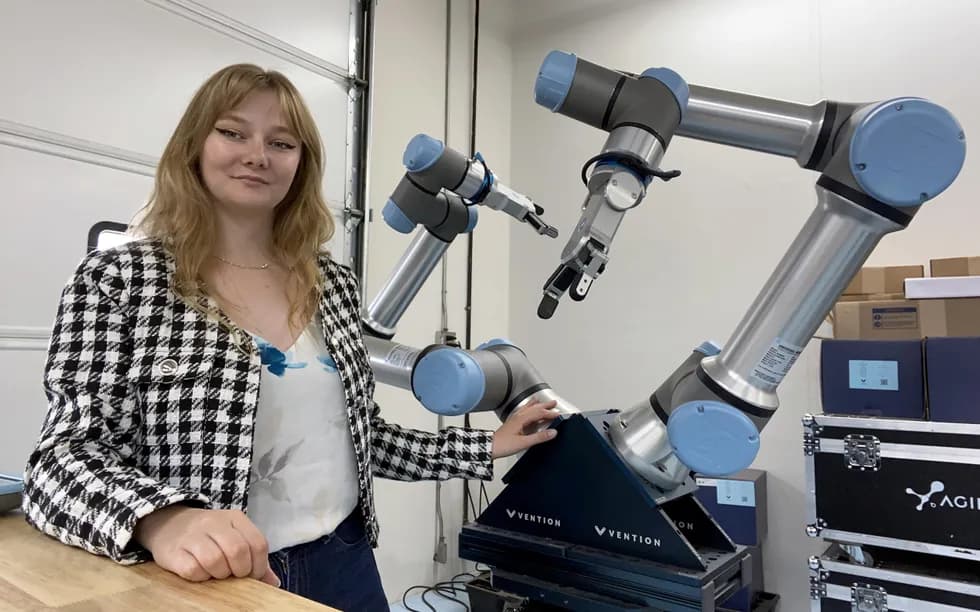
Rather than relying on cameras, Downs's robotic arm uses a force-feedback-based insertion procedure to sense the position and orientation of objects in its environment. The robot grips the antenna with a relatively loose hold, using torque sensors on the gripper to "feel" the force feedback that reflects the relative position between the satellite and the antenna. It then guides the antenna component into the target opening on the satellite and maintains position while the adhesive sets.
Adding to the complexity, the robot must perform this task in a zero-gravity environment.
"Without gravity, you have to account for the reaction torques the arm exerts on the satellite to avoid sending the satellite drifting off into space," Downs explains. Any arm movement during insertion — particularly as force increases — can cause the satellite to continue moving in that direction.
To address this, Downs is developing calculations to apply directed counter-thrust to neutralize the forces generated by the robot's motion.
She says her graduate project captures the essence of what fascinates her about robotics — the way it is simultaneously simpler and more complex than most people expect.
"I think robots are both more complex and simpler than people imagine," she says. "Really, you just need to know a robot's Denavit-Hartenberg parameters to start programming it and do a lot with it" — referring to the four values used to describe the position and orientation of a robotic arm or manipulator. Even with different grippers and degrees of freedom, "fundamentally, all robot manipulators start from there," she says.
"But," she adds, "there is still so much to learn about how robots interact with their environment. Even things that are simple for us — like manipulating a pen — are still incredibly complex for a robot."
Downs is completing her doctoral dissertation as part of the Robotic Space Simulator project at Texas A&M's Robotics and Automation Design (RAD) Lab, which focuses on developing machines capable of operating in extreme environments and works in close collaboration with NASA.
Her thesis advisor is Robert Ambrose, a NASA veteran who founded the RAD Lab in 2022. The IEEE member is set to become associate director of the university's Space Institute, which is expected to open in Houston this year, located adjacent to Johnson Space Center.
After completing her PhD, Downs says she hopes to one day work at NASA — developing rovers to collect samples from Mars, or robotic arms to operate aboard space stations.
Stepping Outside the Engineering Bubble
Downs joined IEEE as a freshman in 2020 to become more engaged in electrical engineering activities on campus. At the time, the COVID-19 pandemic had prevented clubs and organizations from meeting in person.
She became actively involved in her university's IEEE student branch and was elected president for the 2022–2024 term. Under her leadership, the branch grew from hosting occasional events to holding activities every two weeks — including lunch-and-learn sessions and networking dinners that connected students with professional engineers and alumni. Downs also organized hands-on workshops covering soldering, 3D printing, CAD modeling, and résumé writing.
Her efforts grew the branch's executive committee from around 5 students to 25 by 2023. That same year, a soldering workshop she organized drew approximately 80 student attendees.
She says she greatly enjoyed her work with IEEE, particularly "networking with alumni and learning from engineers." She notes that IEEE is an outstanding networking resource, especially since "during the COVID-19 pandemic, engineering students were stuck in their own bubbles" — and IEEE events helped students build connections that have proven invaluable for their careers.
"In today's tough job market, networking matters a great deal," she says. "A lot of it comes down to who you know and how others perceive your work ethic."
Now serving as an IEEE graduate student advisor at the University of Tulsa, Downs says she has seen firsthand how the student branch network benefits its members. "Many of them have found jobs because of IEEE," she says.
Engineering Work and Professional Networks
As an IEEE graduate student advisor, Downs has noticed that many electrical engineering undergraduates finish their degrees without any hands-on experience — whether through projects or internships. "Their résumés are very thin, with no evidence of technical ability," she says.
She herself completed a facilities engineering internship at the American Airlines maintenance facility at Tulsa International Airport after her sophomore year, and worked as an electrical engineering intern at Flight Safety International — a company that designs, builds, and maintains its own flight simulators — on the outskirts of Tulsa after her junior year and again after graduation.
Her advice to undergraduates is to sharpen and demonstrate both hard and soft skills through research projects or personal passion projects.
"A Raspberry Pi board doesn't cost much — you can start right away," she says. She also encourages students to participate in engineering interest communities and professional organizations on campus.
"Take the initiative and join a research team," she says. "It's a great way to show others that you're a good collaborator and that you can contribute to the field."
It's also, she adds, an excellent way to keep learning — which is precisely what draws her to a field that has only begun to take shape over the past century.
"We are still constantly learning about robots," she says.
"Don't stop asking questions," she advises students. "Especially in engineering, don't pretend you know everything, because the nature of science is a constant desire to learn and to listen."
原文來源: 查看原文
FAQ
Reviewed and published by the LAETimes editorial desk ·