Seeing the World with Radio Waves: The QuadRF Four-Channel Phase-Coherent SDR Project
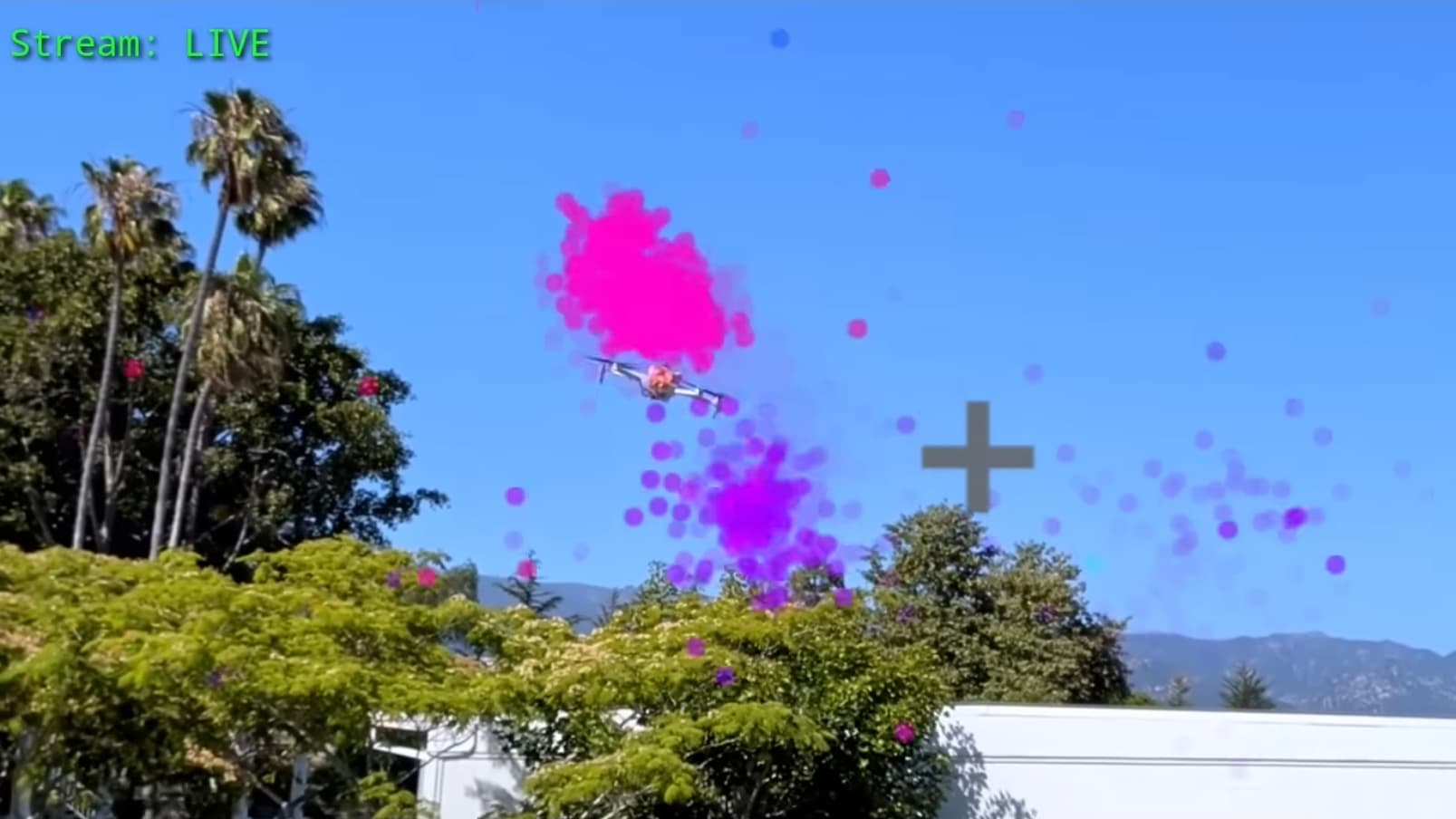
QuadRF is an open-source four-channel phase-coherent software-defined radio (SDR) development board that pairs with a Raspberry Pi 5 to perform radio direction finding (RDF) across the 4.9–6.0 GHz band. Its standout 'RF Camera' mode delivers real-time, 30 fps visualization of signal sources. In a practical demonstration, the system successfully tracked two independent radio transmitters aboard a flying drone.
Highlights
- QuadRF is an open-source four-channel phase-coherent SDR board operating across the 4.9–6.0 GHz band, paired with a Raspberry Pi 5 for onboard computation.
- The system's 'RF Camera' mode visualizes radio signal directions in real time at 30 frames per second, overlaying signal data onto a standard camera feed.
- In a live test, QuadRF tracked two independent radio transmitters aboard a single drone in flight, demonstrating fine-grained signal resolution.
- QuadRF is the first open-source multi-antenna SDR hardware to include transmit capability, distinguishing it from all prior comparable solutions.
- Multiple QuadRF boards can be chained together to form a phased array, and the hardware is compatible with GNU Radio and other standard SDR software platforms.
Seeing the World with Radio Waves: The QuadRF Four-Channel Phase-Coherent SDR Project
The core principle behind Radio Direction Finding (RDF) is straightforward: measure the phase difference between multiple antennas and calculate the angle of arrival. In practice, however, the radio hardware required to do this has long been out of reach for most developers and hobbyists. The QuadRF project aims to change that by delivering a phase-coherent, four-channel SDR that makes radio direction mapping accessible to all. The project is fully open-source and available on GitHub.
Hardware Architecture: Dual-Board Design with Raspberry Pi 5
QuadRF uses a two-board architecture: an RF main board for signal reception and pre-processing, paired with a Raspberry Pi 5 for advanced computation.
The RF main board features four patch antennas, each capable of transmitting or receiving across the 4.9 GHz to 6.0 GHz band with switchable right-hand or left-hand circular polarization (RHCP/LHCP). The onboard processing core is a Lattice ECP5 FPGA, which connects to the Raspberry Pi's camera and display interfaces via two MIPI flex cables for high-speed data transfer. Once processed by the Pi, data can be transmitted externally over Ethernet or Wi-Fi.
Multiple QuadRF boards can also be daisy-chained in a mesh configuration to form a larger-scale phased array, significantly expanding the system's application potential.
Software Highlights: Real-Time RF Camera at 30 fps
QuadRF's most impressive capabilities lie in its software stack. Beyond compatibility with mainstream SDR platforms such as GNU Radio, the development team has built several proprietary applications — the most notable being the 'RF Camera' mode.
This feature continuously scans the entire supported frequency band at 30 frames per second, tracks the directional origin of detected signals, and renders the results as a spatial scatter plot. When this overlay is superimposed on a standard camera feed, users can literally 'see' radio emissions from electronic devices in their environment.
In a real-world demonstration, developers used this mode to track a drone in flight, successfully identifying two separate radio transmitters onboard the aircraft — a testament to the system's fine-grained signal resolution.
A Note on Regulatory Considerations
While QuadRF is technically impressive, multi-antenna SDR solutions are not entirely new. What sets this project apart is that QuadRF is the first open-source multi-antenna SDR hardware to also include transmit capability — a distinction with significant implications.
Developers and researchers should exercise caution: certain use cases may fall under arms export control regulations. Users are strongly advised to verify applicable local laws before deploying the hardware.
Hat tip to [Swake] for the tip!
原文來源: 查看原文
FAQ
Newsletter
Subscribe to our Low-Altitude Industry Newsletter
Daily curated news on low-altitude economy and drone industry, delivered to your inbox.
Reviewed and published by the LAETimes editorial desk ·