Skydio CEO Adam Bry Blasts Large-Drone DFR Programs: 'It Defies the Laws of Physics'
Skydio CEO Adam Bry published a detailed post on X on June 8, using physics and operational data to argue against large quadcopters in Drone as First Responder (DFR) programs. Drawing on optical scaling laws, noise, kinetic energy, and cost data—backed by 60,000 drones built and 4 million customer flights—he contends that small, intelligent drone fleets are the correct DFR solution. He also hinted that Skydio's next platform will deliver DFR-grade imaging within FAA Part 107's 5-lb over-people weight limit.
Highlights
- Skydio CEO Adam Bry published a detailed post on June 8 arguing that optical cube-scaling laws cause a DFR drone's weight to balloon from 5 lb to 40 lb when its operational range doubles from 1,000 ft to 2,000 ft.
- A 40 lb drone landing under parachute assistance carries kinetic energy equivalent to a baseball hit at over 100 mph, exceeding FAA Part 107 Category 2 and 3 over-people safety limits and restricting legal urban operations.
- Bry grounded his argument in Skydio's operational record of approximately 60,000 drones manufactured and more than 4 million customer flights, presenting cost-per-flight-minute as structurally proportional to drone weight at scale.
- Skydio hinted that its next platform will deliver DFR-grade imaging within the 5 lb Part 107 over-people weight limit using breakthrough optics and energy technology, while the company's larger F10 is already listed as 'coming soon' for public safety missions.
- Bry acknowledged large drones are appropriate for heavy-lift tasks and stated Skydio might build large drones for those missions, creating a notable tension with his broader argument against large DFR platforms.
Skydio CEO Adam Bry Blasts Large-Drone DFR Programs: 'It Defies the Laws of Physics'
Skydio CEO Adam Bry published a lengthy post on X on June 8, directly challenging the trend of deploying large quadcopters in Drone as First Responder (DFR) programs.
The post is not a marketing pitch. It is a physics-based argument that attacks the core premise—that bigger drones carrying bigger cameras are the right tool to give aerial coverage to every 911 call—and backs that argument with hard numbers.
The Central Argument
Bry's core thesis is straightforward: DFR should be available to every law-enforcement agency on every call, and a fleet of small, intelligent drones can deliver that outcome faster, cheaper, and more safely than a handful of oversized quadcopters trying to replicate a police helicopter.
His framing is precise. The problem, he argues, is not setting the helicopter as a goal; it is treating the helicopter as the model to imitate. Helicopters are expensive, dangerous, and scarce—deployed on only a tiny fraction of emergency incidents. Replicating their drawbacks in drone form misses the real DFR opportunity entirely.
Bry grounds his argument in Skydio's operational track record: roughly 60,000 drones manufactured and more than 4 million customer flights logged. Whether or not readers agree with his conclusions, the underlying mathematics repays careful attention.
The Scaling Laws Bry Cites
The technical heart of the post is optics. To read a license plate at twice the distance, Bry writes, a camera's aperture and focal length must approximately double. Volume—and therefore mass—scales as the cube of linear dimensions. The result: a drone weighing 5 lb (2.27 kg) that can read a plate at 1,000 ft (305 m) would need to weigh roughly 40 lb (18.14 kg) to do the same at 2,000 ft (610 m). Double the range, eight times the weight.
That cube-law conclusion runs through every subsequent argument. Noise, cost, and crash energy all scale with weight, meaning every advantage gained from a larger platform carries multiplied penalties across every other dimension.
Noise, Kinetic Energy, and FAA Part 107 Constraints
On noise, Bry argues that the audible output of a multirotor drone is broadly proportional to its weight. An eightfold-heavier drone produces roughly eight times the noise at the source. Distance attenuates sound linearly, so a drone operating farther away does not simply become eight times louder at the target location—but his calculations show that, under equivalent operating conditions, the perceived ground-level noise of a large drone remains meaningfully higher than that of a small one.
On safety, the kinetic-energy comparison is the post's most quotable data point. A 5 lb drone landing under parachute-assisted descent carries energy equivalent to a slow baseball thrown at 36 mph (58 km/h). A 40 lb drone under the same conditions carries energy equivalent to a hard line drive at more than 100 mph (161 km/h).
Bry notes that the latter figure far exceeds the FAA's Category 2 and Category 3 thresholds for safe flight over people under Part 107. The practical consequence: large drones cannot legally fly over the cities and towns they are meant to serve.
On cost, the analysis follows the same logic. Bry's footnotes observe that, across mature manufacturers' product lines, cost per gram remains remarkably consistent from 250 g (8.8 oz) mini-drones up to 10 kg (22 lb) platforms; battery cost per gram is even more consistent. At scale, cost per flight minute is roughly proportional to weight. Under this framework, large drones are not merely expensive today—they are structurally expensive.
What Large Drones Cannot Do
The final operational argument is the one technical readers will grasp most quickly: an oversized DFR drone cannot fly under a bridge to check for a suspect in hiding, cannot drop low to cover the back door of a residence while officers approach the front, and cannot intervene with precision in a dynamic scene.
Bry frames this as the opposite end of the same helicopter comparison. Helicopters—and large quadcopters—excel at maintaining standoff surveillance on a small number of high-priority incidents. They cannot scale to cover every call.
He acknowledges that for the narrow category of missions involving lifting or carrying heavy payloads, large drones or helicopters are the right tool—and he even states that Skydio "might build large drones for those missions" itself. But that is not, in his definition, the DFR opportunity.
Skydio's Implied Next Step
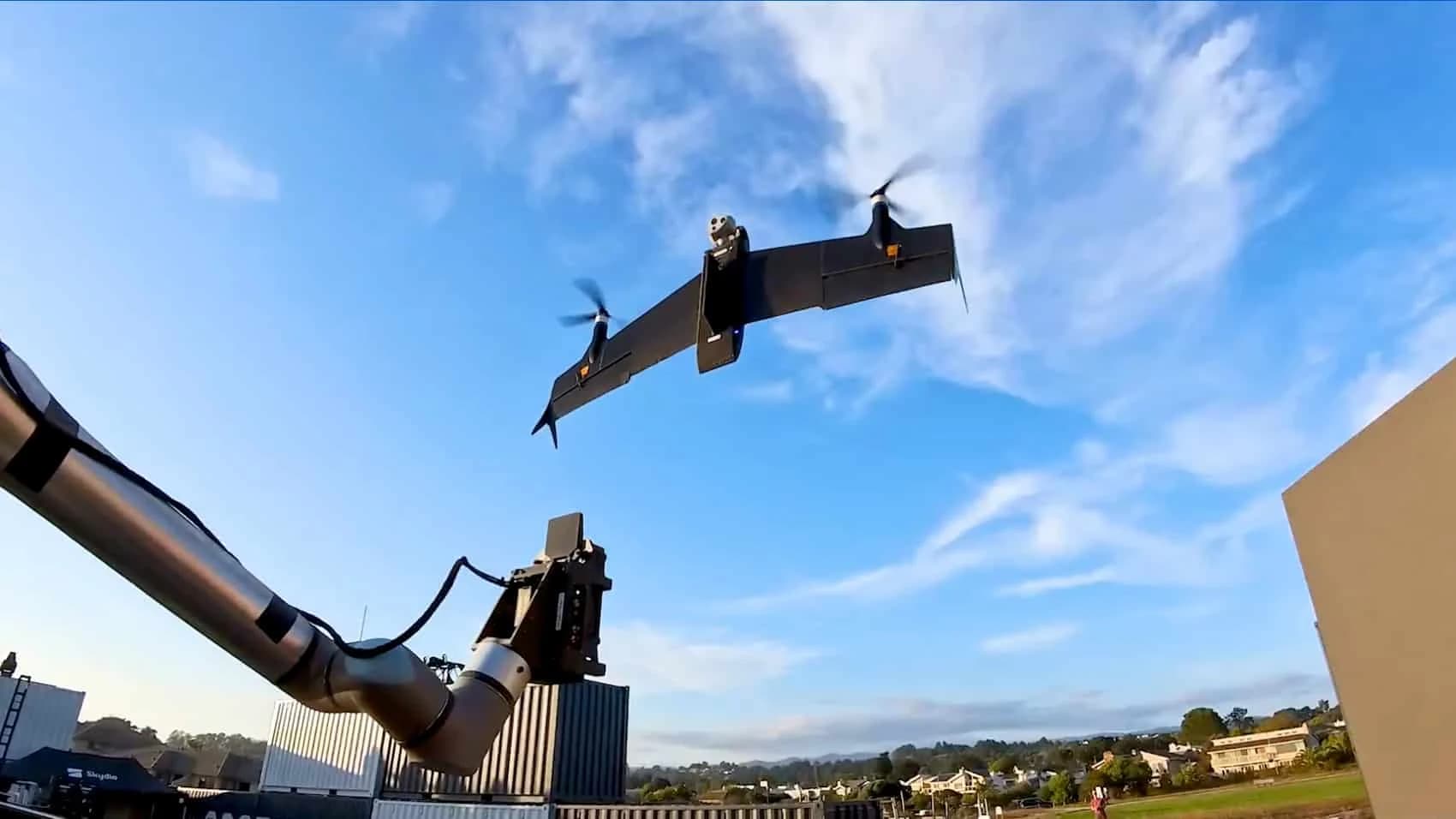
The post ends with a product roadmap signal that is easy to overlook amid the technical argument. Bry writes that Skydio has developed "breakthrough technology in optics and energy utilization that dramatically improves camera performance and flight time, competitive with drones many times larger than our flagship." The implication: the next Skydio platform will claim DFR-grade imaging and endurance while remaining within the 5 lb over-people weight limit set by FAA Part 107.
He also expresses interest in fixed-wing loitering missions, noting that smaller fixed-wing platforms would "beat large quadcopters decisively" for tasks requiring rapid camera deployment and extended time-on-station.
DroneXL Editorial Perspective
To state it plainly: this is the most logically coherent public argument anyone in the U.S. DFR industry has published in the past year. Bry is not selling a spec sheet; he is making a physics-based case that the loudest voices in the DFR market—those pushing for platforms that look more like police helicopters—are solving the wrong problem. And he is making that case backed by 60,000 drones built and 4 million flights flown.
The large drones Bry targets—unnamed, but clearly encompassing several startups that have recently entered the DFR market, including Flock (which launched a new aerial camera following its acquisition of Aerodome) and incumbents pushing larger platforms into public-safety contracts—are not called out by name. His math on noise and sizing is sound, but the harder question is consistency.
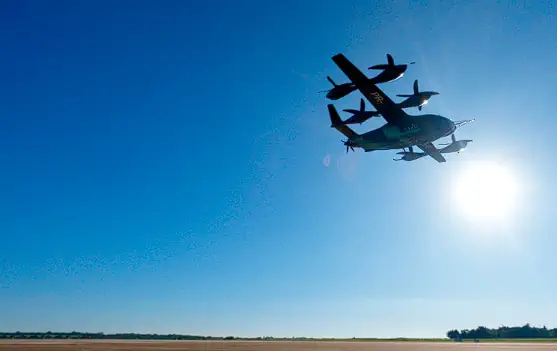
Skydio's own F10 is currently listed on its product page as "coming soon," positioned for long-range utility inspection, naval reconnaissance, and public safety. That is precisely the category of larger platform Bry warns the rest of the market against. The line "Skydio might build large drones for those missions" reads rather differently when the company already has such a product in its pipeline.
So what is the real DFR answer? Is it truly small, near-silent drones that ghost over a scene undetected? U.S. operators face a genuine set of tradeoffs—cost, data security, noise, operational effectiveness, and platform reliability—all sitting on the same table. The hope is that those decisions are made on rational grounds rather than political pressure.
Image credits: Skydio, Adam Bry
原文來源: 查看原文
FAQ
Reviewed and published by the LAETimes editorial desk ·