Thales UK and Kongsberg Maritime Team Up on Royal Navy Type 92 ASW Concept
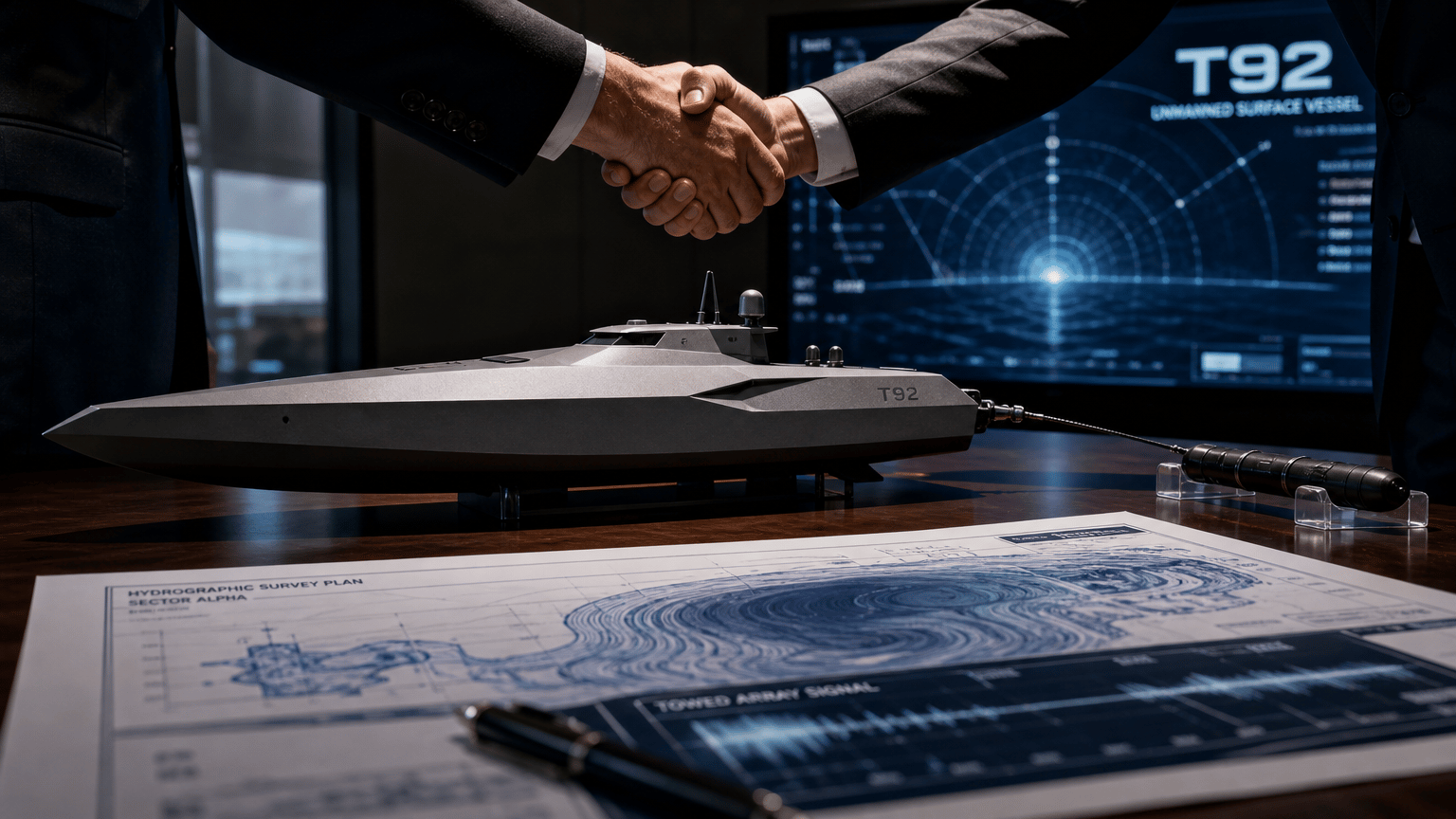
Thales UK and Kongsberg Maritime have signed a memorandum of understanding to explore an anti-submarine warfare solution for the UK Royal Navy’s future Type 92 unmanned surface vehicle. The proposed platform could support persistent sensing, communications and coordination with ships, submarines and aircraft. However, the companies have not disclosed their division of responsibilities, platform specifications, sensors, sonar, weapons, autonomy technology, budget or schedule. The agreement establishes a cooperation framework and does not represent a Royal Navy procurement contract.
Thales UK and Kongsberg Maritime have formed a partnership to study an anti-submarine warfare solution for the Royal Navy’s future Type 92 unmanned surface vehicle, although technical specifications, funding and development schedules remain undisclosed.
Key points
- Thales and Kongsberg will develop a T92 concept
- The proposed USV will support anti-submarine warfare
- The partnership remains at the planning stage
- Technical specifications and company roles remain undisclosed
- No procurement budget or delivery schedule was announced
Highlights
- Thales UK and Kongsberg Maritime signed a memorandum of understanding to study an anti-submarine warfare solution for the Royal Navy’s future Type 92 unmanned surface vehicle.
- The Type 92 cooperation remains at the concept and requirements-shaping stage, and no formal Royal Navy procurement contract has been announced.
- Thales UK and Kongsberg Maritime have not disclosed their division of responsibilities under the Type 92 cooperation framework.
- The companies have not released the proposed vehicle’s dimensions, endurance, sensors, sonar, weapons configuration, autonomous control technology or testing programme.
- No Type 92 procurement value, competitive procedure, prototype evaluation plan or delivery schedule has been announced.
Thales UK and Kongsberg Maritime have signed a memorandum of understanding to jointly examine an anti-submarine warfare concept for the UK Royal Navy’s future Type 92, or T92, unmanned surface vehicle.
The agreement positions the two companies to respond to an emerging Royal Navy requirement, but the initiative remains at the concept and requirements-shaping stage. Neither company has announced a formal development contract, and the Royal Navy has not been identified as having placed a procurement order under the arrangement.
Targeting the Type 92 requirement
Publicly available information indicates that the partnership will focus on proposing a T92 unmanned surface vehicle for anti-submarine warfare. Such a platform could provide a persistent maritime presence while reducing the need to expose sailors and crewed vessels to higher-risk operating areas.
An unmanned surface vehicle can serve as a host for sensors, communications equipment and other mission systems. Depending on its eventual configuration, a T92 platform could operate alongside surface warships, submarines and maritime aircraft, contributing to a distributed network for detecting and monitoring underwater activity.
The Royal Navy’s precise operational requirements have not been released in the information provided. It therefore remains unclear whether T92 would function primarily as an independent sensing platform, a communications node, part of a wider multi-platform surveillance network or a vehicle carrying additional mission equipment.
Integration will be central to operational value
Anti-submarine warfare involves detecting, tracking and identifying underwater targets before transmitting usable information to commanders and other assets. For an unmanned platform, mission performance will depend not only on the sensitivity of its sensors but also on navigation reliability, communications resilience and the ability to operate under difficult sea conditions.
Any future T92 system would also need to fit within the Royal Navy’s wider command-and-control environment. Relevant integration considerations are likely to include data links, cybersecurity, mission-system interfaces and compatibility with existing combat-management infrastructure. Autonomous navigation and decision-support functions would require validation before the vehicle could be routinely incorporated into fleet operations.
These challenges distinguish naval unmanned systems from remotely operated demonstrators. A platform intended for extended deployment must be able to manage communications interruptions, changing weather, vessel traffic and system faults while continuing to operate safely. The quality and reliability of the data returned to crewed assets will ultimately determine whether the system provides useful operational capacity.
Specifications and procurement path remain open
Thales UK and Kongsberg Maritime have not disclosed how responsibilities will be divided between them. No information has been released on the proposed vehicle’s dimensions, endurance, propulsion, sensors, sonar equipment, weapons configuration, autonomous control technology or testing programme.
The companies have also not announced a procurement value or development timetable. Details concerning the Royal Navy’s budget, competitive process, prototype evaluation and expected delivery schedule remain unavailable.
The memorandum of understanding should therefore be viewed as a framework for industrial cooperation rather than confirmation of a production programme. Future milestones will depend on whether the Royal Navy publishes detailed requirements and whether the companies advance their concept into prototype development, sea trials or a formal procurement competition.
Key developments to watch include the selection of existing Thales and Kongsberg technologies for integration, the allocation of engineering responsibilities and the emergence of a test platform. If the programme proceeds, Type 92 could become a significant European example of autonomous maritime systems moving into demanding anti-submarine missions.
What it means for Taiwan
For Taiwan’s unmanned-systems manufacturers, industry associations and maritime supply chain, the partnership highlights potential demand for rugged communications, cybersecurity, autonomous navigation, marine electronics and sensor-integration capabilities. Taiwanese suppliers should monitor the release of Royal Navy requirements and any subsequent prototype or sea-trial phase, since those milestones will determine whether subcontracting or component opportunities emerge. For local maritime inspection operators, the programme may provide future procurement benchmarks for redundancy, data links and operation in difficult sea conditions. Its immediate effect on aerial inspection, exterior cleaning and agricultural spraying providers is limited because no standard or contract has been issued. However, operators purchasing dual-use autonomous equipment should expect customers to place greater emphasis on secure data handling, system interoperability and documented fail-safe performance.
FAQ
Reviewed and published by the LAETimes editorial desk ·