Voliro Launches Smart Battery for Voliro T: Hot-Swap Technology Keeps Industrial Inspections Running Non-Stop
Voliro has announced a new Smart Battery system for its Voliro T drone, featuring hot-swap capability that enables a return to flight in under 20 seconds after a battery change. The battery includes self-health monitoring, low-temperature self-heating down to -10°C, and IATA compliance for air transport. It supports a full range of industrial NDT applications including UT, EMAT, PEC, and LPS testing, significantly improving mission continuity and operational efficiency.
Highlights
- Voliro 為 Voliro T 無人機推出智慧電池,支援熱插拔設計,換電後不到 20 秒即可重返飛行。
- 智慧電池符合 IATA Table 2.3.A 規範,可作為手提行李攜帶搭乘全球商業航班。
- 內建自加熱功能,可在低至 -10°C 的環境下正常運作,適合寒冷氣候及海上平台作業。
- 電池具備自我健康監控,自動偵測狀態並在飛行、充電與儲存模式間切換,無需人工介入。
- 所有全新 Voliro T 訂閱方案均隨附智慧電池,現有訂閱用戶將透過分階段推出計畫獲得升級。
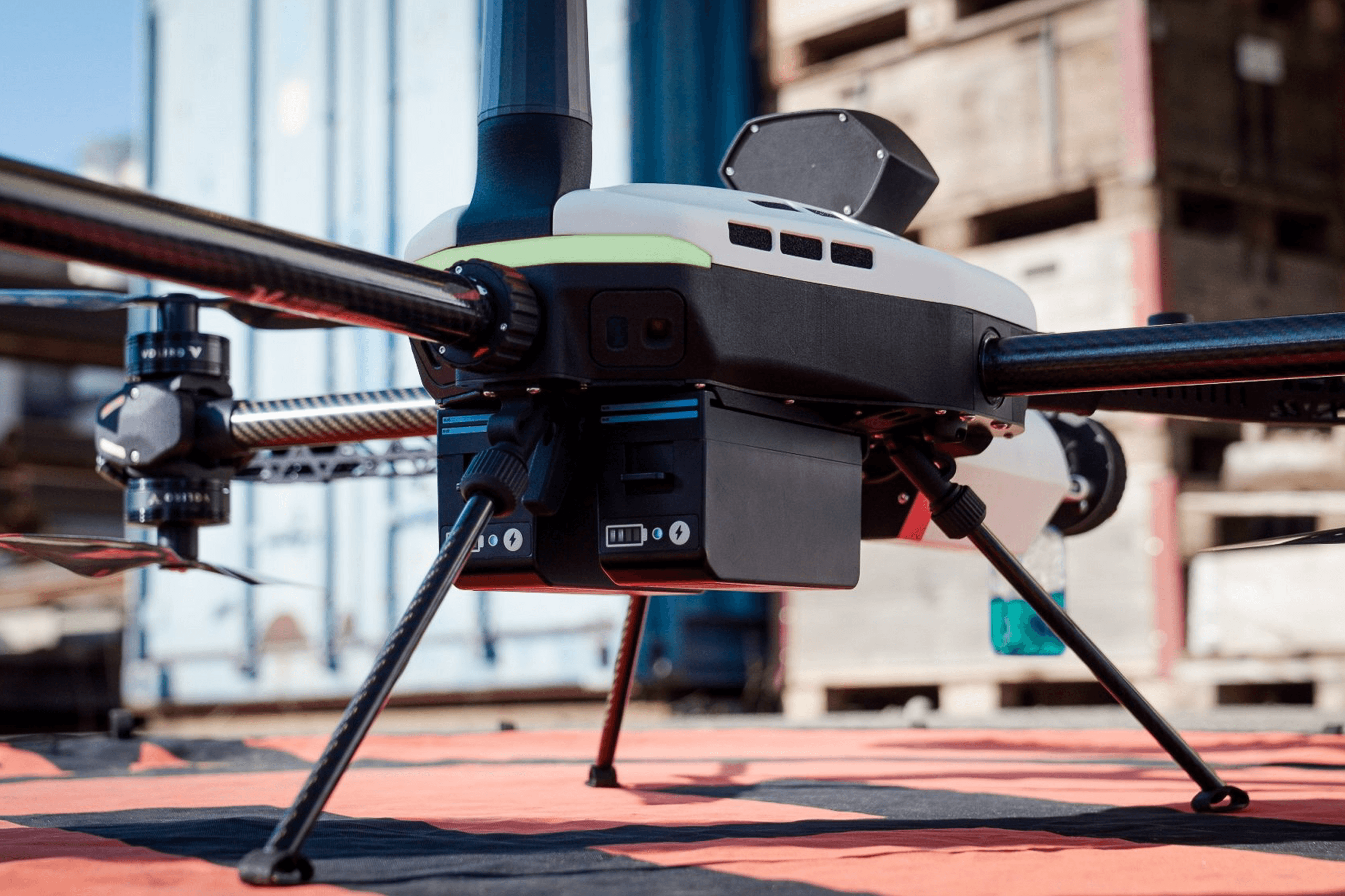
Voliro has officially announced the launch of Smart Batteries designed exclusively for the Voliro T — a hot-swap, self-managing power system built for robotic industrial inspection. The new batteries enable a return to flight in under 20 seconds after a swap, feature built-in health monitoring, comply with IATA air transport regulations, and support self-heating for operation in temperatures as low as -10°C.
How Smart Batteries Are Changing the Game for Robotic Industrial Inspection
In professional robotic industrial inspection, power management dictates nearly everything: how many sorties a team can complete in a day, how confident operators feel about mission completion, and whether a remote site requires one technician or two.
The direct cost recovery from faster battery swaps is quantifiable. The indirect benefits — unlocked once a platform can operate continuously — are harder to measure but potentially more significant. When inspection missions are no longer constrained by battery cycles, operational planning can be structured around equipment access windows rather than charging downtime.
Key Features at a Glance
Hot-Swap Power Batteries can be swapped without powering down the Voliro T. While the first battery is being changed, the second keeps the system running — enabling a return to flight in under 20 seconds.
IATA Air Transport Compliance Conforms to IATA TABLE 2.3.A, allowing batteries to travel as carry-on baggage on commercial flights worldwide, so the power system goes wherever the mission does.
Included in All New Voliro T Subscriptions All new Voliro T subscription plans include Smart Batteries. Existing subscribers will receive upgrades through a phased rollout — contact your account manager for availability details.
Five Key Advantages of the Smart Battery
1. Hot-Swap — Return to Flight in Under 20 Seconds
Depleted batteries can be swapped without shutting down the platform. Operational planning shifts from working around downtime to planning for continuous availability. For contact inspection, LPS testing, and elevated spot repairs — scenarios where access windows can close at any moment and equipment must return to service immediately — this capability is a fundamental operational change.
2. Self-Managing Power
The battery automatically detects its own state and switches between flight, charging, and storage modes. Prolonged storage at full charge accelerates cell degradation. Voliro Smart Batteries handle storage protection autonomously, with no manual intervention required — eliminating the risk of degraded cells showing up in a critical mission six months later.
3. Self-Heating — Operable Down to -10°C
Cold batteries behave unpredictably and can fail suddenly under load. Pre-heating before power delivery eliminates this risk entirely, making the system suitable for teams operating in northern climates, offshore platforms, or winter inspection seasons.
4. Real-Time Telemetry — Know Exactly Where Your Batteries Stand
The companion app displays simultaneous real-time state of charge (SOC), state of health (SOH), and voltage data for both batteries. Knowing a battery is at 73% charge and in good health — versus estimating charge level from time on the charger — is the difference between confident and anxious decision-making.
5. A Truly Global Power System
Voliro Smart Batteries comply with IATA Table 2.3.A and can be carried aboard any commercial flight worldwide. Paired with a smart charger supporting 110–240V AC universal input and the ability to simultaneously charge up to three battery pairs, the complete power system is genuinely plug-and-work anywhere in the world.
Inspection Applications Unlocked by Continuous Operation
The full payload manifest for the Voliro T illustrates what continuous operation makes possible:
- Ultrasonic Testing (UT): Complete, uninterrupted wall-thickness mapping on tanks, vessels, and structural steel — with no seam artifacts caused by repositioning.
- High-Temperature UT: Live inspection of assets operating at up to 260°C / 500°F, with no cooling or scaffolding required, saving significant time during planned shutdowns.
- Electromagnetic Acoustic Transducer (EMAT): Couplant-free, non-contact thickness measurement that accelerates surface-to-surface transitions and expands area coverage per sortie.
- Dry Film Thickness (DFT): Coating verification across large surfaces with greater spatial resolution and more complete coverage per operation.
- Pulsed Eddy Current (PEC): Corrosion screening without insulation removal — the most cost-effective aerial NDT method currently in production, and the application where data continuity is most critical.
- Lightning Protection System (LPS) Testing: Complete verification of lightning protection systems. What once required rope access or multiple days of scaffolding can now be completed in a single continuous operation.
Redefining the Framework for Evaluating Inspection Platforms
Traditional evaluation frameworks for drone-based NDT platforms focus on sensor specifications, payload compatibility, flight time, and software integration. These are necessary criteria — but not sufficient.
The standards that determine whether a platform can deliver value in real production environments, across full operational cycles, under genuine industrial conditions, should include:
- Inspection throughput per shutdown window: Not flight time, not battery capacity — but actual inspection coverage per hour of access time, after accounting for all swaps, repositioning, re-initialization, and inter-flight preparation.
- Data continuity across flight segments: Whether datasets produced across multiple sorties constitute a single, coherent, defensible record — or contain seams, gaps, and re-initialization artifacts that complicate integrity reporting.
- Platform operational envelope in actual deployment conditions: Reliability at real operating temperatures, wind conditions, and site environments. A platform with automated thermal management at -10°C and IATA-compliant batteries is a fundamentally different tool from one that requires favorable weather and freight logistics planning.
- Total cost per inspection operation: Including personnel hours, mobilization costs, battery handling, re-initialization, repositioning, and the probability of return visits due to incomplete or fragmented data.
Evaluated against these criteria — rather than peak sensor specifications or single-flight demonstration performance — the operational and economic significance of seemingly minor platform design differences becomes clear.
Book a Demo
Whether you are evaluating the Voliro T for the first time or looking to optimize an existing workflow, schedule a 20-minute online demonstration to explore how Smart Batteries can elevate your inspection operations.
原文來源: 查看原文
FAQ
Newsletter
Subscribe to our Low-Altitude Industry Newsletter
Daily curated news on low-altitude economy and drone industry, delivered to your inbox.
Reviewed and published by the LAETimes editorial desk ·