U.S. Air Force: More Than 20 Vendors Competing for CCA Increment 2
The U.S. Air Force has confirmed that more than 20 companies remain eligible in the supplier qualification pool for the Collaborative Combat Aircraft (CCA) Increment 2 program, despite only nine being announced for the concept refinement phase. The Air Force plans to make a final competitive production decision for Increment 1 by October 2025, and has requested over $1.1 billion in FY2027 production funding plus nearly $1.4 billion in R&D. Secretary Troy Meink says prototypes are ahead of expectations and that modular open architecture will help control costs.

Highlights
- The U.S. Air Force confirmed that more than 20 companies remain eligible in the CCA Increment 2 supplier qualification pool, despite only 9 being announced for the concept refinement phase.
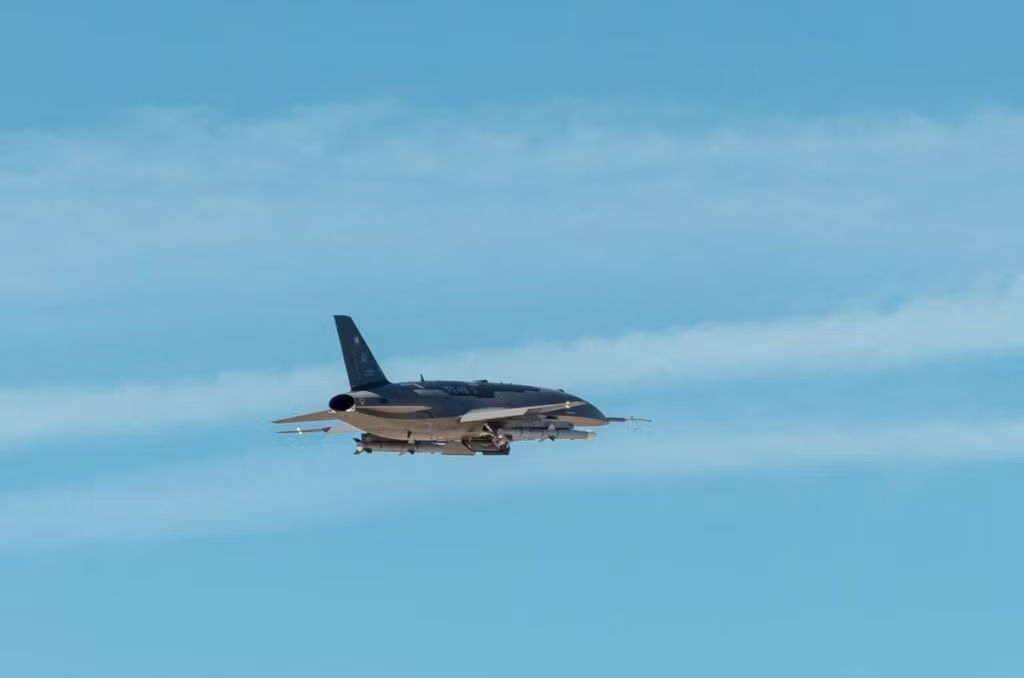
- The Air Force plans to finalize the CCA Increment 1 competitive production decision in FY2026, choosing between General Atomics' YFQ-42A 'Dark Merlin' and Anduril's YFQ-44A 'Fury.'
- The FY2027 budget request includes $1.1 billion for CCA production and nearly $1.4 billion for R&D, targeting an initial deployment of 100–150 aircraft by 2029 out of a 1,000–2,000 total procurement goal.
- Northrop Grumman's YFQ-48A 'Talon Blue' became the third officially designated CCA prototype and is expected to compete in Increment 2.
- Air Force Secretary Troy Meink stated CCA prototypes have exceeded performance expectations and that modular open architecture and competition among contractors will help control unit costs.
U.S. Air Force: More Than 20 Vendors Competing for CCA Increment 2
The U.S. Air Force announced in February that it had selected nine companies for the concept refinement phase of the Collaborative Combat Aircraft (CCA) Increment 2 program. However, the Air Force confirmed this week that more than 20 companies remain eligible to compete in the supplier qualification pool. Meanwhile, the service plans to make a final competitive production decision for CCA Increment 1 before October, with General Atomics Aeronautical Systems' YFQ-42A "Dark Merlin" and Anduril Industries' YFQ-44A "Fury" as the competing candidates.
Increment 1 and Increment 2 Advancing in Parallel
In an email response to Defense Daily, the Air Force stated: "The Air Force remains on track to make a final competitive production decision for CCA Increment 1 in FY2026. Additionally, the Air Force is actively advancing Increment 2. Early in FY2026, the Department of the Air Force began refining CCA Increment 2 concepts. While nine companies entered the concept refinement phase, all 20-plus industry partners in the supplier qualification pool will have the opportunity to compete for the next design phase."
FY2027 Budget: Over $2.5 Billion Directed Toward CCA
The Air Force's FY2027 budget request includes $1.1 billion to initiate CCA production and nearly $1.4 billion for research and development. However, the Air Force has not yet disclosed how many aircraft those funds would procure. The service has previously estimated an initial deployment of 100 to 150 CCAs by 2029, out of a total procurement objective of 1,000 to 2,000 aircraft — a figure that could potentially increase significantly.
Third Prototype Joins Competition
Northrop Grumman's YFQ-48A "Talon Blue" has become the third CCA prototype to receive an official Air Force designation and is expected to be a strong contender for Increment 2. The Air Force has not yet published the list of nine Increment 2 competitors. Flight testing at the Experimental Operations Unit (EOU) at Nellis Air Force Base, Nevada, will play a key role in shaping the operational requirements for Increment 2.
Cost Concerns: High Value or Too Expensive?
In April, a retired fighter pilot described the CCA as "the defense aviation obsession of the decade," arguing that its advanced autonomy, low-probability-of-intercept communications, digital architecture, and logistics requirements would drive costs substantially higher. The critic also cited limitations including "limited range, insufficient endurance, and constrained payload," which could diminish the CCA's appeal as a substitute or supplement for manned fighters.
In response to concerns about CCA's ability to operate across the vast Indo-Pacific theater, the Air Force said it is working to make the CCA "a highly adaptable, cost-effective, and rapidly deployable system." The service cited the use of a government reference architecture, investment in next-generation propulsion technology, and the Agile Combat Employment (ACE) concept — including streamlined maintenance and "ready-to-fly" status — as measures to reduce traditional logistics demands and sustain operations from dispersed locations.
Unit Cost Targets Still Under Review
Two years ago, the Air Force estimated a "sophisticated" CCA's flyaway cost at between $25 million and $30 million, while projecting a future mix that could include expendable variants at approximately $5 million to $10 million per unit. Using the FY2027 budget's $300,000 per-unit cost cap as a rough metric, the $1.1 billion procurement request would cover roughly 36 aircraft.
The Air Force is currently reassessing total CCA procurement requirements and unit cost targets through the summer and fall, evaluating which missions CCAs can assume from manned aircraft. The CCA is expected to focus initially on air-to-air missions, with potential expansion into other mission types in the future.
SecAF Meink: CCA Is Not 'Expendable' but Offers Cost Advantage
Air Force Secretary Troy Meink told the Senate Appropriations Committee's Defense Subcommittee last week that CCA prototypes are "on schedule — they've held to budget targets and performance has exceeded expectations in many areas."
"In terms of controlling future costs, we're using competition and open standards, having multiple contractors responsible for different hardware components, and bringing in more contractors — from avionics to airframes and engines," Meink said. "We're working to build a modular open architecture to drive down costs, and we're also working closely with allies who are investing in similar systems."
Meink acknowledged that the CCA would likely "not be viewed as truly expendable," but emphasized the favorable cost exchange ratio it offers: "One CCA carrying multiple long-range weapons, compared to the fighters an adversary might deploy to counter it — that's a very favorable cost exchange for us."
原文來源: 查看原文
FAQ
Newsletter
Subscribe to our Low-Altitude Industry Newsletter
Daily curated news on low-altitude economy and drone industry, delivered to your inbox.