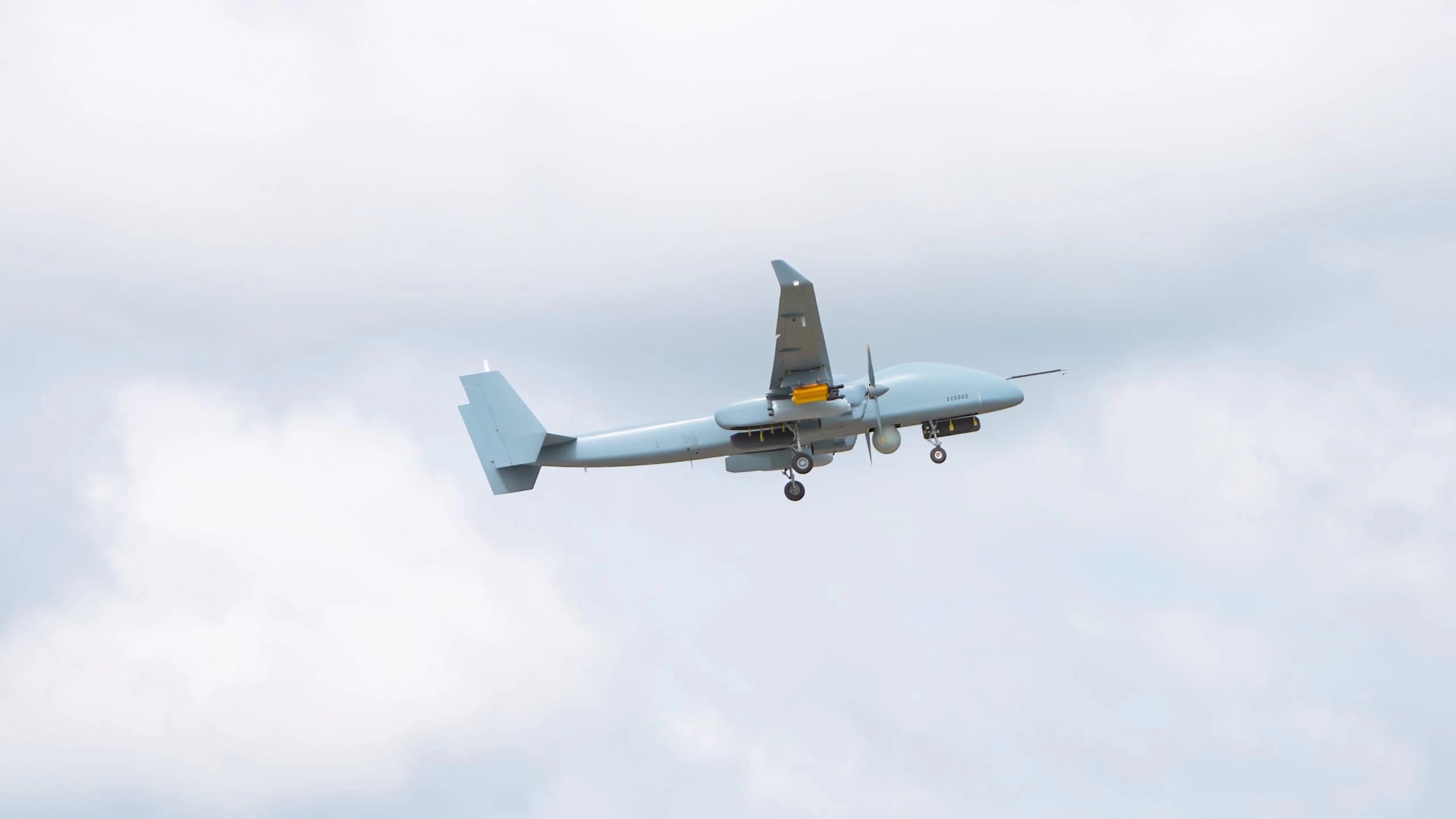
At 8,500 Metres: Zongheng CAS Cloud Dragon Fixed-Wing Drones Complete High-Altitude Weather Modification Flight Trials
From June 1–3, 2026, Zongheng CAS successfully flew its Cloud Dragon-1P and Cloud Dragon-3C fixed-wing weather modification drones from Hongyuan Airport (3,535 m AMSL) over the western Sichuan Plateau, reaching a maximum operational altitude of 8,500 metres. The trials confirmed the series' readiness for routine high-altitude cloud-seeding and hail-suppression missions.

Highlights
- Zongheng CAS flew its Cloud Dragon-1P and Cloud Dragon-3C fixed-wing AWI drones from Hongyuan Airport (3,535 m AMSL) to a maximum altitude of 8,500 m during June 1–3, 2026 cloud-seeding trials.
- The proprietary 270 V de-icing system maintained leading-edge temperatures at 5–20 °C under a severe icing red alert at 8,500 m, with both cameras fully encased in ice.
- The full AWI payload suite — including cloud particle spectrometers and a 20-tube YF-1 flare dispenser — can be swapped between both aircraft types and tested within one hour.
- For the first time, no ground control station was deployed at the departure airport; takeoff and landing were managed remotely via a single satellite link from the landing site.
- Chengdu University of Information Technology and Zongheng CAS jointly established the Multi-Modal UAV Perception and Artificial Weather Influence Joint Laboratory in November 2025 to support intelligent AWI operations.
At 8,500 Metres: Zongheng CAS Cloud Dragon Fixed-Wing Drones Complete High-Altitude Weather Modification Flight Trials
Between June 1 and 3, 2026, the Cloud Dragon-1P and Cloud Dragon-3C — two fixed-wing unmanned aircraft developed in-house by Zongheng CAS (縱橫股份) for artificial weather influence (AWI) operations — took off from Hongyuan Airport on the western Sichuan Plateau (elevation 3,535 m AMSL) and conducted cloud-seeding and snow-enhancement flight trials, reaching a maximum operational altitude of 8,500 metres.
The campaign marks the transition of the Cloud Dragon series from proof-of-concept to full operational readiness in high-altitude, complex meteorological environments.
Homogeneous Dual-Aircraft Operations Validated
A key objective of the trials was to validate homogeneous, interchangeable operations between the Cloud Dragon-1P and Cloud Dragon-3C. Both aircraft flew with a complete AWI mission payload suite comprising:
- Cloud particle spectrometer
- Cloud particle imaging spectrometer
- Precipitation particle imager
- Total/liquid water content meter
- 20-tube YF-1 flare-seeding dispenser
- EO/IR gimbal
- Satellite communications equipment
- Proprietary high-efficiency de-icing system
Thanks to an integrated system architecture and modular payload design, the full AWI payload can be swapped and tested between the two aircraft types within one hour, significantly streamlining logistics and multi-aircraft mission support.
Integrated "Detect–Seed–Assess" Precision Operations
Artificial weather modification is a strategic application within China's low-altitude economy, playing a critical role in agricultural drought relief, road-fog dispersal, and protection of cash crops from hail. Both Cloud Dragon variants carry the full AWI payload and are capable of large-area, sustained "detect–seed–assess" precision operations — particularly suited to high-altitude and complex mountainous terrain.
On November 10, 2025, Chengdu University of Information Technology (home to China's first dedicated weather modification college) and Zongheng CAS jointly inaugurated the "Multi-Modal UAV Perception and Artificial Weather Influence Joint Laboratory." The facility aims to build an end-to-end intelligent AWI technology chain covering high-precision detection, smart decision-making, and dynamic operations, with a focus on solving intelligent application challenges in rain enhancement, hail suppression, and fog dispersal. First-hand data collected during these plateau trials will be critical to closing the intelligent AWI operational loop.
Proprietary 270 V De-Icing System Validated at 8,500 Metres
During the Cloud Dragon-3C trials, the aircraft faced extreme conditions: an operational ceiling of 8,500 m, cloud tops exceeding 8,500 m, and a cloud base just 150 m above ground level. When icing sensors triggered a "severe icing" red alert and both the forward camera and EO gimbal lens were fully encased in ice, Zongheng's proprietary 270 V high-efficiency de-icing system continued to operate stably — precisely maintaining leading-edge temperatures on the wings and horizontal stabilizer between 5 °C and 20 °C, ensuring flight safety and uninterrupted AWI operations.
Single-Satellite-Link Remote Takeoff and Landing Control
For the first time, no ground control station or differential GNSS reference station was deployed at the departure airport. Takeoff and landing were controlled entirely via satellite communications from the landing-site station alone. This operational proof-of-concept demonstrates a viable path toward centralizing full flight control in a central command center, substantially reducing deployment and operating costs for future missions.
Outlook
The successful completion of these cloud-seeding and snow-enhancement trials formally establishes the Cloud Dragon AWI series as operationally capable of routine high-plateau missions, including rain enhancement, hail suppression, and ecological water replenishment in high-altitude regions.
Zongheng CAS states it will continue to advance drone applications in weather modification, ecological restoration, water resource security, and forest fire prevention and suppression — delivering efficient, reliable, and scalable aerial solutions for meteorological services and emergency response.
原文來源: 查看原文
FAQ
Newsletter
Subscribe to our Low-Altitude Industry Newsletter
Daily curated news on low-altitude economy and drone industry, delivered to your inbox.
Reviewed and published by the LAETimes editorial desk ·