Newport News, Virginia to Deploy Drones in 90 Seconds for 911 Calls
Newport News, Virginia is launching a Drone as First Responder (DFR) program that will dispatch drones to priority 911 calls before officers or firefighters arrive, with some units reaching scenes within 90 seconds. Eight drones supplied by Flock Safety are stationed at four launch sites across the city, equipped with thermal imaging and live video. The program notably integrates both police and fire departments under a single drone fleet, making Newport News one of the first cities in Virginia—and among the earliest in the U.S.—to do so.

Highlights
- Newport News市部署8架Flock Safety無人機於4個起飛站,部分飛行器可在90秒內抵達優先級911報案現場。
- 該計畫整合警察與消防部門共用同一套無人機機隊,是維吉尼亞州首例、全美最早之一。
- 無人機搭載熱成像儀與即時影像傳輸,覆蓋範圍涵蓋Interstate 64及詹姆士河濱水區。
- 系統運作需取得FAA的BVLOS飛行豁免許可,約20名警消人員已完成飛行認證。
- 城市官員主動聲明無人機僅用於響應優先一級報案,非日常巡邏監視工具,未來可能擴充危材採樣及空投Narcan等功能。
Newport News, Virginia is preparing to dispatch drones to 911 calls ahead of police officers or firefighters, with some aircraft capable of reaching scenes within 90 seconds.
The city has deployed eight drones across four launch sites. Once a high-priority call comes in—homicides, shootings, missing persons, or medical emergencies—the nearest drone lifts off immediately. Approximately 20 police and fire personnel have already received flight certification. The program is expected to go live next week.
Eight Drones, Four Launch Sites Across the City
Each launch site is equipped with two drones and distributed across different districts of Newport News. Trained pilots can scramble the nearest aircraft the moment a priority call is received, streaming live footage to commanders while ground units are still en route. This "eyes on scene first" advantage is the core value proposition of any Drone as First Responder (DFR) program.
The drones are supplied by Flock Safety, the vendor selected by Newport News. Flock is widely known across the United States for its automated license plate recognition (LPR) networks and has been aggressively expanding into the DFR market. This partnership makes Newport News part of Flock's rapidly growing public safety airspace portfolio.
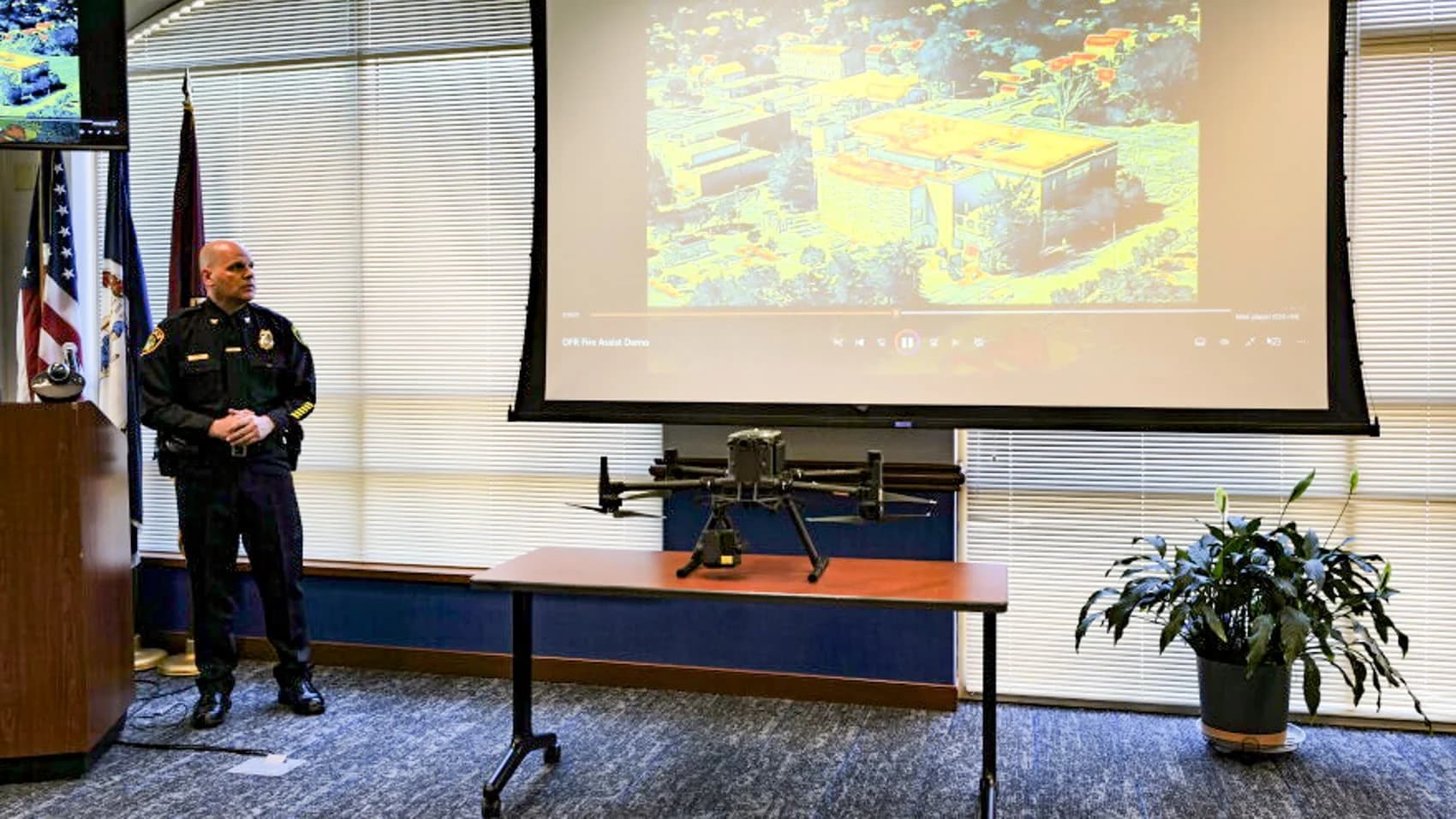
The aircraft are equipped with thermal imaging cameras and live video transmission, enabling pilots to locate individuals in darkness or identify hotspots in a structure fire before ground crews arrive. Coverage extends across the entire city, including the Interstate 64 corridor and the James River waterfront.
The operational impact shows in how calls are handled. In cities that have already adopted similar systems, real-time aerial footage has allowed dispatchers to quickly close out unfounded calls and direct more resources toward genuine emergencies. Officers no longer have to walk into a scene blind—the camera has already scouted it.
Programs of this nature require a Federal Aviation Administration (FAA) waiver to conduct beyond visual line of sight (BVLOS) operations within city limits. Obtaining that waiver is the single longest step in the process and is what separates a true DFR system from recreational drone use.
Shared Police-Fire Fleet Is a Rare Achievement
The vast majority of DFR programs in the United States are built and operated solely by police departments. Newport News has integrated its fire department into the same system, and city officials say this makes it one of the first cities in Virginia—and among the first in the country—to serve both law enforcement and fire suppression with a single drone fleet.
For fire operations, thermal cameras provide an aerial overview of structure fires and incident scenes, giving incident commanders a situational picture that ground personnel cannot obtain. Fire Chief Wesley Rogers cited the city's geographic characteristics—a major interstate highway and a waterway running through it—as reasons why an aerial perspective is particularly valuable.
According to WTKR, city officials have already outlined a vision for future capabilities, including air-quality sampling for hazardous materials (hazmat) support and the potential delivery of medical supplies—such as dropping Narcan (naloxone) to an overdose scene before an ambulance arrives.
Officials Drew Privacy Lines Before Residents Asked
City leadership proactively addressed privacy concerns ahead of the program launch, emphasizing that these drones are deployed in response to Priority 1 calls and are not surveillance tools patrolling neighborhoods. That framing matters as police drone programs continue to face scrutiny from civil liberties advocates.
"They're really not being used for surveillance," said City Manager Alan Archer. "They're being used to respond to what we call Priority 1 service requests." Councilmember Rob Coleman was more direct, acknowledging that residents might worry about surveillance and stating clearly that this program is not designed for that purpose.
Civil liberties organizations have long argued that the real risk in programs like this lies not in the first flight but in the footage. How long video is retained and who can search it later are questions whose answers outlast any launch-day promise—especially when footage from one call could later be used in an unrelated investigation.
Police Chief Steve Drew framed the launch as a transformation in how his department operates. "This is the future of law enforcement," he said. "This is the future of how we respond." He added that drones are positioned for high-risk emergencies—the moments when the city asks its personnel to walk into high-pressure, dangerous situations.
DroneXL Perspective
The most striking aspect of this story is how routine it has become. Seven years ago, the drone as first responder concept was a single experiment in Chula Vista, California, with the entire industry watching anxiously. Today, a mid-sized Virginia city is launching it as a standard municipal service. That is no longer a distant ambition.
What makes Newport News worth watching is its integrated police-fire model. Running a single drone fleet for two departments is far more difficult than it looks from the outside—police and fire personnel operate under fundamentally different missions and legal frameworks. Pulling it off within one system represents a genuine engineering and policy achievement, not just a press release.
The surveillance commitment is the detail to track over time. Every DFR program launches with a strict list of qualifying call types and a promise that this is not patrol surveillance. The real test comes when drones sit idle during quiet periods and someone asks why they aren't doing more.
A drone that can deliver a defibrillator or Narcan in seconds, help locate a missing person, or keep an officer safer on a dangerous call is worth more than any "what if" concern about the technology. Drones are coming—and they are at their best when operated with good intentions and held to the communities they serve.
Virginia Beach and York County are also preparing their own programs. It will be worth watching whether they replicate Newport News's integrated police-fire model or follow the police-only path that most cities have taken first.
Image credits: WTKR, Yiqing Wang / WHRO, Flock Safety
原文來源: 查看原文
FAQ
Newsletter
Subscribe to our Low-Altitude Industry Newsletter
Daily curated news on low-altitude economy and drone industry, delivered to your inbox.