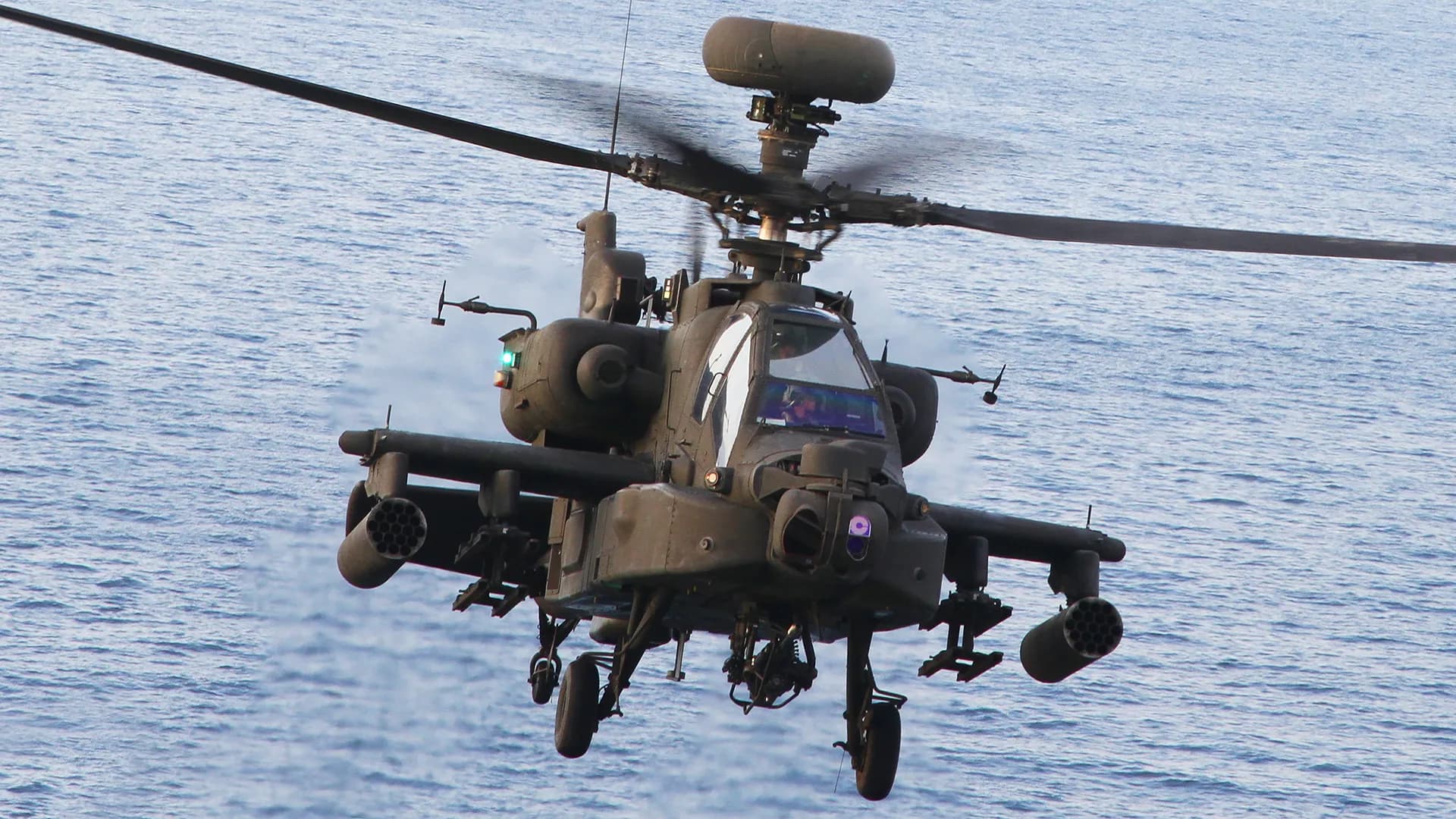
Iran Drone Downs U.S. Army AH-64 Apache Helicopter; Trump Orders Retaliatory Strikes
A U.S. Army AH-64 Apache attack helicopter was shot down near the Strait of Hormuz by an Iranian drone and crashed into the Gulf of Oman. Both crew members were rescued unharmed by an unmanned surface vessel. President Trump announced a retaliatory response, and U.S. Central Command subsequently launched self-defense strikes against multiple targets in southern Iran.

Highlights
- A U.S. Army AH-64 Apache helicopter was shot down near the Strait of Hormuz by an Iranian drone and crashed into the Gulf of Oman; both crew members were rescued unharmed.
- A U.S. official confirmed to Axios that an Iranian drone struck the Apache, with IRIB identifying the weapon as a Shahed drone.
- The two pilots were rescued by an unmanned surface vessel (USV), marking an unprecedented use of autonomous craft in combat rescue.
- CENTCOM announced self-defense strikes against Iran at 5:00 p.m. ET, with explosions reported at Sirik, Qeshm Island, and Jask in southern Iran.
- President Trump described the U.S. response as "very tough, very powerful" while simultaneously downplaying the incident to The Wall Street Journal, calling it "not a big deal."
Incident Overview
President Donald Trump announced via Truth Social that a U.S. Army AH-64 Apache attack helicopter was shot down by Iranian forces while conducting a patrol mission over the Strait of Hormuz. The helicopter went down in the Gulf of Oman; both pilots were rescued safely and without injury. Notably, the rescue operation was carried out by an unmanned surface vessel (USV) — an unprecedented method of combat rescue.
Trump's statement read: "I was just informed by our great military that the Iranians shot down one of our highly sophisticated Apache helicopters last night… The United States must respond to this attack."
How the Helicopter Was Shot Down
Trump did not elaborate on the specific method used to down the Apache. However, a U.S. official told Axios that the investigation had "confirmed that an Iranian drone struck the helicopter, causing it to crash," though it had not yet been determined whether the act was intentional.
Reports noted that Iranian small boats have long been regarded as a source of man-portable air-defense systems (MANPADS) threats. Additionally, small FPV drones and loitering munitions have emerged as credible threats to rotary-wing aircraft. Iran's state broadcaster IRIB, citing CNN, reported that the helicopter was brought down by a Shahed drone.
Iran's Response
Iranian state media neither confirmed nor denied involvement in the downing. Iranian Parliament Speaker Mohammad Ghalibaf issued a veiled warning on X: "We prefer the language of diplomacy, but we are more fluent in other languages. Break your promises and we will switch to the method we are most proficient in."
Iran's English-language state broadcaster Press TV responded with a sardonic tone: "So the Iranian military has been 'obliterated,' has it?"
Trump Attempts to Downplay the Incident
In a phone interview with The Wall Street Journal, Trump attempted to minimize the episode, calling it "not a big deal" and emphasizing that "the pilots are fine."
U.S. Retaliatory Strikes
At 5:00 p.m. ET, U.S. Central Command (CENTCOM) announced on X: "U.S. forces began conducting self-defense strikes against Iran today at 5 p.m. at the direction of the Commander in Chief, in response to yesterday's downing of a U.S. Army Apache helicopter. This mission is a proportional response to Iran's unlawful aggression."
Iran's Mehr News Agency subsequently reported explosions in multiple locations across southern Iran, including the port of Sirik, Qeshm Island, Jask, and Mount Mubarake Jask.
ABC News chief Washington correspondent Jonathan Karl was on the phone with Trump when CENTCOM made the announcement. Trump stated: "I think it's very important to respond. They shot down a helicopter, and we're responding… I think the response should be very tough, very powerful — and it is."
Latest Developments
Iran's Tasnim News Agency reported that the U.S. wave of strikes appeared to have temporarily concluded and that the situation had returned to calm. The agency also released footage purportedly showing "a suicide drone over Iraq."
U.S. CENTCOM Commander Admiral Brad Cooper, following a classified congressional briefing, was asked by reporters how the U.S. would respond. He replied tersely: "We'll see."
This story is developing and will be updated as new information becomes available.
原文來源: 查看原文