Inside Ukraine's AI Drone Strike Campaign: Targeting Russian Supply Lines 250 km Behind the Front
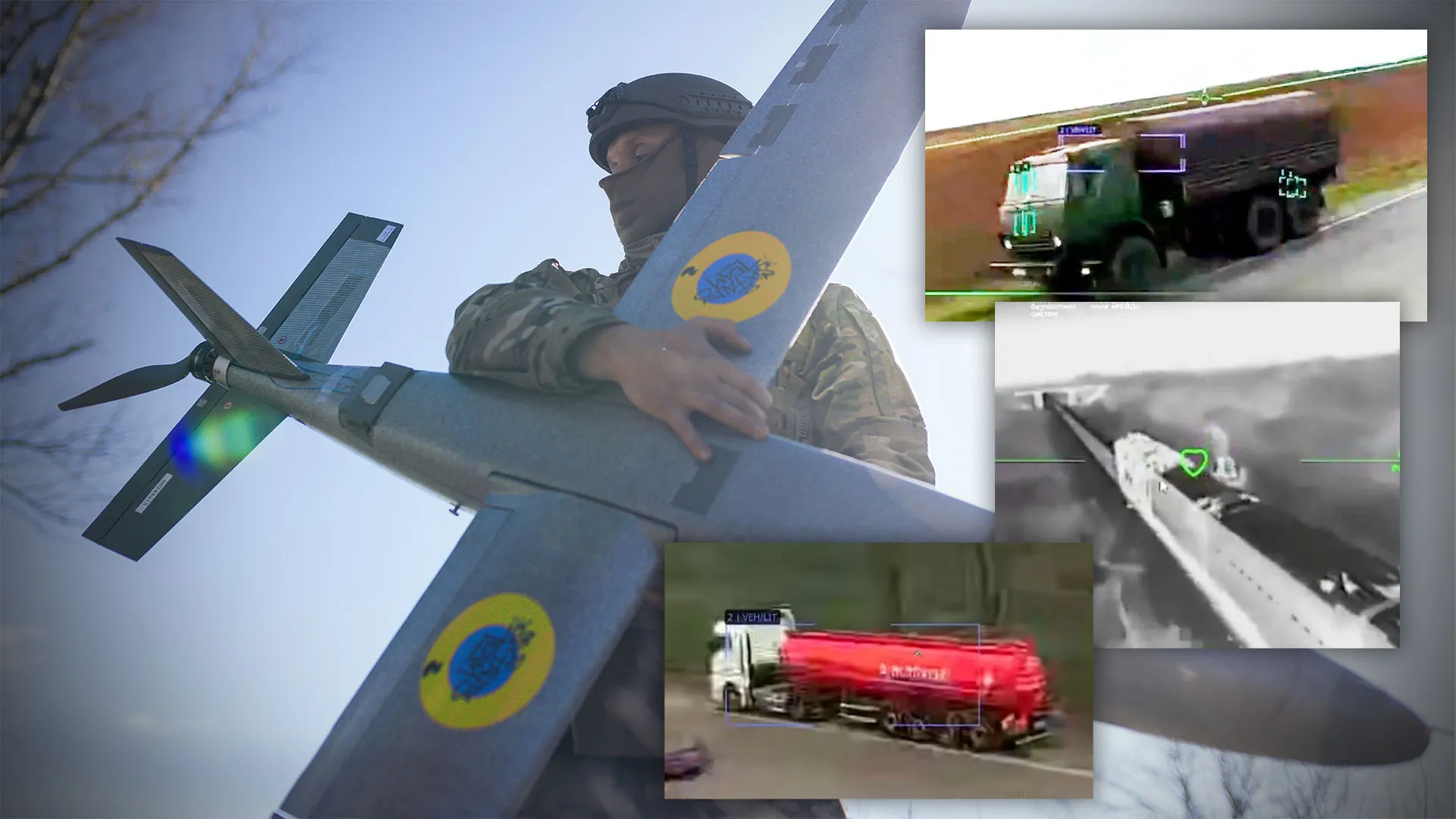
An officer from Ukraine's Azov First Corps has revealed details of a 'medium-range strike campaign' using modified fixed-wing kamikaze drones fitted with Starlink communications, capable of hitting targets up to 250 km deep. Supported by AI-assisted target recognition and terminal guidance, the campaign is systematically destroying Russian fuel trucks, cargo vehicles, and railway trains, severely disrupting Moscow's rear-area logistics.

Highlights
- Ukraine's Azov First Corps has extended the strike range of modified fixed-wing kamikaze drones from 50 km to 250 km by integrating Starlink satellite communications and upgraded engines.
- The 'medium-range strike campaign' targets Russian fuel tankers, cargo trucks, and railway freight trains up to 240 km behind the front line, causing severe fuel shortages in Crimea and other Russian-occupied areas.
- AI serves two functions in the campaign: terminal guidance (last-mile targeting) and autonomous target recognition, enabling multiple drones to strike simultaneously without operator intervention.
- The operation is a pan-Ukrainian effort with different units assigned to specific road corridors; the Azov First Corps monitors supply routes from Rostov-on-Don through Mariupol to Donetsk near Dobropillia in Donetsk Oblast.
- All drone modifications are performed by front-line units; initial tests began in early winter, with combat deployment starting between January and February of this year.
Ukraine's AI-Enhanced Drones Strike Deep Into Russian Rear-Area Supply Lines
Over recent weeks, a series of disclosures has confirmed that Ukraine is deploying modified, AI-enhanced kamikaze drones to strike Russian trucks, fuel tankers, railcars, and even vessels operating as far as approximately 240 km (150 miles) behind the front line. Kyiv refers to the operation as a "medium-range strike campaign", and it is inflicting severe damage on Russian logistics — severing key routes into Crimea, blunting Moscow's offensive momentum, and laying groundwork for future Ukrainian counteroffensives.
Why Strike Deep in the Rear?
An officer from the Unmanned Systems unit of the Azov First Corps, National Guard of Ukraine, gave an exclusive interview explaining the operational rationale. He noted that closer to the front, enemy supplies are highly dispersed — soldiers carry packs, light vehicles operate nearby, and only further back do trucks, articulated lorries, and freight trains appear.
"The deeper we go, the higher the enemy's cargo concentration," the officer said. "Another critical factor is that the further from the front, the larger the area Russia must defend. Air defences are densest within 50 km of the front line; at 300 km depth, covering the entire zone with protective assets becomes impossible."
Crucially, the drones used in these strikes cost roughly the same as tactical-grade assets — the extended operational range is achieved purely through technical modification, with no increase in per-unit weapon cost.
What Drones Are Used, and How Are They Modified?
The officer disclosed that the unit employs fixed-wing, chemically-propelled kamikaze drones, including the US-made Hornet system and the Darts system, among other models. Key modifications include:
- Integration of Starlink satellite communications to maintain the control link at long range
- Upgraded propulsion systems and engines to extend operational range
- Extension of maximum strike range from the original 50 km to up to 250 km
"As time goes on, our strike range will continue to increase," he added.
Notably, all modifications are carried out by front-line units themselves. The Hornet drone has been in service with the unit for nearly a year.
How It Works: A Ukraine-Wide 'Hunter' Operation
This is not a single-unit mission. The officer described it as a "pan-Ukrainian operation" in which different units are assigned responsibility for specific road sections and geographic zones, dispatching drones in a "hunter mode" to patrol designated highways.
Intelligence units supply target prioritization — specifying vehicle types and cargo categories to be engaged. Both AI-assisted tools and manual operator judgment are used in target selection.
The Azov First Corps' area of operations is near Dobropillia in Donetsk Oblast, eastern Ukraine, monitoring supply routes running from Rostov-on-Don through Mariupol to Donetsk.
The Role of AI
Artificial intelligence serves two core functions in this campaign:
- Terminal guidance (last-mile system): Once the drone reaches the target area, AI steers it precisely onto the target.
- Autonomous target recognition: In autonomous flight mode, the drone can independently identify target types and initiate an attack without any operator intervention.
This capability allows multiple drones to be launched simultaneously, increasing the efficiency of coordinated strikes. In footage already made public, one fixed-wing drone is seen conducting reconnaissance while a second carries out the strike — demonstrating a high degree of tactical coordination.
However, the officer stressed that a "man in the loop" principle is currently maintained: "Usually a human makes the final strike decision, because we don't want to become over-reliant on automation."
Battlefield Impact: Severe Russian Fuel Shortages
The campaign has triggered acute fuel shortages for Russian forces. Serious fuel scarcity has been reported in Crimea and in other Russian-occupied areas.
"Fuel is the blood of war," the officer explained. "Russian FPV drone operations require generator fuel; the vehicles delivering FPV drones to the front need fuel too. If we destroy a small car carrying fuel to the front line, we eliminate roughly 40 litres. But if we hit a fuel tanker, we may destroy several tonnes."
When asked whether the campaign is preparing the ground for a Ukrainian counteroffensive in the east or in Zaporizhzhia direction, the officer was careful to note that severing supply lines to Zaporizhzhia Oblast and Crimea is a "by-product" of striking the supply routes within his unit's area of responsibility — and that higher-level strategic assessments are a matter for the Ukrainian General Staff.
Azov Corps' Independent Innovation
The medium-range strike concept was developed independently by the Azov Corps. Initial modification tests began in early winter this year, with combat deployment commencing approximately one month later, between January and February.
The officer highlighted that previous medium-range strike tactics had been designed around expensive, scarce weapons systems. The Azov Corps therefore had to develop entirely new tactics and targeting cycles — replacing high-value, low-quantity assets with low-cost, mass-deployable modified drones.
Communications: Some Details Remain Classified
Regarding Starlink, the officer emphasized that it is only one of several communications systems the unit employs; other solutions remain classified because no drone of this type has yet been captured by Russian forces. On the question of whether SpaceX authorization is required, he noted that matters of international cooperation are handled at the governmental level and fall outside his remit.
原文來源: 查看原文