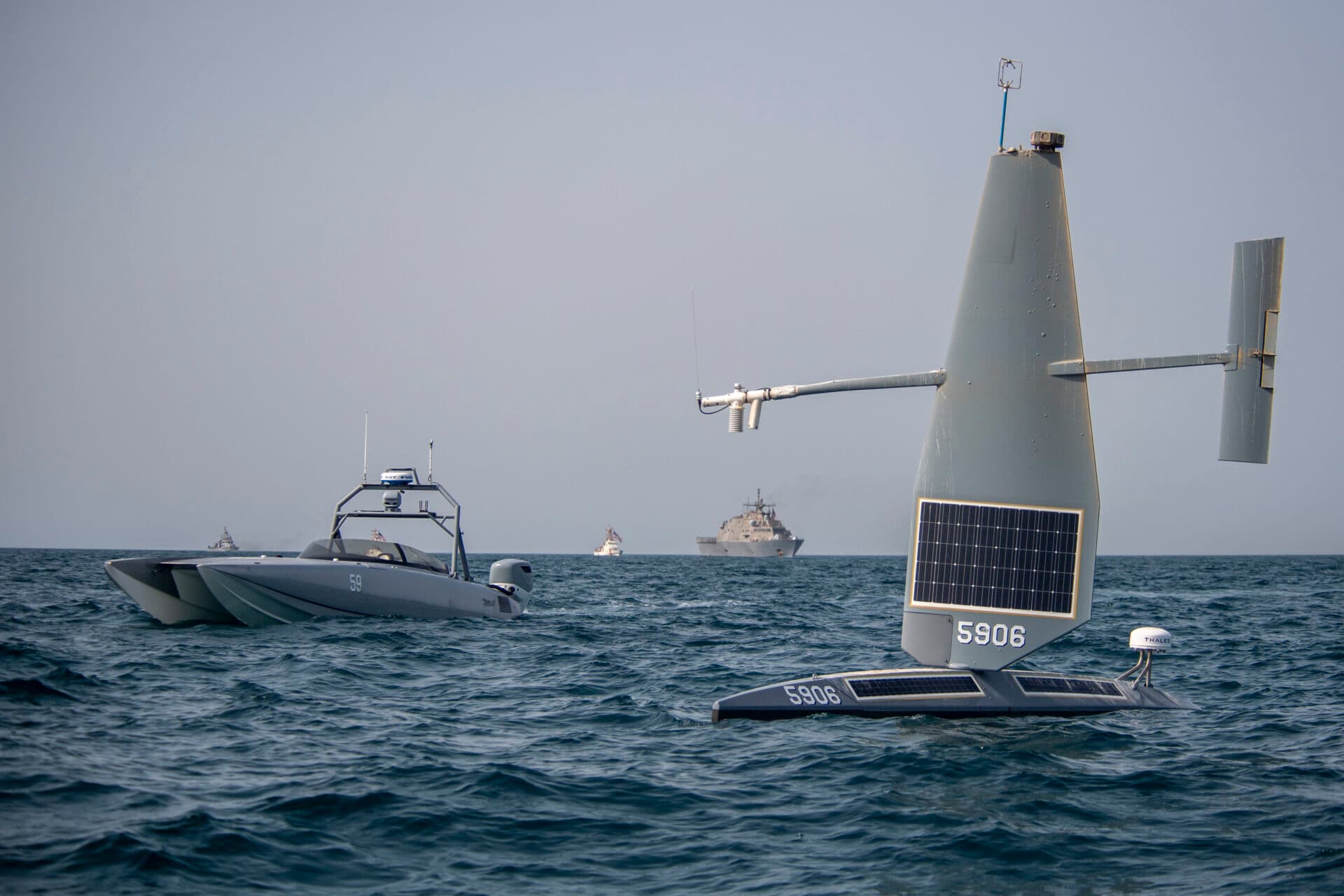
US Navy Surface Drone Rescues Two Apache Crew Members After Crash Off Oman — A First in Combat SAR Operations
On June 8, 2026, a U.S. Army AH-64 Apache attack helicopter crashed into the sea off Oman during a patrol. A U.S. Navy unmanned surface vessel (USV) located and recovered both crew members within approximately two hours — marking the first time an autonomous surface drone has performed a personnel rescue in a real-world combat scenario.

Highlights
- On June 8, 2026, a U.S. Navy unmanned surface vessel (USV) rescued two U.S. Army AH-64 Apache crew members from the sea off Oman within approximately two hours — the first combat SAR mission completed by an autonomous surface drone.
- The rescue operation was led by U.S. Naval Forces Central Command and the 82nd Airborne Division, with Task Force 59, a Bahrain-based unmanned maritime unit under U.S. Fifth Fleet, providing critical support.
- The downed AH-64 Apache is the first such aircraft lost during Operation Epic Fury, a U.S. military operation against Iran that began on February 28, 2026.
- Since Operation Epic Fury began, U.S. forces have suffered multiple aviation incidents, including three F-15E crashes over Kuwait on March 2, 2026, and the disappearance of a KC-135 tanker over western Iraq on March 12, 2026.
- The successful USV-led rescue highlights the expanding operational role of unmanned systems in contested maritime environments, particularly for search-and-rescue missions.
US Navy Unmanned Surface Vessel Rescues Apache Crew in Historic First
U.S. Central Command (CENTCOM) confirmed that on June 8, 2026, a U.S. Army AH-64 Apache attack helicopter went down in the sea off the coast of Oman while on patrol. Both crew members were successfully recovered within approximately two hours of the crash.
According to CENTCOM, the crew members were rescued at 19:33 EDT on June 8, 2026 — roughly two hours after the helicopter entered the water.
In a significant milestone, a U.S. Navy unmanned surface vessel (USV) located the crew members on the water's surface and carried out the rescue, returning both individuals to shore. The operation is widely regarded as the first confirmed instance of an autonomous surface drone successfully completing a personnel search-and-rescue (SAR) mission in a combat environment.
Multi-Unit Joint Rescue Operation
The rescue was led jointly by U.S. Naval Forces Central Command and the U.S. Army's 82nd Airborne Division, with support from multiple U.S. Air Force and Navy units. Among the key contributors was Task Force 59, a Bahrain-based naval task force under U.S. Fifth Fleet that specializes in unmanned and autonomous maritime systems.
First Apache Loss During Operation Epic Fury
The downed Apache is the first of its type lost during Operation Epic Fury, which commenced on February 28, 2026, in connection with U.S. military operations against Iran. U.S. Army rotary-wing assets have been deployed around the Gulf of Oman and the Strait of Hormuz in support of maritime interdiction missions.
Since the operation began, U.S. forces have experienced several aviation incidents:
- March 2, 2026: Three U.S. Air Force F-15E Strike Eagles crashed over Kuwait in what is suspected to have been a friendly-fire incident.
- March 12, 2026: A U.S. Air Force KC-135 tanker aircraft disappeared over western Iraq; CENTCOM classified the event as a non-combat incident.
The successful USV rescue underscores the growing role of unmanned systems in modern maritime operations — particularly their potential to conduct search-and-rescue missions in contested or hazardous environments where manned vessels may face greater risk.
Source: AeroTime
原文來源: 查看原文