The Physics of Launching a Drone Inside a Moving Vehicle: How Inertia Keeps It in Sync
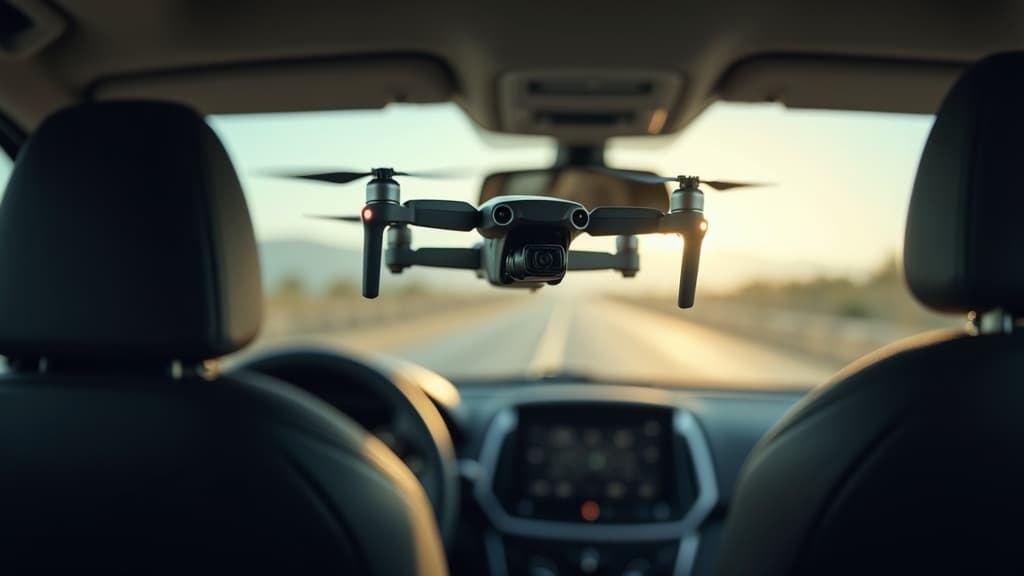
When a drone takes off inside a moving vehicle, it, the cabin air, and the vehicle form a single inertial system. Because the drone already shares the vehicle's horizontal velocity before liftoff, Newton's First Law means no additional thrust is needed to keep it in sync — a principle with practical implications for drone operations on moving platforms.

Highlights
- Before liftoff inside a moving vehicle, a drone already shares the vehicle's horizontal velocity, making it part of the same inertial system.
- Newton's First Law means the airborne drone requires zero additional horizontal thrust to remain synchronized with the moving vehicle in a closed cabin.
- Inside a closed vehicle cabin, aerodynamic drag on the drone is negligible, allowing inertia alone to maintain horizontal velocity after takeoff.
- This inertial principle applies fully only in closed or semi-enclosed environments; open-air launches from moving platforms require compensation for external airflow.
- Understanding inertial system dynamics has direct practical value for planning drone takeoffs and landings on moving platforms such as cars, ships, and mobile launch vehicles.
The Physics Behind Flying a Drone Inside a Moving Vehicle
A discussion about drones taking off inside moving vehicles has drawn renewed attention to a fundamental principle of classical mechanics. What looks like a simple party trick is, in fact, an elegant demonstration of Newton's Law of Inertia.
Before Liftoff: Matched Velocity
Before the drone leaves the ground, it is at rest relative to the vehicle's interior — meaning it already shares the same horizontal velocity as the vehicle itself. This is the critical starting point for understanding the whole phenomenon. The drone is not transitioning from a stationary state into a moving environment; it has been part of that moving system from the very beginning.
After Liftoff: An Inertial System in Action
Once the drone becomes airborne, the drone, the air inside the cabin, and the moving vehicle can all be treated as a single system. According to Newton's First Law of Motion, an object in motion stays in motion unless acted upon by an external force. In the horizontal direction, no additional thrust is required for the drone to remain perfectly in sync with the vehicle.
This is because the drone carries the same horizontal momentum it had before takeoff. Inside a closed cabin, the effect of aerodynamic drag is negligible, so without any significant external horizontal force, the drone naturally maintains its original horizontal velocity through inertia alone.
Practical Implications for Drone Operations
This physical principle has real-world relevance for drone takeoff and landing operations on moving platforms. Whether launching from a moving car, a vessel at sea, or another mobile platform, understanding how inertial systems work helps operators plan flight missions more effectively and ensures safer, more stable takeoff and landing sequences.
It is worth noting, however, that this principle applies fully only in closed or semi-enclosed environments. When a drone takes off from a moving platform in an open environment, external airflow and wind shear must be factored in, as they can significantly affect flight stability.
原文來源: 查看原文