Russian Engineers Patent New C-UAS System Using Active Kinetic Protection to Intercept Drones at Close Range
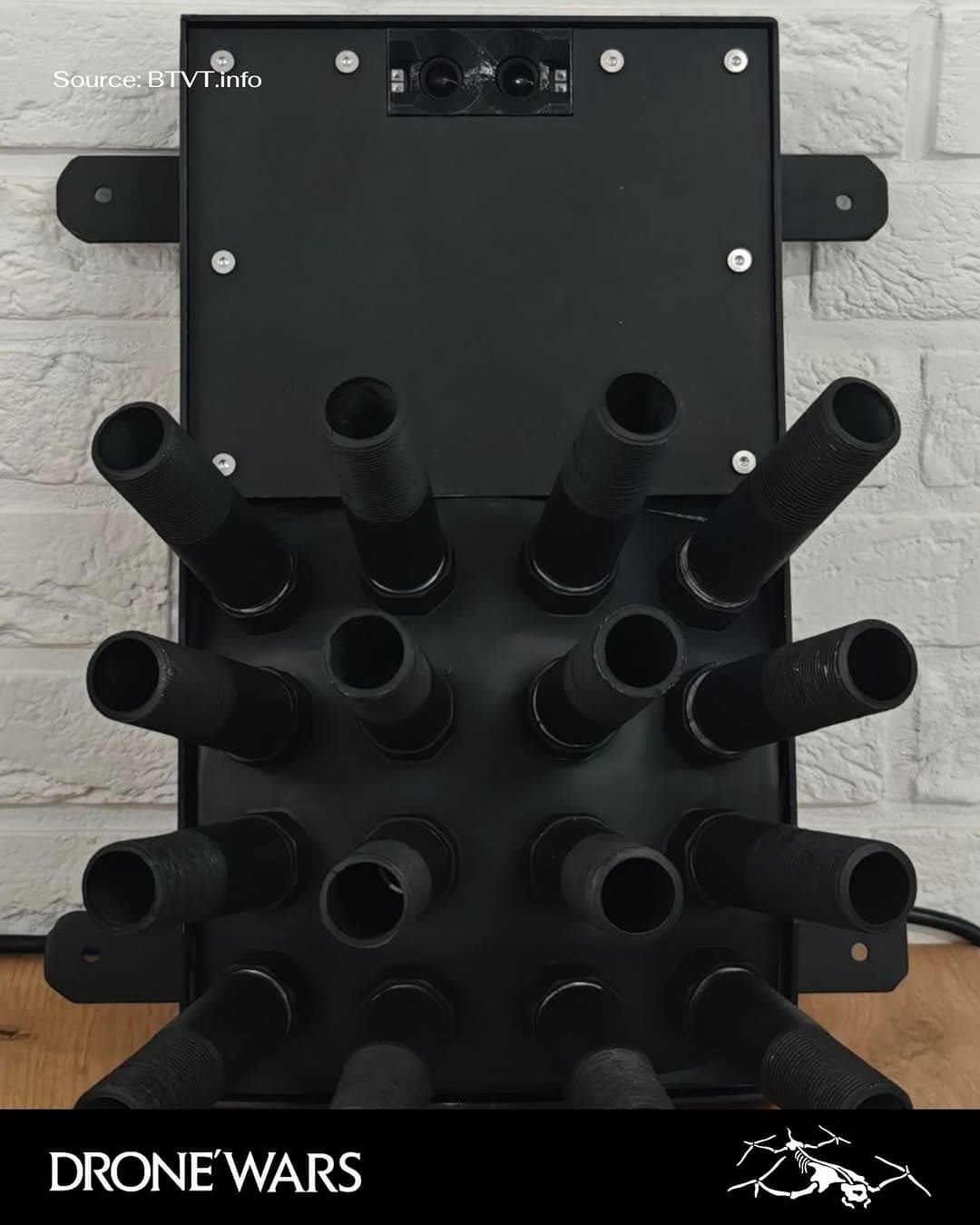
Russian engineers have patented a new counter-UAS (C-UAS) system featuring an active kinetic protection mechanism designed to destroy incoming drones at close range. The system uses a multi-barrel launcher mounted on a curved housing and a stereo camera to automatically detect, locate, and engage targets using 12-gauge shotgun cartridges. It is primarily designed for vehicle-mounted deployment.

Highlights
- Russian engineers have patented a close-range C-UAS system that uses 12-gauge shotgun cartridges loaded into multiple launch tubes mounted on a curved housing.
- A stereo camera feeds real-time imagery to a control unit that calculates the drone's 3D position and automatically selects the optimal tube for engagement without human input.
- The system supports both mechanical and electrical firing modes and is designed primarily for vehicle-mounted deployment, powered by the host vehicle or an onboard battery.
- Compared to jamming and laser-based soft-kill systems, the kinetic approach offers lower cost and greater resilience against electronic countermeasures.
- The patent publication reflects Russia's ongoing R&D investment in counter-drone technology amid growing battlefield use of unmanned systems.
Russian Engineers Patent New C-UAS System Using Active Kinetic Protection to Intercept Drones at Close Range
Russian engineers have been granted a patent for a new counter-unmanned aerial system (C-UAS) that employs an active kinetic protection mechanism specifically designed to intercept and destroy incoming drones at close range.
System Architecture
According to the patent description, the system consists of a curved housing fitted with multiple launch tubes oriented in different directions, covering a range of horizontal and vertical angles. Each tube can be loaded with a 12-gauge shotgun cartridge and supports both mechanical and electrical firing modes.
Automated Target Detection and Engagement Logic
At the heart of the system is a stereo (binocular) camera that continuously scans the surrounding airspace and feeds image data to a control unit. The control unit analyzes the imagery and calculates the three-dimensional position of any target drone. Once a drone is detected within engagement range, the system automatically selects the optimal launch tube and fires the corresponding cartridge — entirely without human intervention.
As stated in the patent:
"The stereo camera enables precise target localization, allowing the system to determine which launch tube provides the best firing solution against an approaching drone."
Deployment
The device is primarily designed to be installed on protected assets, with vehicle-mounted platforms as the main use case. It can draw power directly from the host vehicle or operate independently using a built-in battery.
Background and Analysis
The publication of this patent reflects Russia's continued investment in counter-drone technology. Compared to soft-kill approaches such as electronic warfare jamming or laser systems, ammunition-based kinetic solutions carry a lower cost threshold and offer greater resilience against electronic countermeasures, giving them a practical edge in battlefield applications.
Source: BTVT.info
原文來源: 查看原文
FAQ
Newsletter
Subscribe to our Low-Altitude Industry Newsletter
Daily curated news on low-altitude economy and drone industry, delivered to your inbox.