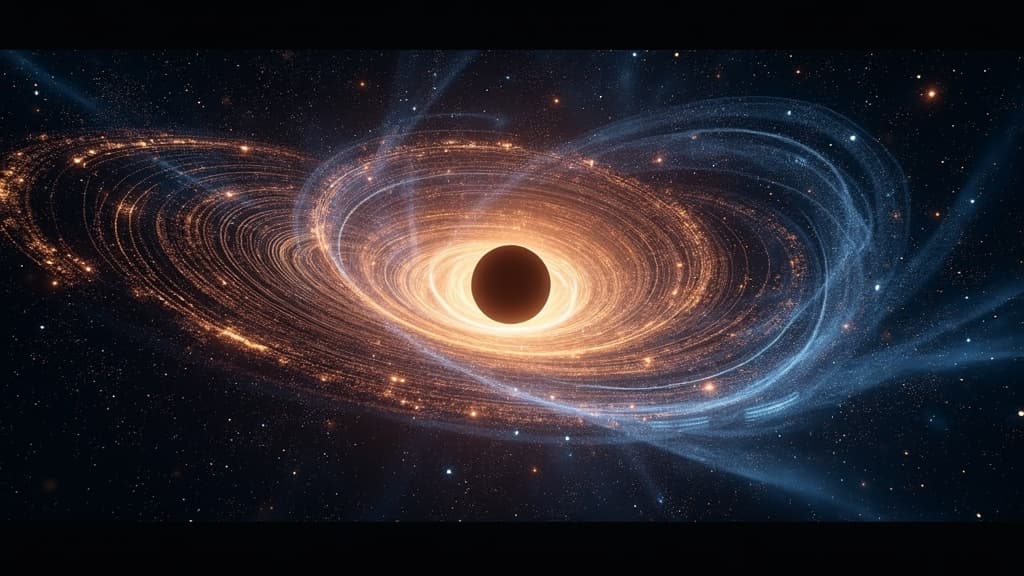
Gravitational Wave 'Fingerprint' of a Black Hole Event Horizon Detected for the First Time
An international research team has announced the first-ever detection of gravitational wave 'fingerprints' left by a black hole event horizon, published in Nature. Analyzing the strongest gravitational wave event on record, GW250114, the findings support Einstein's general theory of relativity and open pathways to studying frame dragging and quantum fluctuations near black holes.

Highlights
- An international research team detected gravitational wave 'fingerprints' from a black hole event horizon for the first time, with findings published in Nature.
- The discovery was made by analyzing GW250114, the most powerful gravitational wave event ever recorded, at the moment of final merger.
- The findings provide new empirical support for Einstein's general theory of relativity.
- Future applications of the technique may include detecting frame dragging effects and quantum fluctuations near black holes.
Gravitational Wave 'Fingerprint' of a Black Hole Event Horizon Detected for the First Time
Editor's note: This article covers astrophysics and gravitational wave research. It has limited direct relevance to the drone industry. For the latest drone and aviation technology news, please continue to follow our coverage.
An international research team has announced the first successful detection of gravitational wave "fingerprints" imprinted by a black hole's event horizon — a breakthrough published in the leading academic journal Nature.
Analyzing the Strongest Gravitational Wave Event on Record
Researchers conducted an in-depth analysis of GW250114, the most powerful gravitational wave event ever recorded, focusing on the signal characteristics produced at the precise moment two compact objects underwent their final merger. Embedded within those signals were distinctive "fingerprints" unique to the black hole event horizon — information that had never previously been identified in observational data.
Support for General Relativity
The discovery provides new empirical support for Einstein's general theory of relativity. The event horizon is the critical boundary surrounding a black hole beyond which no matter or light can escape its gravitational pull. Successfully identifying event horizon characteristics within a gravitational wave signal marks a significant step forward in humanity's understanding of black hole physics.
Future Research Prospects
The researchers indicate that this technique could, in the future, be applied to investigate two important physical phenomena near black holes:
- Frame Dragging: The way a rotating black hole drags the surrounding spacetime fabric
- Quantum Fluctuations: Quantum effects arising in the extreme environment near the event horizon
The findings were first reported by Phys.org, with full research details published in Nature.
原文來源: 查看原文
FAQ
Newsletter
Subscribe to our Low-Altitude Industry Newsletter
Daily curated news on low-altitude economy and drone industry, delivered to your inbox.