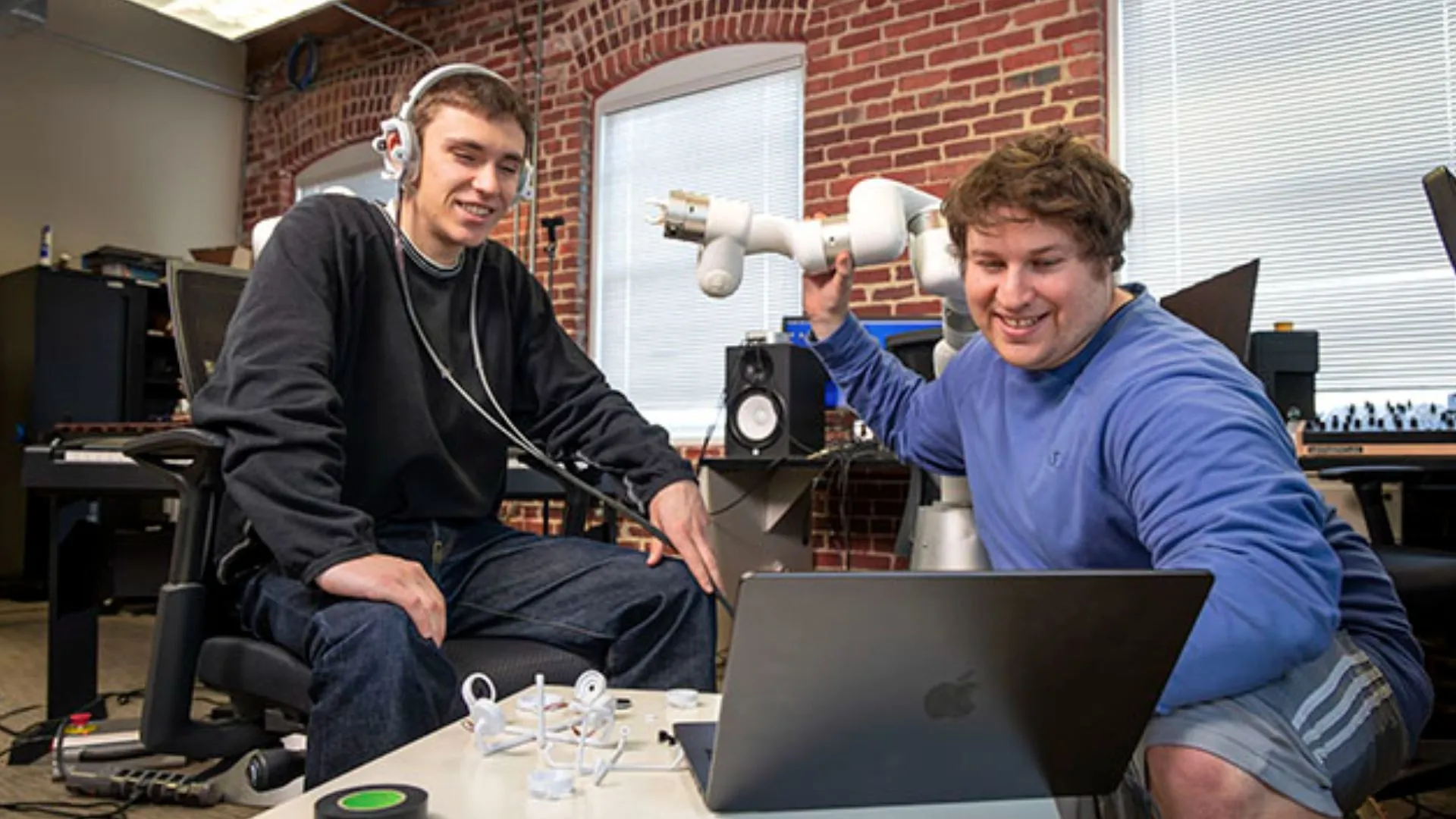
Georgia Tech Develops 'Spherephones' Wearable That Turns Robot Movements Into Warning Music
Researchers at Georgia Tech's Center for Music Technology have developed Spherephones, a wearable audio system that converts nearby robot movements into dynamic alert music inspired by horror film soundtracks. The open-ear headset features four speakers around each ear to create a 3D spatial soundscape, enabling workers to track robot position, direction, and arrival time without interrupting their tasks — improving safety in human-robot shared workspaces.

Highlights
- Georgia Tech's Robotic Musicianship Group developed Spherephones, a wearable headset that converts nearby robot movements into real-time Lo-Fi alert music.
- Each Spherephones unit features four speakers per ear (front, back, above, below), enabling full 3D spatial sound localization that standard headphones cannot replicate.
- The system communicates a robot's position, direction, and estimated time of arrival without requiring workers to stop their tasks or look away.
- Early prototypes used fixed wall-mounted speakers, but the design was shifted to a personal wearable to prevent workers from receiving each other's irrelevant audio alerts.
- Georgia Tech researchers have also tested Spherephones in VR environments, with participants reacting instinctively to behind-the-head audio cues absent any visual trigger.
Georgia Tech Develops 'Spherephones' Wearable That Turns Robot Movements Into Warning Music
Researchers at Georgia Tech have developed a wearable audio system that translates nearby robot movements into dynamic warning sounds, alerting workers to potential hazards before incidents occur. Inspired by the tension-building techniques used in horror film scores, the system is designed to improve situational awareness in human-robot collaborative work environments and reduce workplace accidents.
Making Robots 'Sound' Safer
The wearable audio system, called Spherephones, converts the movements of nearby robots into dynamic alert music, helping workers stay informed about robot activity without interrupting their tasks. The device was developed by the Robotic Musicianship Group led by Gil Weinberg at the Georgia Tech Center for Music Technology.
Unlike conventional alarm systems, Spherephones uses computer-generated music to communicate a robot's position, direction of travel, and estimated time of arrival. The researchers note that traditional alarms can attract attention but often fail to convey sufficient contextual information about a hazard. Repeated exposure to the same alarm sounds can also cause workers to become desensitized and ignore them over time. Spherephones instead delivers continuous audio cues that function as background music, allowing workers to maintain focus on their tasks.
An Immersive Approach to Robot Awareness
The wearable device uses open-ear headphones with four speakers positioned around each ear — front, back, above, and below — to generate a three-dimensional spatial soundscape. This configuration allows users to perceive the direction of a robot's movement relative to their own position. The speakers located below the ear enable vertical sound localization, a capability that conventional headphones cannot provide.
As a robot approaches, the system generates a melody that evolves over time. Users can gauge the robot's distance and anticipate its arrival simply by listening to how the music progresses, without needing to look up from their work. In initial testing, participants performed assembly and sorting tasks while naturally responding to changing audio cues.
The music itself is presented in a Lo-Fi style commonly associated with ambient study playlists. According to the researchers, the audio not only conveys the robot's direction but also signals whether it poses a potential hazard, creating an intuitive mode of human-robot interaction.
An earlier concept used speakers fixed to the walls of the workspace, but this caused all workers to hear each other's alert sounds simultaneously — creating confusion in busy environments. To address this, the team redesigned the system as a personal wearable, so each worker receives only the audio information relevant to their own proximity to nearby robots.
Potential Applications in VR and Gaming
Beyond industrial settings, the researchers believe the technology has strong potential in virtual reality (VR) and gaming. The team has already tested Spherephones in VR environments, where participants instinctively reacted to sounds coming from behind them even when no visual object was present.
Unlike conventional gaming headsets that primarily distinguish audio using left and right channels, Spherephones can reproduce sounds from above, below, behind, and in front of the listener. The open-ear design also keeps wearers aware of their real-world surroundings, offering potential advantages in both immersive entertainment and live safety applications.
In a related development, Italian researchers recently unveiled a wearable robotic exoskeleton that delivers real-time haptic feedback to help musicians improve synchronization, coordination, and rhythm during ensemble performances — highlighting the growing breadth of innovation in wearable robotics across multiple fields.
原文來源: 查看原文
FAQ
Newsletter
Subscribe to our Low-Altitude Industry Newsletter
Daily curated news on low-altitude economy and drone industry, delivered to your inbox.