Biomimetic Robotic Bird May Solve Drones' Biggest Aerodynamic Challenge
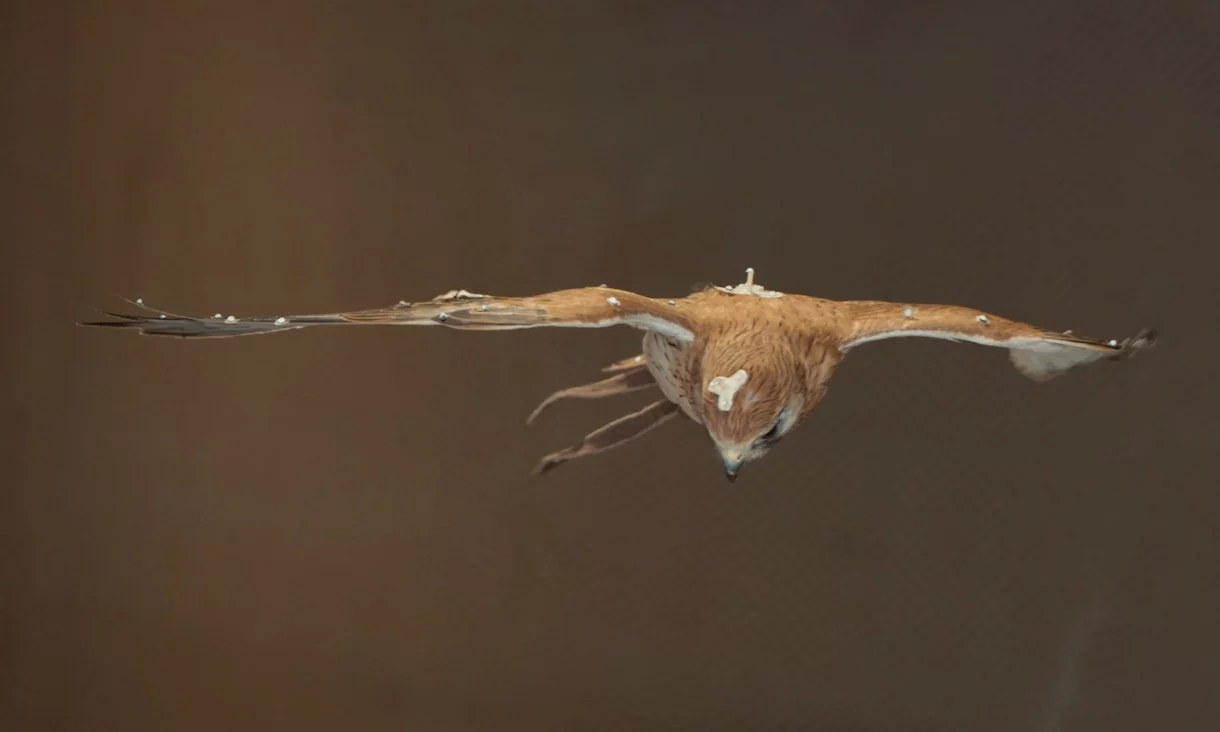
Researchers from RMIT University in Melbourne and the University of Bristol have reverse-engineered the flight mechanics of the Australian kestrel (Falco cenchroides) to understand how the raptor hovers effortlessly in gusty winds. Their biomimetic robotic bird has passed wind tunnel testing, offering a potential blueprint for improving small UAV stability in high-wind conditions.

Highlights
- RMIT University and the University of Bristol jointly reverse-engineered the Australian kestrel (Falco cenchroides) to study its passive aerodynamic hovering mechanism in gusty winds.
- A biomimetic robotic bird modeled on the kestrel's wing structure has completed wind tunnel testing and demonstrated stable performance under simulated gust conditions.
- Current small UAVs rely on electronic control systems to counteract wind disturbances; the kestrel-inspired design aims to achieve natural stability through aerodynamic shape alone.
- Successful integration of biomimetic aerodynamic profiles into UAV platforms could significantly improve drone performance in logistics, infrastructure inspection, and search and rescue missions in adverse weather.
- The research provides both theoretical foundations and physical proof-of-concept for next-generation aerodynamic design in commercial and military small UAVs.
Biomimetic Robotic Bird May Solve Drones' Biggest Aerodynamic Challenge
A biomimetic robotic bird tested inside a wind tunnel may hold the design blueprint that finally allows drones to handle strong and gusty winds with confidence.
Researchers from RMIT University in Melbourne, Australia, and the University of Bristol in the United Kingdom have used reverse-engineering techniques to recreate the flight architecture of the Australian kestrel (Falco cenchroides) — studying how this raptor hovers effortlessly in variable winds and what that capability could mean for small UAVs (sUAVs) that still struggle to cope with strong gusts.
Learning from Nature
The Australian kestrel is renowned for its precise stationary hovering ability, maintaining its aerial position with remarkable accuracy even in turbulent, rapidly changing wind conditions. The research team applied detailed biomimetic engineering methods to analyze the geometric structure of the kestrel's wings, feather arrangement, and the real-time postural adjustments the bird makes in response to varying wind speeds.
The Aerodynamic Bottleneck Facing Drones
Today's small UAVs commonly suffer from flight instability, sudden spikes in power consumption, and even loss of control when encountering unexpected gusts. Conventional multirotor drone designs rely primarily on electronic control systems to counteract wind disturbances, rather than leveraging the vehicle's own aerodynamic shape to achieve natural stability.
The researchers believe the kestrel's wing structure allows it to respond passively to changes in airflow — settling into a stable hover naturally, without requiring extensive active control intervention. If this characteristic can be transferred to drone design, it could significantly improve both flight efficiency and wind resistance.
Wind Tunnel Validation
The biomimetic robotic bird constructed by the team has successfully completed wind tunnel experiments, providing initial validation that wing structures modeled on the kestrel's aerodynamic principles deliver stable performance in simulated gusty environments. The findings offer both a strong theoretical foundation and physical proof-of-concept for next-generation aerodynamic design in small UAVs.
Looking Ahead
This international collaborative research not only deepens our understanding of raptor flight mechanics but also opens new design possibilities for both commercial and military drones. Should biomimetic aerodynamic profiles be successfully integrated into existing UAV platforms, drones operating in adverse weather conditions — whether for logistics delivery, aerial inspection, or search and rescue missions — could see a significant improvement in their ability to handle challenging environments.
原文來源: 查看原文
FAQ
Newsletter
Subscribe to our Low-Altitude Industry Newsletter
Daily curated news on low-altitude economy and drone industry, delivered to your inbox.