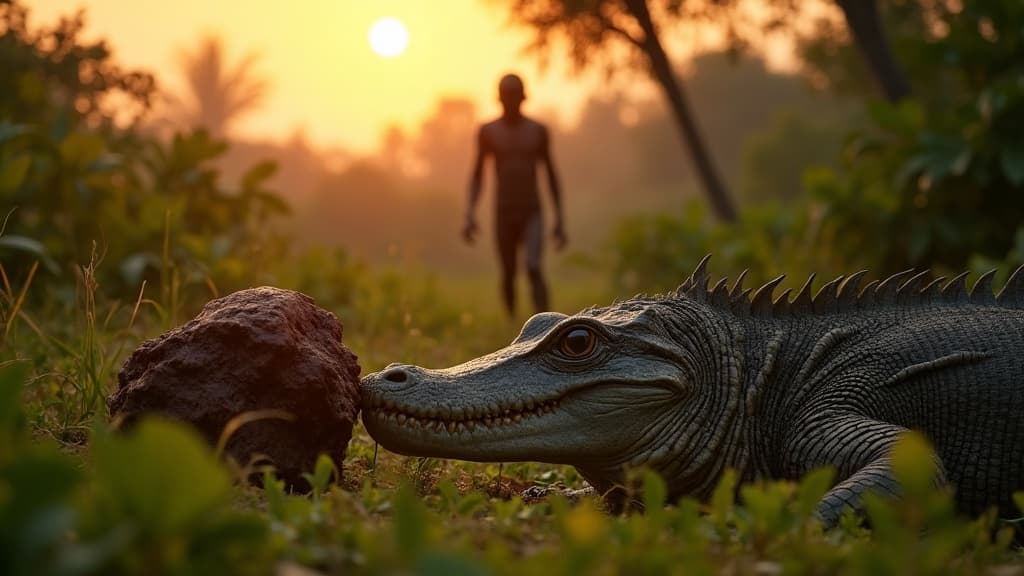
The 'Hobbit' Hominin May Have Survived by Scavenging Komodo Dragon Kills
New research suggests Homo floresiensis — the prehistoric human relative nicknamed the 'Hobbit' for its small stature — may not have been a skilled hunter or fire-user, but instead survived by scavenging leftover prey from Komodo dragons. The study indicates the species had a brain only slightly larger than a chimpanzee's, suggesting a far lower level of cognitive evolution than previously assumed.

Highlights
- New research proposes that Homo floresiensis ('Hobbit') survived by scavenging carcasses left by Komodo dragons rather than by active hunting.
- The species' brain volume was only marginally larger than a chimpanzee's, suggesting cognitive abilities far below what scientists previously assumed.
- Researchers believe Homo floresiensis followed Komodo dragons and fed on the remains of the reptiles' kills, similar to how Komodo dragons ambush and wait for water buffalo to die.
- The findings significantly challenge and reframe Homo floresiensis's position in the human evolutionary timeline.
The 'Hobbit' Hominin May Have Survived by Scavenging Komodo Dragon Kills
New research is challenging long-held assumptions about Homo floresiensis — the diminutive prehistoric human relative popularly nicknamed the 'Hobbit' — suggesting it may not have been a skilled hunter or capable of making fire, but instead relied on scavenging carcasses left behind by other predators.
As reported by CNN, the findings add to a growing body of evidence indicating that Homo floresiensis was far less cognitively advanced than scientists had previously believed. Researchers note that the species' brain volume was only marginally larger than that of a chimpanzee, pointing to a survival strategy rooted in opportunistic scavenging rather than active hunting.
The research team proposes that Homo floresiensis may have followed Komodo dragons — much as the giant lizards hunt buffalo today by biting them and waiting for the prey to succumb to its wounds — and then moved in to feed on the remains of the reptiles' unfinished kills. This would have provided a relatively accessible food source for a hominin with limited predatory capabilities.
The findings carry significant implications for reassessing the place of Homo floresiensis in the human evolutionary timeline, prompting a broader reconsideration of this enigmatic ancient species.
Source: Slashdot / CNN
原文來源: 查看原文
FAQ
Newsletter
Subscribe to our Low-Altitude Industry Newsletter
Daily curated news on low-altitude economy and drone industry, delivered to your inbox.