Safe Drone Airspace Integration: Why 'Visibility' Alone Is Not Enough
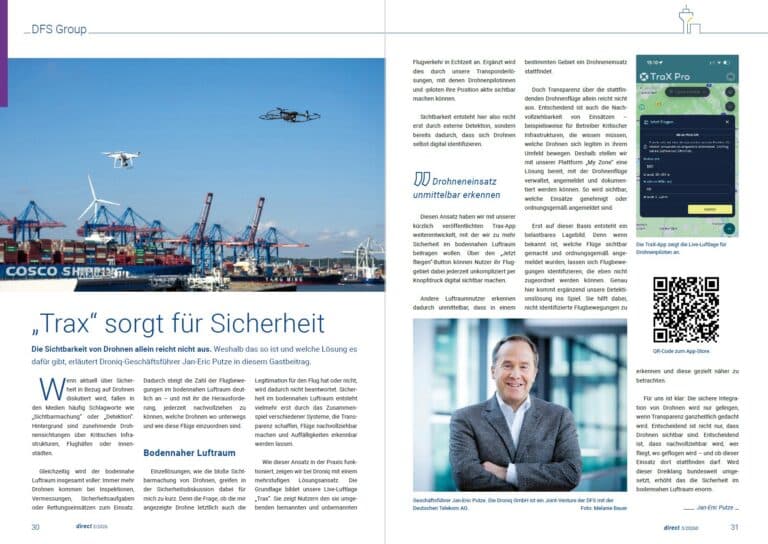
German drone services provider Droniq has published a guest commentary in the DFS (German Air Navigation Services) magazine 'direct', arguing that simply detecting a drone's presence is insufficient for reliable airspace situational awareness. Droniq contends that true safe integration requires three pillars working in concert: real-time digital visibility, flight transparency, and traceable mission records — all supported by its TraX App and MyZone platform.

Highlights
- Droniq published a guest commentary in DFS magazine 'direct' arguing that drone detection alone is insufficient for reliable airspace situational awareness.
- Safe drone airspace integration requires three pillars: real-time digital visibility, transparency on who is flying and where, and traceable mission records.
- Droniq's TraX App enables pilots to actively self-declare their missions digitally via a 'Fly Now' button, moving beyond passive external detection.
- The MyZone platform allows drone missions to be managed, declared, and archived, producing a structured and auditable airspace situational awareness picture.
- When authorised flights are digitally declared in advance, detection systems can more precisely flag and prioritise unidentified flight activity as potential risks.
Droniq Publishes Guest Commentary in DFS Magazine 'direct'
The integration of drones into shared airspace continues to accelerate, bringing with it heightened demands for safety, transparency, and traceability. Yet even as drone detection technology advances, one fundamental question is becoming increasingly clear: detecting a drone is not enough to establish reliable airspace situational awareness.
Only a holistic approach — one that consolidates all relevant information and places it in context — can truly deliver results.
From 'Seeing' to 'Understanding': Why Detection Technology Falls Short
Detection solutions undeniably contribute to airspace safety — they make flight activity visible and show that a drone is operating in a given area. But that is precisely where the limitation lies: not every detected drone represents a risk.
Context is what matters:
- Is this a declared and authorised mission?
- Who is responsible for this flight?
- Is the operation being conducted within the approved parameters?
Without this information, operators are left with only a fragmented picture — not genuine situational awareness.
Transparency: The Core of Safe Drone Integration
Reliable airspace situational awareness requires three elements working in tandem:
- Real-time digital visibility: a live picture of drone flight activity
- Transparency: a clear picture of who is flying, when, and where
- Traceability: an audit trail built from documented and categorised missions
Only when all three work together can flight activity be assessed correctly — and legitimate operations distinguished from potentially hazardous behaviour.
The Core Tool: TraX App
Droniq's TraX App was designed precisely to address these needs.
The app enables drone pilots to view the current airspace picture while actively broadcasting their own mission details digitally. Via a 'Fly Now' button, pilots can quickly and intuitively declare their operating area.
This delivers a critical benefit: drone flights are no longer solely reliant on passive detection by external systems — pilots themselves actively complete their own digital identification.
Other airspace users can instantly see:
- Whether a drone mission is underway
- Where that mission is taking place
- How long the mission remains active
From Visible to Traceable: Structured Mission Classification
Visibility alone, however, does not constitute a complete safety solution. Droniq therefore complements the TraX App with its MyZone platform.
Within this platform, drone missions can be:
- Managed
- Declared
- Archived
This means that which missions are legitimate and properly authorised is clearly documented at all times.
The result: a structured, dependable airspace situational awareness picture in which all identifiable flight activity can be unambiguously categorised.
The Role of Detection Systems in the Broader Architecture
Only once this foundation is in place can detection solutions fully deliver on their value.
When it is already known which flights are legitimate and digitally declared, unidentified flight activity can be flagged precisely and prioritised for review and assessment.
Detection technology is therefore not displaced — rather, it is meaningfully complemented and enabled to operate with far greater precision.
Conclusion: Comprehensive Transparency Is the Cornerstone of Safety
The safe integration of drones into airspace is only achievable when transparency is fully implemented.
What matters is not simply:
- Whether a drone is visible
But, more critically:
- Who is flying
- Where they are flying
- And whether the mission is authorised
Only when these elements work together does trustworthy situational awareness emerge — laying the groundwork for safe, scalable drone operations.
This article was originally published on the Droniq website as a guest commentary contributed to DFS magazine 'direct'.
View the latest issue of 'direct'
原文來源: 查看原文
FAQ
Newsletter
Subscribe to our Low-Altitude Industry Newsletter
Daily curated news on low-altitude economy and drone industry, delivered to your inbox.
Reviewed and published by the LAETimes editorial desk ·