Germany's Cobra 600 Jet-Powered Interceptor Drone Debuts at ILA Berlin: Extends Air Defence Range to 400 km with IRIS-T Missiles
Diehl Defence unveiled the Cobra 600 drone at ILA Berlin 2025, combining a jet-powered flying-wing platform with IRIS-T missiles to serve as a 'missile taxi' for ground-based air defence systems. The system can extend the effective intercept range from 40 km to approximately 400 km, offering a cost-effective solution to modern air defence challenges exposed by conflicts in Ukraine and the Middle East.

Highlights
- Diehl Defence於2025年ILA柏林航展首度公開Cobra 600無人機,搭載IRIS-T飛彈,作戰半徑約400公里。
- Cobra 600採用Polaris Raumflugzeuge飛翼平台,搭載兩具JetCat P1000-PRO渦噴引擎,並預留四發動機構型。
- 無人機透過資料鏈與地面IRIS-T SLM/SLS系統連結,由地面操作員遙控引導並下達飛彈發射指令。
- Cobra 600已完成掛載模擬飛彈的首批飛行測試,至少一個國家已投入研發資金。
- 與IRIS-T SLM地面發射40公里射程相比,Cobra 600將有效攔截距離延伸約10倍,並可整合至其他地面、空中或海上防空系統。
Germany Publicly Unveils Cobra 600 Jet-Powered Interceptor Drone
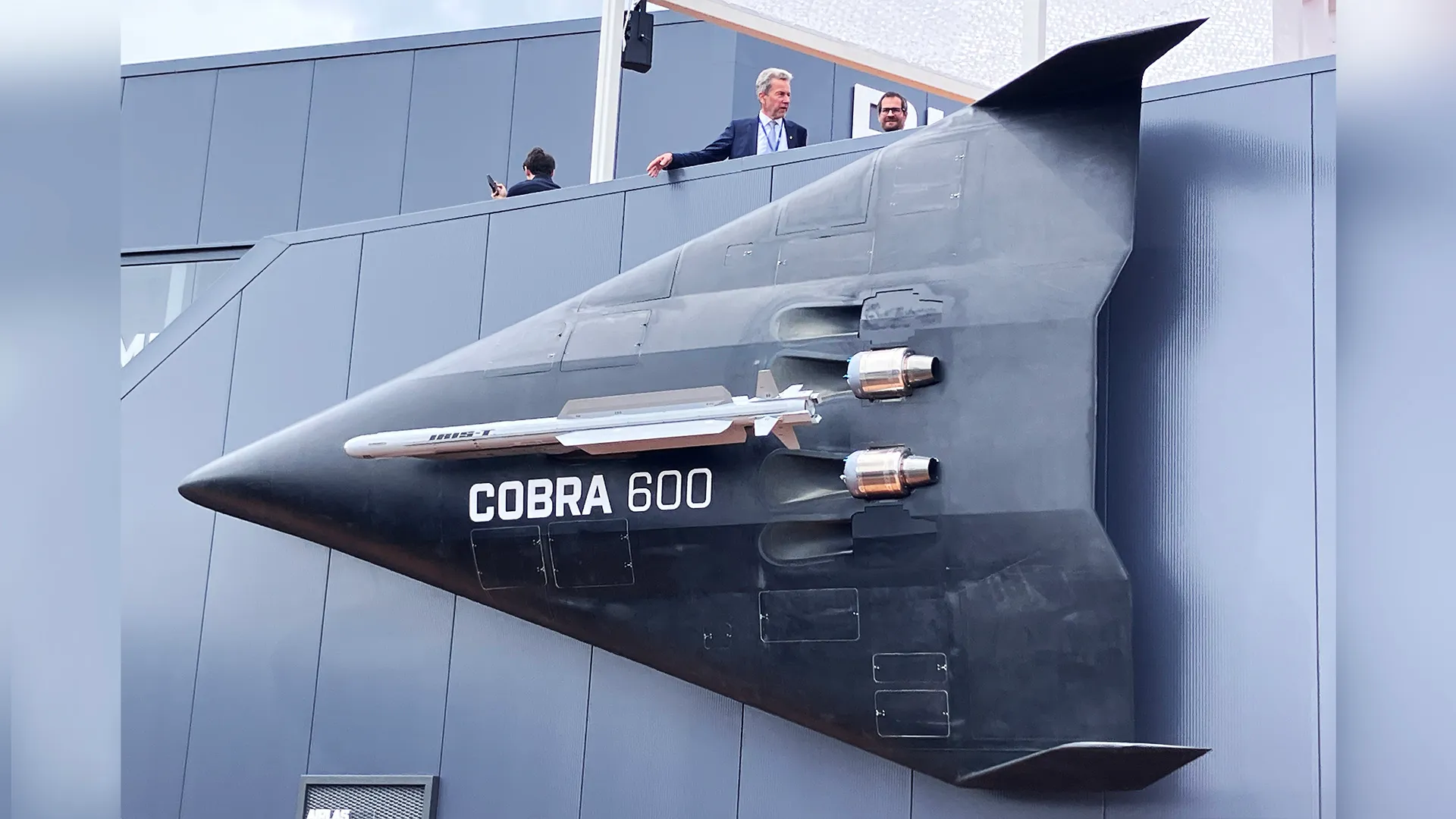
German weapons manufacturer Diehl Defence publicly showcased a new drone-based air defence system — the Cobra 600 — for the first time at this week's ILA Berlin Air Show. The previously unseen unmanned aircraft combines a jet-powered platform with an IRIS-T missile pylon, designed to dramatically extend the operational reach of ground-based air defence systems.
Also known as the AirLAS (Airborne Launch and Attack System), the programme was formally initiated last year.
The 'Missile Taxi' Concept
The core concept behind the Cobra 600 is to act as a 'missile taxi' — an unmanned platform that carries an IRIS-T missile over considerable distances while maintaining a data-link connection with a ground-based air defence system. It is primarily paired with Diehl's own IRIS-T SLM or IRIS-T SLS systems. The missile carried by the Cobra 600 is the same as the air-to-air variant used by the IRIS-T SLS. The physical interface between the drone and the missile uses the same standard pylon found on the Eurofighter.
With a missile onboard, the Cobra 600 has a range of approximately 400 km (250 miles) — compared to roughly 40 km for the IRIS-T SLM's ground-launched missile and just 13 km for the IRIS-T SLS. This means the Cobra 600 has the potential to transform a ground-based IRIS-T system into something functionally equivalent to a long-range surface-to-air missile.
Platform Design
The unmanned platform is supplied by German aerospace start-up Polaris Raumflugzeuge, and adopts an aerodynamically efficient delta-wing layout similar to Iran's Shahed-136, combined with a refined flying-wing design featuring tip-mounted endplate vertical stabilisers.
The exhibited version is fitted with two JetCat P1000-PRO micro turbojet engines, each capable of producing a maximum of 20 lbf (approximately 89 N) of thrust. The airframe, however, incorporates intake provisions for two additional engines. Concept imagery released by Polaris depicts a four-engine configuration, with turbojets buried within the fuselage and longer intake ducts to help reduce radar detectability.
The Cobra 600 is also equipped with retractable tricycle landing gear, indicating it is intended to be reusable in certain scenarios. The drone can operate from conventional runways, short temporary airstrips, or even public roads. Its unit cost has also been deliberately kept low enough that commanders would accept the risk of losing it in combat.
Operational Employment
In a combat scenario, the Cobra 600 is 'tethered' to a ground-based air defence system via a data link. Targets are detected and identified by the ground system, which then guides the drone into position. The IRIS-T missile's imaging infrared (IIR) seeker locks onto the target, after which a ground operator issues the launch command.
The current Cobra 600 carries no additional onboard sensors — it relies solely on the IRIS-T missile's built-in IIR seeker. Future variants may incorporate an infrared camera or similar sensor to allow a human-in-the-loop operator to confirm the missile has locked onto the correct target.
An alternative employment mode would involve releasing the missile seeker's constraints within a designated kill zone, allowing it to autonomously search for and engage any detected target — though this raises unresolved questions around operational requirements and ethical considerations.
Beyond integration with IRIS-T SLM/SLS, the Cobra 600 is designed to be compatible with other ground-based air defence systems and can also be embedded into airborne or maritime operational environments.
Comparison with Russian Approaches
Russia has previously fitted Shahed/Geran drones with R-60 air-to-air missiles or man-portable air-defence system (MANPADS) missiles, but the concept differs fundamentally from the Cobra 600. The Russian approach is primarily a deterrence measure, and its practical intercept effectiveness remains questionable due to limited situational awareness and restricted drone manoeuvrability.
By contrast, the Cobra 600 is significantly larger, jet-powered, and potentially equipped with up to four engines — offering substantially superior response speed and manoeuvrability compared to its Russian counterparts.
Development Status and Outlook
The Cobra 600 has completed its first flight tests, carrying a simulated IRIS-T missile. Development funding has been predominantly self-financed by the company, though at least one nation has already contributed financially. Given that the IRIS-T SLM/SLS has been combat-proven in Ukraine, the lessons of that conflict have almost certainly played a significant role in shaping the Cobra 600's development.
The Cobra 600 reflects a broader shift in air defence thinking exposed by recent conflicts — particularly in Ukraine and the Middle East — where the limitations of traditional ground-based air defence architectures have been laid bare against persistent drone threats and cruise missiles. By combining the endurance and flexibility of an unmanned platform with the proven IRIS-T interceptor missile, the Cobra 600 offers a cost-effective means of extending defensive coverage over greater distances and positioning the 'shooter' in contested areas inaccessible to crewed systems.
原文來源: 查看原文
FAQ
Newsletter
Subscribe to our Low-Altitude Industry Newsletter
Daily curated news on low-altitude economy and drone industry, delivered to your inbox.