DJI Matrice 30 Helps Oregon Police Locate Stranded Dog on Cliff, Enabling Successful Rope Rescue
A dog stranded on a cliff face approximately 100 feet deep in Oregon's Ecola State Park was located by a Cannon Beach Police Department DJI Matrice 30 drone, enabling a rope rescue team to retrieve the animal safely. The multi-agency operation highlighted the growing role of drones as standard search-and-rescue tools for small law enforcement departments across the United States.

Highlights
- On June 6, Cannon Beach Police Department deployed a DJI Matrice 30 drone to locate a dog stranded approximately 100 feet (30 m) down a cliff face at Ecola State Park, Oregon.
- The M30's aerial reconnaissance confirmed the dog's exact position before any rescuer rigged a rope or went over the edge, enabling a safe high-angle rope rescue by Cannon Beach Fire Department.
- The rescued dog sustained only minor scrapes and was reunited with its owner after a veterinary check.
- The operation involved three agencies — Oregon State Parks rangers, Cannon Beach Police, and Cannon Beach Fire Department — demonstrating the cross-agency coordination that makes drones effective SAR tools.
- The incident highlights an ongoing national debate: U.S. federal pressure to ban DJI drones from law enforcement conflicts with the cost-performance advantages that keep small departments relying on them.
A Dog, a Cliff, and a Drone
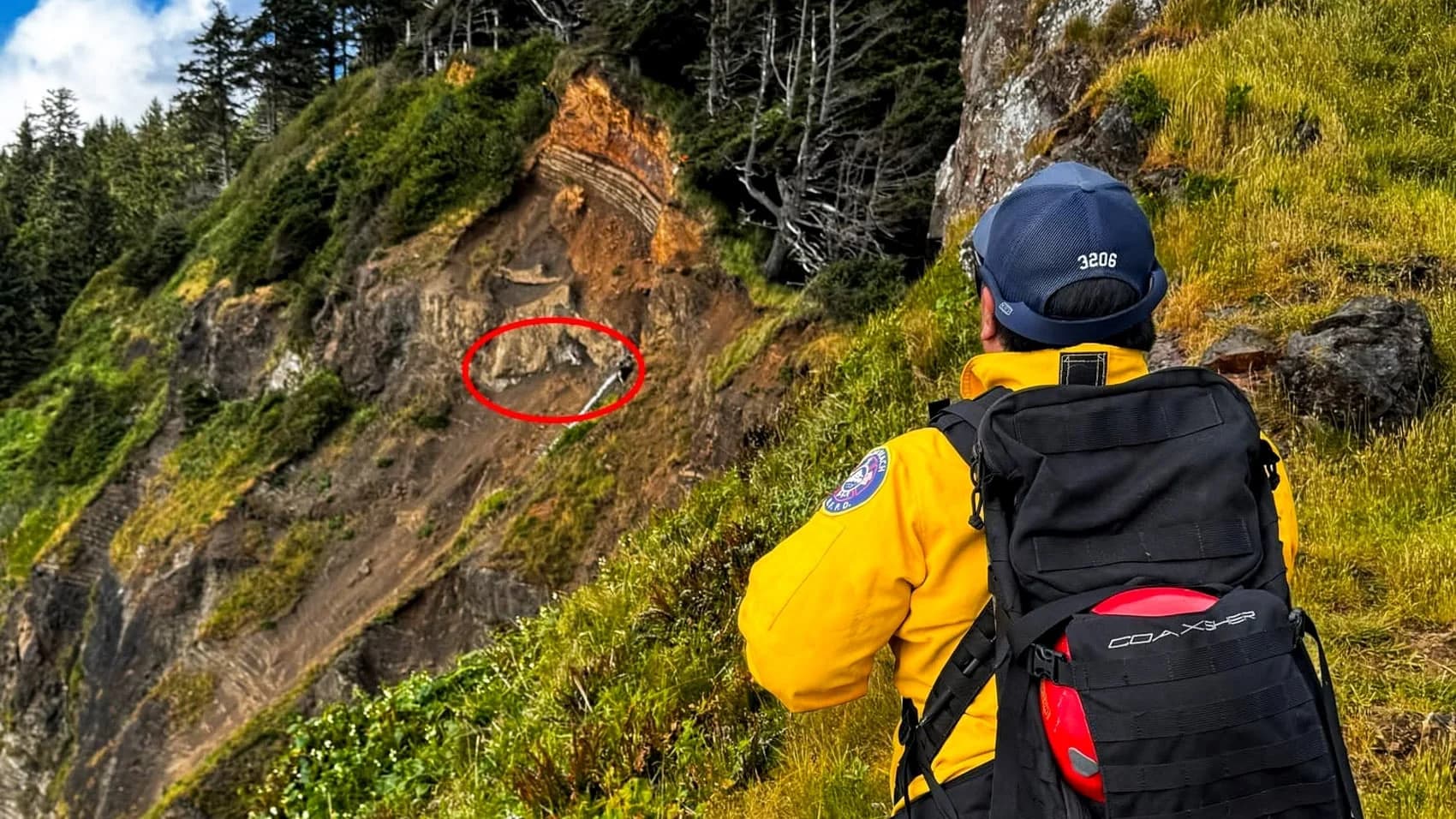
A dramatic animal rescue unfolded recently at Ecola State Park on the Oregon coast. A dog bolted after being startled during a hike and went missing for nearly two hours. When rescuers finally located the animal, it was stranded on a steep cliff face roughly 100 feet (approximately 30 meters) below the rim — a position no one could safely reach on foot. The breakthrough came not from a search dog or a helicopter, but from a small police drone.
Two-Hour Search Ends on a Cliff Face
The incident began around 3:30 p.m. on Saturday, June 6, when an Oregon State Parks ranger flagged down a Cannon Beach Fire Department deputy chief who was conducting a routine patrol in the park. The dog had fled after being spooked during a hike, and its owner had already been searching for close to two hours. Shortly afterward, two hikers arrived with troubling news — they had spotted the dog, but it was trapped on the cliff.
The coastal headland terrain above Cannon Beach is precisely the kind of environment where such emergencies occur frequently. The promontory cliffs are steep, the rock is loose, and the ground drops sharply toward the Pacific Ocean. Local rescue personnel have long trained in high-angle rope rescue for this reason. Frightened animals can reach places humans simply cannot follow, ending up in seemingly inaccessible positions.
DJI Matrice 30 Deployed for Aerial Reconnaissance
The deputy chief made a critical call: request the Cannon Beach Police Department's drone operator to survey the cliff from the air.
Once airborne, the drone quickly located the dog, confirming it was approximately 100 feet below the cliff top on a sheer face. That confirmation proved invaluable — before anyone rigged a rope or went over the edge, the team needed precise knowledge of where the target was and what terrain they would be dealing with.
Based on identification by DroneXL, the aircraft used was a DJI Matrice 30, operated with a DJI Enterprise RC Plus controller — both visible in photos released by the department itself.
The Matrice 30 is a Chinese-manufactured drone, and the timing is noteworthy. In 2026, as Washington applies pressure on police departments nationwide to phase out DJI products, a small Oregon force used one to rescue a dog from a cliff. The M30 offers up to 41 minutes of flight time, a 48-megapixel zoom camera, and an IP55-rated weatherproof body — at a price point below domestic U.S. alternatives. For a department of this size, that trade-off encapsulates a debate playing out across the country.
As the original reporting notes, the flight itself was no trivial task. The Matrice 30 weighs nearly 8 pounds (3.8 kg) and is not known for nimble handling. Holding a stable hover over a cliff edge with that airframe takes a skilled pilot.
Ropes, a Harness, and a Frightened Dog
Following aerial confirmation of the dog's location, the fire department's high-angle rope rescue team took over. They established anchor points at the cliff top, rigged a rope system, and began lowering a rescuer down the face toward the animal.
The frightened dog, however, did what frightened dogs do — when the first rescuer approached, it panicked and moved further along the cliff, preventing the second rescuer from reaching the original target position and adding another layer of complexity to an already difficult operation.
Eventually, the rescue team adjusted their approach, reached the dog, and secured it to the rescuer's harness. Once both were safely attached, the team at the top hauled them back up together. The dog sustained only minor scrapes and, after a veterinary check, was safely reunited with its owner.
Three Agencies, Seamless Coordination
The rescue brought together three separate agencies: state park rangers who raised the alarm, the police department whose drone operator conducted aerial reconnaissance, and the fire department's rope rescue team who executed the technical extraction. Those handoffs — unremarkable on paper — are precisely what transforms a drone from a gadget into a genuine rescue tool.
Drones Quietly Becoming Standard SAR Equipment
This is the kind of drone industry story that rarely makes headlines. There was no record-breaking swarm display, no military payload — just a small-town police drone doing unglamorous work on a Saturday afternoon.
But these scenarios are becoming increasingly routine, and that is the point. Law enforcement agencies across the United States now routinely deploy drones as a first step whenever someone — or an animal — is reported missing, trapped, or in a location too dangerous for personnel to reach safely. Low entry cost and manageable training requirements translate into faster, safer search outcomes.
A few years ago, a small police department owning a drone was a novelty. Today it is approaching standard kit — as expected on a patrol as a radio or a first-aid bag. For a dog stranded on a cliff, that shift meant the difference between hours of guesswork and a confirmed location within minutes.
Editor's Note
This story is another reminder of the positive contributions drone technology makes to everyday life. Drones are making things better, not worse. While many large companies are involved in military and destructive applications, stories like this demonstrate that a significant part of the industry is working toward something far more constructive — search and rescue, delivering equipment to places human hands cannot reach, and accelerating survey and photogrammetry work that once took days. That work deserves recognition.
原文來源: 查看原文
FAQ
Newsletter
Subscribe to our Low-Altitude Industry Newsletter
Daily curated news on low-altitude economy and drone industry, delivered to your inbox.