US Air Force Awards Simultaneous Production Contracts for General Atomics FQ-42 and Anduril FQ-44 CCAs
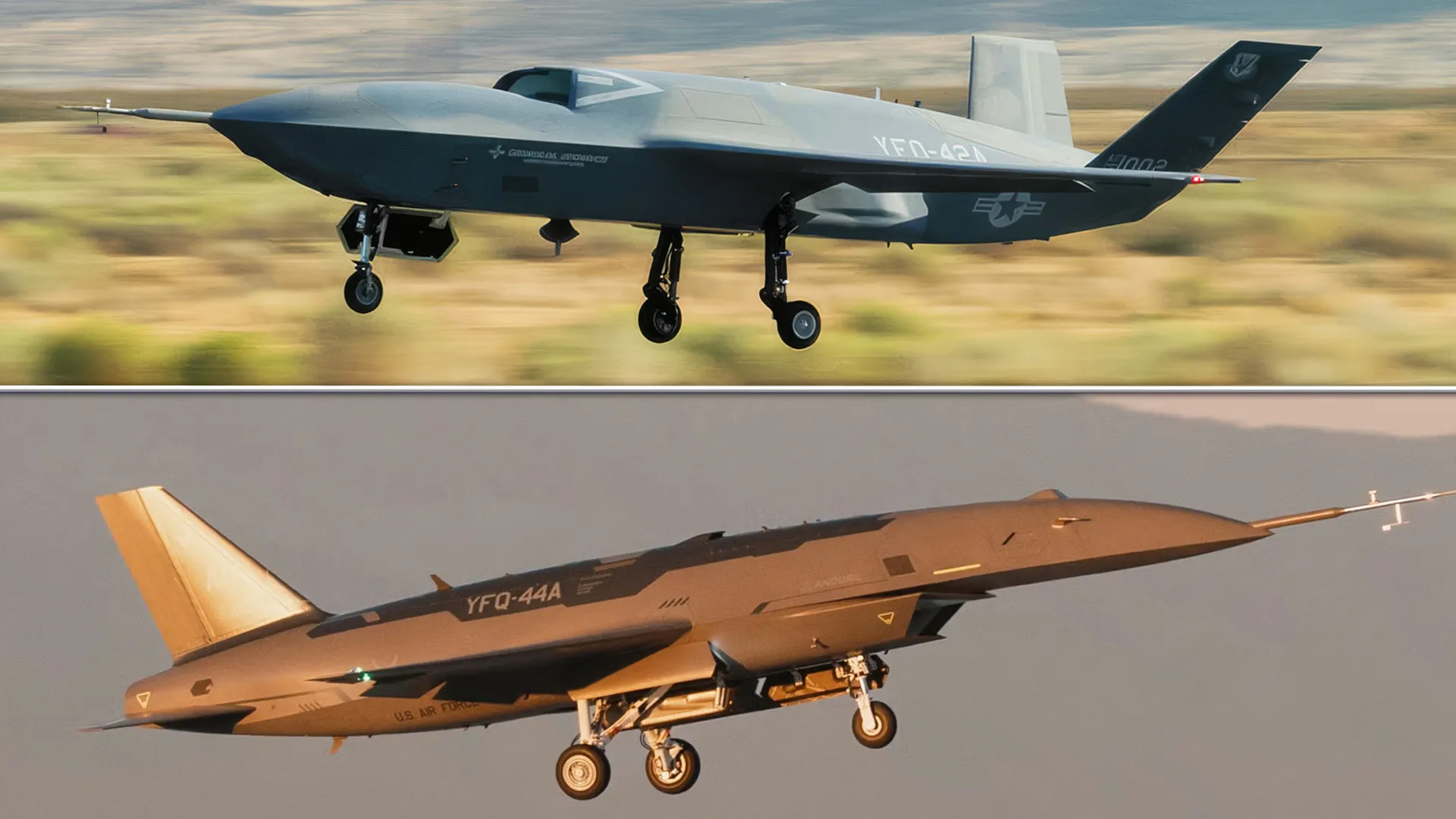
The US Air Force has formally awarded full-rate production contracts to General Atomics for the FQ-42A Dark Merlin and Anduril for the FQ-44A Fury Collaborative Combat Aircraft (CCA). The service plans to procure more than 150 operationally capable CCAs before the end of the decade, with nearly $1 billion requested in the FY2027 budget. The Air Force is also separating hardware and software procurement, awarding autonomous mission software contracts to Anduril, Collins, and Shield AI.

Highlights
- 美國空軍正式授予 General Atomics FQ-42A Dark Merlin 與 Anduril FQ-44A Fury 全規模量產合約,比原定進度提前四個月。
- 空軍計畫在 2030 年前採購逾 150 架具備作戰能力的 CCA,並在 FY2027 預算申請中編列近 10 億美元用於採購。
- 空軍另行向 Anduril、Collins 及 Shield AI 授予任務自主軟體合約,Anduril 成為唯一同時持有 CCA 硬體與軟體合約的廠商。
- 空軍將硬體與軟體採購解耦,採「作戰性能決定付款」的創新授權機制,主要軟體供應商預計 2027 年夏天確定。
- 美國海軍陸戰隊計畫 2029 年接收首批 Kratos MQ-58 Valkyrie CCA,海軍計畫則仍處於早期階段。
US Air Force Awards Simultaneous Production Contracts for General Atomics FQ-42 and Anduril FQ-44 CCAs
The US Air Force has formally awarded full-rate production contracts for the General Atomics FQ-42A Dark Merlin and the Anduril FQ-44A Fury unmanned aircraft, establishing an initial mixed-fleet posture in which both types will operate concurrently under the Collaborative Combat Aircraft (CCA) program — a scenario that analysts had long anticipated since the program's inception.
From Competitive Selection to Production Authorization
The Air Force selected both General Atomics and Anduril designs to advance through the CCA program's first development increment (Increment 1) back in 2024. Originally designated YFQ-42A and YFQ-44A as prototypes, both aircraft completed their first flights in August and October 2025, respectively, and have continued through follow-on testing. Flight testing of the Dark Merlin was briefly suspended following the loss of one aircraft but has since resumed.
The Air Force stated that the contract awards came four months ahead of schedule, reflecting that "the FQ-42 and FQ-44 have met rigorous mission requirement standards and are ready for full-scale production."
Officials: Accelerating Combat Advantage Ahead of End-of-Decade Fielding Goal
Secretary of the Air Force Troy Meink said in a statement: "By rapidly moving from competitive selection to full-scale manufacturing, we are putting high-confidence, operationally ready semi-autonomous systems in the field to stay ahead of our primary challenges. These contracts reaffirm our confidence in the program's strategic path — with a goal of procuring more than 150 operationally capable CCAs before the end of the decade."
Air Force Chief of Staff Gen. Ken Wilsbach added: "Collaborative Combat Aircraft change how we project force and create mass in highly contested environments. Delivering this capability to warfighters faster ensures our forces maintain the tactical advantage needed to deter and, if necessary, defeat any adversary."
The Air Force has included nearly $1 billion in its FY2027 budget request to fund procurement of these aircraft. While the delivery timeline for the first production-standard CCAs has not been officially announced, the Air Force has previously stated its intent to achieve initial operational capability before the end of the decade.
Dual-Type Acquisition Strategy: Risk Mitigation and Operational Flexibility
Anduril Vice President of Autonomous Air Forces Mark Shushnar explained in a blog post published today: "Under the contract, Anduril will deliver initial production quantities of the FQ-44 semi-autonomous combat aircraft to support continued testing, evaluation, and eventual operational deployment. The contract also establishes a framework for the Air Force to procure additional FQ-44s in batches over the coming years, providing a clear pathway to rapidly and cost-effectively expand the combat aircraft fleet."
General Atomics Aeronautical Systems (GA-ASI) President David Alexander stated: "This is an exciting day for our company and for the nation. The FQ-42A entering production is the result of an extraordinary partnership between General Atomics and the US Air Force, as well as years of investment. We were ready for this order, and manufacturing is already well underway."
The split-buy strategy for the Dark Merlin and Fury helps distribute risk. The two designs differ considerably in configuration and performance, giving the Air Force broader operational employment options from the outset while allowing each company to focus on enhancing the specific strengths of its respective aircraft.
Hardware-Software Decoupling: Breaking the Traditional Acquisition Mold
The Air Force has also taken the significant step of separating the CCA program into distinct hardware and software acquisition tracks, with airframe development falling under the former.
An Air Force press release noted: "These separate efforts validate acquisition transformation principles to ensure critical warfighting advantages: decoupling hardware from software. By treating mission autonomy as 'software sold separately,' the Air Force ensures that warfighters receive not only the most advanced physical platforms, but also flexible, easily updated software — effectively breaking the traditional acquisition model."
The current software vendor pool for the CCA program includes Anduril, General Atomics, Lockheed Martin, Northrop Grumman, RTX Collins Aerospace, and Shield AI. The Air Force separately announced today that it has awarded new mission autonomy software contracts to Anduril, Collins, and Shield AI. Notably, Anduril is currently the only vendor holding contracts for both CCA hardware and software.
The Air Force stated that selection of the primary mission autonomy software provider is expected to be completed in summer 2027. The software licensing model also introduces an innovative performance-based payment mechanism — vendors will receive full licensing fees only if they deliver operational capabilities that meet warfighter requirements and feedback.
Shield AI's Hivemind autonomy software is already flying on multiple unmanned platforms. Last month, the Pentagon announced it would leverage the autonomy suite to introduce swarming capabilities to its Low-Cost Unmanned Combat Aerial System (LUCAS) kamikaze drones.
Government IP Control Becomes a Core Acquisition Principle
Retaining greater government control over critical intellectual property — particularly software — has become a central guiding principle in US military procurement in recent years. On the autonomy software front, the government-led Autonomy Government Reference Architecture (A-GRA) has grown into a broader standard framework that extends well beyond the CCA program.
Anduril's Shushnar emphasized: "Lattice Mission Autonomy is currently fully A-GRA compliant, ensuring it can integrate not only all Increment 1 CCAs, but also existing and future A-GRA-compliant aircraft across the force."
Looking Ahead: Increment 2 and Multi-Service Coordination
The Air Force is still planning at least one additional CCA development increment — Increment 2 — though formal requirements have not yet been publicly released. This effort could further expand the diversity of the future CCA fleet. The Air Force has already assigned the designation YFQ-48A to Northrop Grumman's Talon Blue unmanned aircraft design, which was first publicly revealed in December 2025, while Boeing's MQ-28 Ghost Bat — originally developed for Australia — has also taken on a more significant role within the United States.
The US Marine Corps and US Navy are also coordinating closely with the Air Force on their respective CCA fleet plans. The Air Force holds a clear lead in fielding timelines, which may influence decisions by the other services. The Marine Corps currently plans to receive its first MQ-58 Valkyrie CCAs, built by Kratos, in 2029, while the Navy's program remains in a very early stage.
With today's announcements, the US Air Force CCA program has reached another major milestone, taking a decisive step toward its initial fleet goal built around the General Atomics Dark Merlin and the Anduril Fury.
原文來源: 查看原文
FAQ
Newsletter
Subscribe to our Low-Altitude Industry Newsletter
Daily curated news on low-altitude economy and drone industry, delivered to your inbox.