DJI Matrice 300 RTK Thermal Drone Helps Locate Hidden Hot Spots at Clarkson Apartment Fire
A three-story apartment building near SUNY Brockport in Clarkson, New York caught fire, with flames rapidly spreading into the attic. The Monroe County Sheriff's Office deployed a DJI Matrice 300 RTK equipped with thermal imaging to detect hidden hot spots from the air in real time, allowing firefighters to avoid entering the structurally compromised attic. Thirty residents were displaced and four were treated on scene.

Highlights
- The Monroe County Sheriff's Office deployed a DJI Matrice 300 RTK with thermal imaging at a Clarkson, NY apartment fire, detecting hidden attic hot spots in real time without sending firefighters into the collapsed structure.
- Thirty residents were displaced and four were treated on scene after the fire gutted the attic and caused the ceiling to collapse into lower floors.
- The Matrice 300 RTK was acquired through a Monroe County supplemental appropriation and is operated by three FAA-licensed remote pilots; the same platform also supports GIS mapping and LiDAR-based 3D scene reconstruction.
- The Clarkson attic had no sprinkler system and lacked true fire walls, allowing flames to run the full length of the building once they entered the ceiling cavity.
- Drone thermal imaging at this incident follows a pattern established at the Notre-Dame Cathedral fire, where aerial thermal cameras helped firefighters prioritize suppression in the most intensely burning areas.
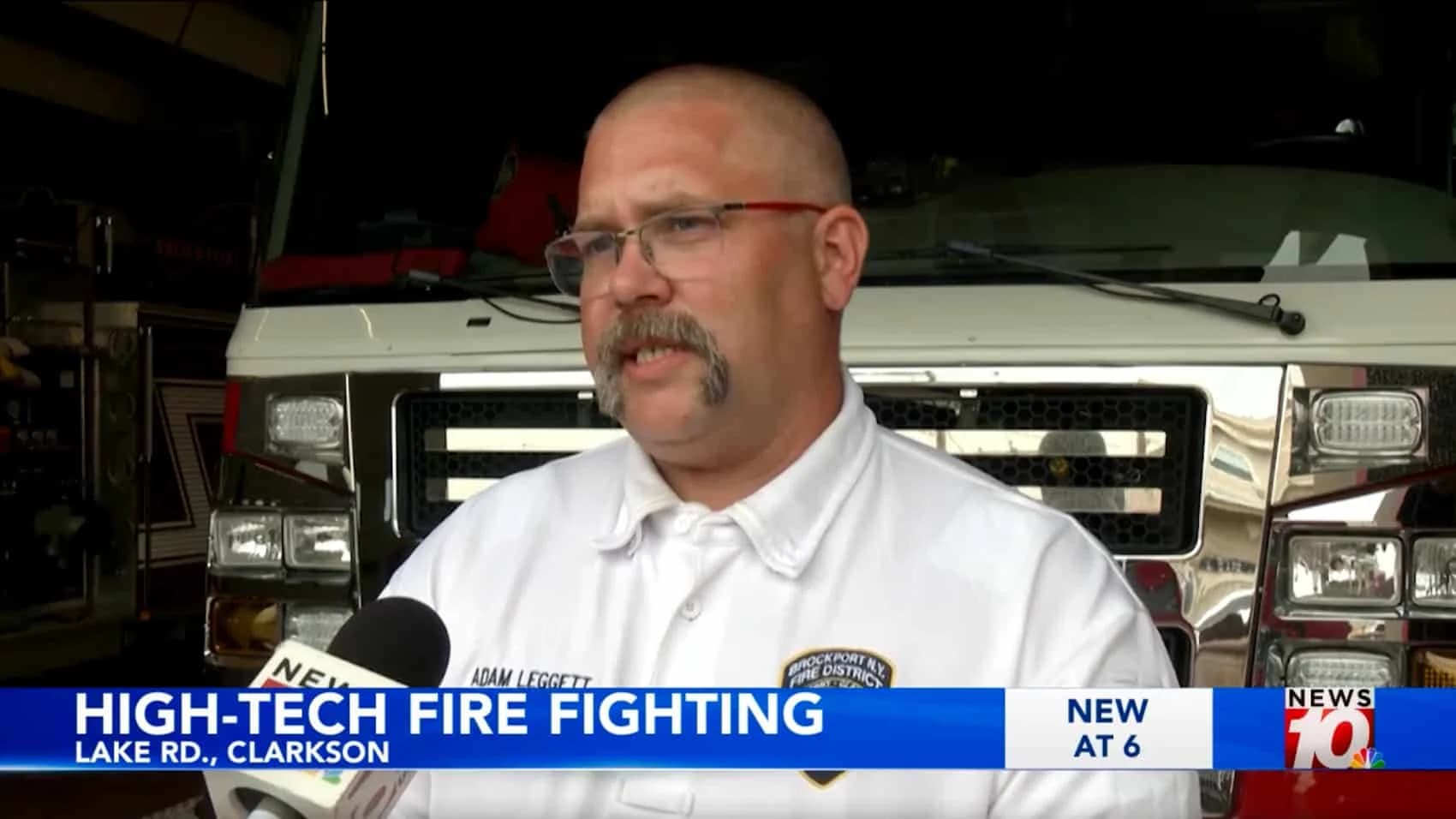
A three-story apartment building near SUNY Brockport in Clarkson, New York caught fire, spreading far faster than firefighters anticipated and racing into the attic space. Brockport Fire Chief Adam Leggett looked up at the building and realized ground crews couldn't see more than half the fire's hot spots. The Monroe County Sheriff's Office immediately deployed a DJI Matrice 300 RTK equipped with thermal imaging.
What happened next is the clearest possible argument for why law enforcement agencies continue to invest in professional-grade drone equipment and keep FAA-certified remote pilots on standby — in emergencies that can't wait for traditional methods to catch up, drones have become indispensable first-response tools.
Image credit: Brockport Fire
The hot spots detected by the Matrice 300 RTK would otherwise have required firefighters to climb to the third floor, enter the attic, and search for fire sources with handheld thermal cameras inside a structurally unstable building. Instead, the drone relayed thermal imagery to ground crews from a safe distance, keeping firefighters out of what had become a near-fatal environment.
Monroe County Sheriff's Office Drone Program
The Monroe County Sheriff's Office operates a small UAS (unmanned aircraft system) unit staffed by three FAA-licensed remote pilots, running two drones with different capabilities.
The DJI Mavic Pro is compact enough for indoor flight and suited to rapid-response missions that don't require advanced sensors. The DJI Matrice 300 RTK is built for complex operations — such as thermal fire detection — or 3D modeling and scene reconstruction using a LiDAR sensor.
The Matrice 300 RTK carries both a high-definition camera and thermal detection equipment. The thermal imager reads heat signatures from the air, identifies hot spots in real time, and transmits imagery to ground personnel without anyone needing to physically reach the scene.
The county acquired the Matrice 300 RTK system through a partnership with the Monroe County Office of Community Planning and Engagement, with funding approved by the county legislature via supplemental appropriation. The same platform is also used to map county-owned properties for GIS systems and to support economic development work.
For a three-story attic fire, the Matrice 300 RTK wasn't simply a convenience — it was the tool that made the entire operation workable without adding additional risk to firefighters.
Why Drones Changed the First-Response Model
According to WHEC News 10, the Clarkson apartment's attic had no fire walls to stop flames from spreading across the entire ceiling cavity — only a partition, not a true fire wall. The attic also lacked a sprinkler system, meaning once fire entered that space, nothing mechanical could stop it from running the full length of the building.
Chief Leggett noted that the building was code-compliant even without attic sprinklers or dedicated fire walls. That sounds reasonable until you watch the attic collapse into the third floor. Code compliance doesn't mean effective fire containment — it means the building met minimum standards at the time of construction, and standards don't always reflect how fire actually behaves.
The fire gutted the attic completely, and the entire ceiling dropped into the floors below. Thirty residents were displaced and four were treated on scene; the Red Cross stepped in to assist those with nowhere to go.
When Chief Leggett said the drone was critical to the operation, he wasn't speaking in generalities. He was describing a specific problem: the attic was three stories up, and fire had already spread through most of that space before firefighters arrived.
Standing on the street, crews could see flames on the building's exterior but couldn't see around corners, inside walls, or across the horizontal extent of the attic space.
If you think drones have only changed the game in commercial photography, photogrammetry, or search and rescue, you may not fully appreciate how much they have altered daily operations for police and fire departments.
Drone thermal imaging first made international headlines during the Notre-Dame Cathedral fire in Paris, when thermal cameras helped firefighters identify the most intensely burning areas and concentrate suppression efforts there first.
The Advantages of Thermal Imaging
Thermal imagers read heat signatures rather than visible light. Hot spots appear as bright points on thermal imagery, giving ground crews precise knowledge of where fire is concentrated — without anyone climbing into an unstable attic and searching with a handheld device.
Image credit: Brockport Fire
Chief Leggett laid out the trade-off plainly: the alternative was sending someone to the third floor with a handheld thermal camera to search through debris. In a building whose attic had just collapsed, that isn't a quantifiable risk — it's a decision that gets firefighters killed for no reason.
The Matrice 300 RTK identified hot spots from above, captured thermal imagery, and relayed that information to ground crews in real time. Firefighters on the ground knew exactly where to direct water and where fire was most active — all without anyone entering a collapsed structure.
Image credit: Brockport Fire
Chief Leggett said the drone improved both safety and operational efficiency. The safety benefit is obvious; the efficiency gain meant firefighters weren't wasting time hosing down areas that had already been extinguished or guessing at the fire's exact location.
They directed water where the thermal imaging showed heat. The fire was suppressed faster, the building burned for less time, and suppression resources were concentrated rather than scattered.
What Makes the Program Work
The Monroe County Sheriff's Office maintains three FAA-licensed remote pilots precisely because emergencies don't wait. When the call comes in — fire burning, structure compromised — there is no time to debate whether aerial thermal imaging is worth attempting.
A certified pilot pairs with the Matrice 300 RTK, the drone goes up, thermal imaging activates, hot spots are found, and firefighters are safer because of it.
That is the only test that actually matters — not how polished the drone looks in a promotional video, but whether it saves lives when a building is on fire.
The Matrice 300 RTK can also carry a LiDAR sensor to build three-dimensional models of buildings and scenes. For fire departments, that capability means they can map a structure before entering it, reconstruct events after a fire, and preserve a complete scene record for investigations.
At the Clarkson fire, thermal imaging was the immediate need. But the same platform gives first responders a complete toolkit for crisis response, scene documentation, and evidence collection.
Drones are becoming indispensable in search and rescue and emergency response. Their value lies not only in seeing what the human eye cannot — it lies in sending a machine into dangerous environments instead of a person, which fundamentally changes how first responders operate.
DroneXL Editorial Perspective
This is what drone discussions should center on: not whether the technology exists, but whether it genuinely delivers when it matters most.
The Clarkson fire was a real event with real consequences. Thirty residents lost their homes, four were injured, and the building was destroyed. But firefighters went home safely, because they had information that could not have been obtained any other way.
That information came from a DJI Matrice 300 RTK, operated by an FAA-certified remote pilot who knew exactly how to use it. That is what makes the case for professional drone programs — not in theory, but in practice.
Image credit: Brockport Fire, DJI
原文來源: 查看原文
FAQ
Newsletter
Subscribe to our Low-Altitude Industry Newsletter
Daily curated news on low-altitude economy and drone industry, delivered to your inbox.