World First: Unmanned Surface Vessel Saronic Corsair Rescues Two U.S. Army Apache Crew Members off Oman Coast
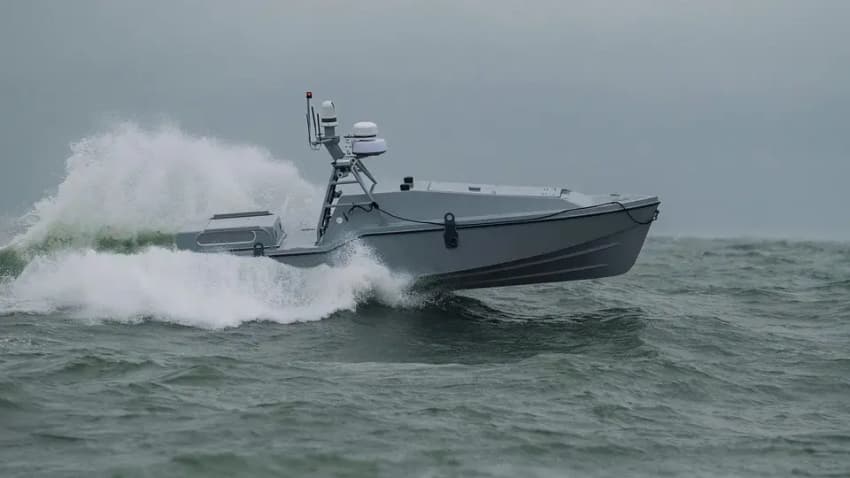
A U.S. Navy unmanned surface vessel (USV), the Saronic Corsair operated by Task Force 59, rescued two crew members from a downed AH-64E Apache attack helicopter near the Strait of Hormuz — marking the first time an unmanned vessel has ever performed a maritime rescue. Both pilots were recovered safely within approximately two hours.

Highlights
- The Saronic Corsair USV, operated by U.S. Navy Task Force 59, rescued two AH-64E Apache crew members off the coast of Oman — the first maritime rescue ever performed by an unmanned surface vessel.
- Both pilots were recovered in approximately two hours and are reported to be in stable condition following the helicopter crash near the Strait of Hormuz.
- The cause of the Apache crash remains under investigation; a U.S. Army safety document from April 2026 had flagged a main gearbox defect in certain AH-64E models as a potential failure risk.
- This is the first Apache helicopter loss since U.S. forces launched Operation Epic Fury in late February 2026.
- A Congressional report found approximately 42 U.S. Air Force aircraft were destroyed or seriously damaged during the six-week conflict with Iran, including 20-plus MQ-9 Reapers and an F-35A.
Unmanned Surface Vessel Makes Maritime Rescue History
The U.S. military announced on Tuesday that an unmanned surface vessel (USV) had successfully rescued two crew members from a downed AH-64E Apache attack helicopter near the Strait of Hormuz — the first time in history that an unmanned vessel has performed a maritime rescue operation.
U.S. Central Command (CENTCOM) spokesperson Captain Timothy Hawkins stated: "A U.S. Navy unmanned surface vessel located and rescued the crew members from the water. U.S. Naval Forces Central Command's Task Force 59 is the Navy's first task force centered on artificial intelligence and unmanned systems."
CENTCOM posted on X: "Both pilots were safely recovered in approximately two hours and are in stable condition. The cause of the incident is under investigation."
Saronic Corsair USV Proves Its Worth
According to The Wall Street Journal, the Saronic Corsair — operated by U.S. Navy Task Force 59 — located the two AH-64E crew members floating in the waters off the coast of Oman and completed the full rescue.
The Saronic Corsair is a high-speed USV developed by Saronic, designed for multi-mission operations. Key features include a wave-piercing hull, an advanced AI-powered autonomous navigation system, and a top speed exceeding 35 knots. The vessel carries modular payload bays, precision sensors, radar, and communications systems, enabling extended independent operations with a reported range of over 1,000 nautical miles.
This rescue marks the first operational use of a USV for a maritime search-and-rescue mission, underscoring the expanding real-world potential of unmanned platforms.
Apache Crash Cause Still Under Investigation
The AH-64 Apache went down near the Strait of Hormuz, representing another aircraft loss for U.S. forces since the outbreak of hostilities with Iran. The exact cause has not been confirmed. The New York Times cited sources indicating the U.S. military is investigating whether the crash resulted from a mechanical failure, enemy fire, or another unknown operational issue.
President Donald Trump told reporters at John F. Kennedy International Airport: "The pilots are fine — nobody was hurt. We'll have a report tomorrow."
This is the first Apache loss since U.S. forces launched Operation Epic Fury in late February 2026. The U.S. Army has deployed AH-64 Apaches extensively throughout the conflict, conducting missions including merchant vessel escort and maritime blockade operations against Iranian ports.
Mechanical Failure as a Possible Cause
An internal U.S. Army safety document from April had revealed that "certain AH-64E improved drive system main gearboxes may experience an internal failure, resulting in loss of accessory gearbox drive, and subsequent loss of tail rotor thrust, electrical power, and hydraulic systems" — a potential factor in the crash.
Additionally, two Apache helicopters were already lost in separate routine training crashes in March 2026, one at Fort Novosel, Alabama, and another at Fort Campbell, Kentucky.
Broader U.S. Losses in the Iran Conflict
A Congressional report released last month revealed that approximately 42 U.S. Air Force aircraft were destroyed or severely damaged during the six-week conflict with Iran. Losses included aircraft shot down by Iranian missiles in flight, aircraft destroyed by drone strikes at Persian Gulf air bases, and losses attributed to friendly-fire incidents.
The inventory of losses includes roughly 20-plus MQ-9 Reaper drones, multiple F-15E Strike Eagles, one F-35A, one A-10 Thunderbolt II, several KC-135 tankers, one E-3 Sentry AWACS, and MC-130J special operations aircraft.
AH-64E Apache: A Battle-Proven Multi-Role Attack Helicopter
Boeing describes the AH-64E as "an advanced, multi-mission helicopter using the latest technology to maintain its status as the world's best attack helicopter." The four-blade, twin-turboshaft aircraft features a nose-mounted sensor suite that streamlines target acquisition; laser and infrared systems allow it to locate, track, and engage targets.
The Apache's armament includes a 30mm automatic cannon (capable of carrying up to 1,200 rounds of high-explosive dual-purpose ammunition), 70mm rockets, and laser-guided Hellfire missiles suited for engaging small vessels. Combined with helmet-mounted displays, FLIR/EO targeting systems, and the Longbow millimeter-wave radar, the AH-64 can detect and engage fast-moving small surface targets at low altitude.
While the crash represents a setback for the U.S. Army and a near-fatal close call for the crew, it does not reflect on the Apache's combat performance record, nor does it diminish the overall operational potential of this battle-hardened attack helicopter.
原文來源: 查看原文