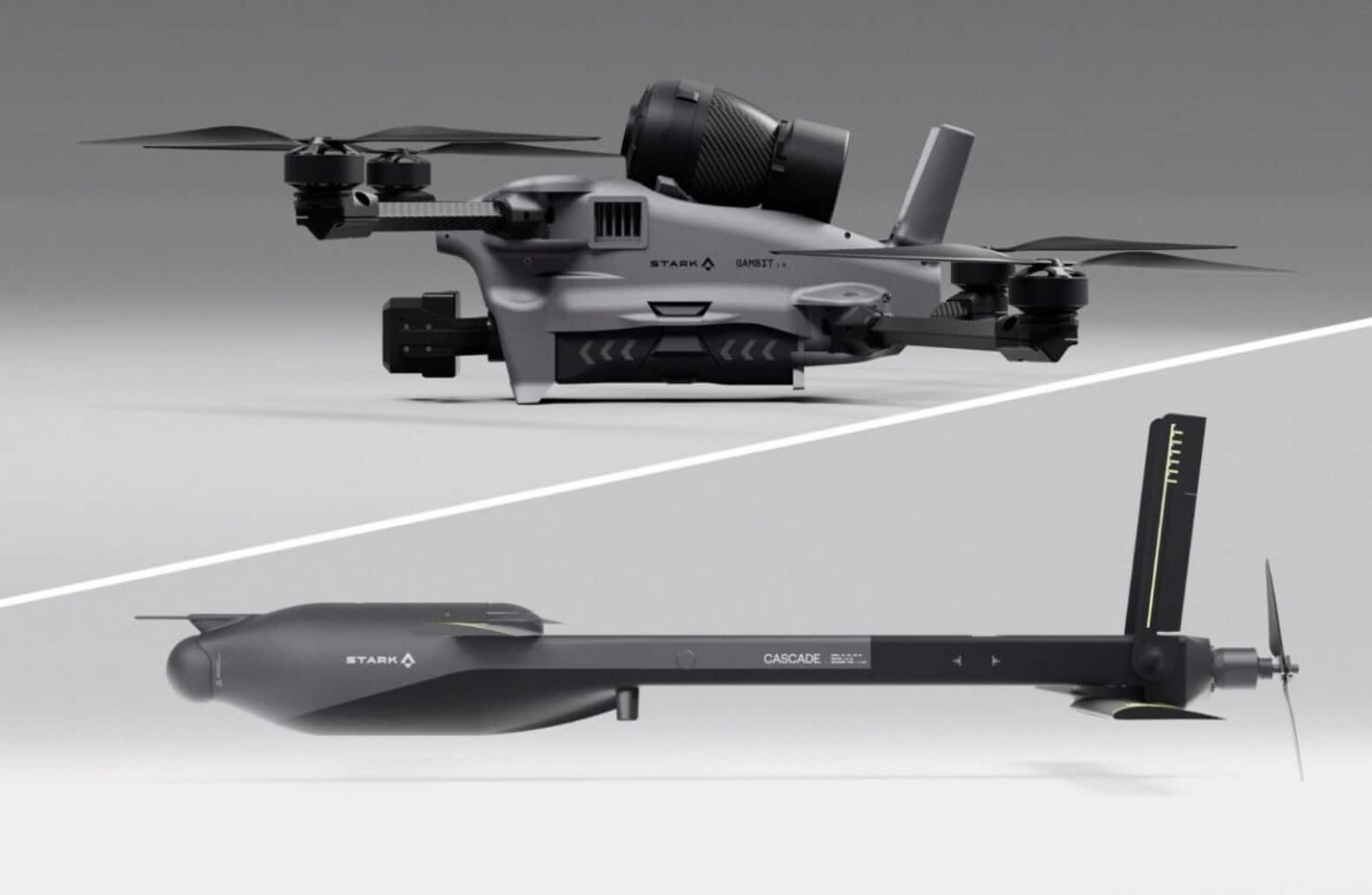
Stark Unveils Cascade and Gambit Loitering Munitions Just Eight Months After Flagship Drone Failed All Military Tests
German defense startup Stark announced two new loitering munitions on June 8—the tube-launched Cascade and man-portable quadrotor Gambit—featuring fiber-optic guidance and GPS-denied navigation. The launch comes only eight months after its flagship Virtus drone missed all four targets during UK and German military trials.

Highlights
- Stark launched the tube-launched Cascade (40–100 km range, 4.5 kg payload, under 20 kg total) and man-portable quadrotor Gambit on June 8, 2025.
- Gambit offers a fiber-optic guidance option that makes it immune to electronic jamming—a battlefield technology that moved from Ukrainian improvisation to NATO catalog in about 18 months.
- UK firm Force Development Services will build a six-tube launcher for Cascade, enabling vehicle and maritime integration.
- The launch comes just eight months after Stark's Virtus drone missed all four targets during UK and German military tests in October 2025.
- Stark holds a ~€300 million Bundeswehr loitering munition contract and was valued at nearly $500 million after a Sequoia-led funding round in August 2025.
Stark Launches Two Loitering Munitions in a Striking Turnaround
German defense startup Stark announced two new loitering munitions on June 8: the tube-launched Cascade and the man-portable quadrotor Gambit, timed just two days before the opening of the ILA Berlin Airshow. The launch punctuates a dramatic comeback story—in October 2025, the company's flagship drone Virtus failed to hit any of its four targets during demonstrations for the British and German militaries.
Cascade: Over Ten Launch Systems on a Single Vehicle
Stark classifies the Cascade as an OWE-T (One-Way Effector, Tube-Launched). Depending on battery configuration, it offers three range options: 40, 60, or 100 km (25, 37, or 62 miles), with a maximum payload of 4.5 kg (10 lbs) and a deployment time of under one minute.
Official specifications list a cruise speed of 100 km/h (62 mph), a maximum dive speed of 220 km/h (137 mph), and up to 60 minutes of flight time. The combined weight of the launcher and munition is under 20 kg (44 lbs), and Stark says a single vehicle can carry more than ten complete systems. This effectively turns a pickup truck into a mobile salvo platform capable of multi-axis strikes to overwhelm air defenses.
Launch options include single-tube ground launch, vehicle- and ship-mounted integrated launchers, and fixed container-based launch systems. Stark has already successfully launched a Cascade from its Vanta unmanned surface vessel, and UK-based Hampshire engineering firm Force Development Services will build a six-tube launcher to extend integration to land and maritime platforms. The system uses a software-defined architecture with over-the-air (OTA) updates; onboard AI and sensor fusion handle navigation, target recognition, and terminal guidance in GNSS-denied environments.
Stark CTO Johannes Schaback said both products draw directly from lessons learned on the Ukrainian battlefield: "Armed forces need the ability to produce quickly, adapt rapidly, and deploy at scale."
Gambit: Bringing Ukrainian Fiber-Optic Guidance Into the NATO Catalog
Gambit is a foldable quadrotor drone available in two variants:
- Strike variant: 25 km (15.5 miles) range, warhead weight under 2 kg (4.4 lbs), maximum takeoff weight of 6 kg (13.2 lbs), flight time under 25 minutes
- Reconnaissance variant: replaces the warhead with EO/IR sensors, range of 40 km (25 miles), weight of 4–4.5 kg (8.8–9.9 lbs), flight time over 50 minutes
Cruise speed is 60 km/h (37 mph), dive speed is 120 km/h (75 mph), deployment takes under five minutes, and a single operator can carry and control the entire system.
The most notable feature is Gambit's fiber-optic guidance option. An ultra-thin fiber-optic cable completely replaces the radio communication link, rendering electronic jamming entirely ineffective. Since Ukraine first deployed jam-resistant fiber-optic FPV drones on the battlefield in December 2024, the technology has proliferated rapidly, with fiber-optic spool prices surging more than eightfold. From improvised workshop modifications on the Donbas front lines to a standard option in a German defense product catalog—the transition took roughly eighteen months.
Another practical distinction from most loitering munitions is that Gambit is recoverable: NATO STANAG-compliant fuzing and human-in-the-loop control allow operators to abort missions and recover the aircraft to its launch point, rather than treating it as expendable.
Both products integrate into Stark's Minerva command-and-control software platform and feature GPS-denied navigation capabilities.
From Total Failure to Procurement Contract: A Dramatic Four-Month Reversal
The backdrop to Stark's new product launch is a four-month journey from embarrassment to procurement contracts.
In October 2025, the Financial Times reported that Virtus had missed all four targets during UK and German military testing. By December, evaluations at the Bundeswehr's Altmark Training Center told a very different story—Inspector General Carsten Breuer noted that both Virtus and Helsing's HX-2 achieved hit rates above 90%.
In January 2025, Helsing and Stark beat out Rheinmetall, each securing loitering munition orders worth approximately €300 million. In February, the German Bundestag's Budget Committee approved the framework agreement while cutting the long-term budget ceiling from €4.3 billion to €2 billion.
The company is barely two years old. Co-founded in 2024 by Quantum Systems CEO Florian Seibel, it is currently led by Project A co-founder Uwe Horstmann. Stark completed a Sequoia-led funding round in August 2025 at a valuation approaching $500 million, and now operates out of Germany, Ukraine, the UK, Sweden, and Greece.
Analysis and Outlook
From a very public test failure to a dual-product launch plus a UK launcher partnership in eight months is a pace no legacy defense prime could match. However, spec-sheet numbers and combat performance are two very different things—until Cascade and Gambit produce independent test data, caution is warranted.
The fiber-optic guidance option is the most significant detail across both products. Ukraine validated the concept under fire, Russia promptly copied it, Hezbollah brought it to Lebanon, and now a Berlin startup sells it as a factory option to NATO—a battlefield-improvisation-to-Western-catalog technology transfer completed in roughly eighteen months.
Notably, Stark has not announced a launch customer for either new system. The existing Bundeswehr framework agreement covers Virtus; whether Cascade or Gambit can enter German or British procurement pipelines remains an open question. The ILA Berlin Airshow (June 10–14) will be a key moment to watch whether Stark displays physical launcher hardware or only renders and mockups.
Sources: STARK Defence, Aviation Week, UK Defence Journal.
原文來源: 查看原文