Inside the IMU: How Drones Sense Motion and Maintain Control
Gyroscopes and accelerometers let IMUs estimate motion and attitude, providing essential control data for aircraft, spacecraft, and drones.
IMUs fuse motion data to stabilize aircraft and drones.
Key points
- IMUs measure motion
- Gyros track rotation
- Accelerometers detect g
- Fusion limits IMU drift
- Drones gain stable flight
Highlights
- An inertial measurement unit uses gyroscopes and accelerometers to measure rotation and motion.
- A typical six-axis IMU measures angular velocity and specific force across the X, Y, and Z axes.
- Drone flight controllers process IMU data to estimate roll, pitch, and yaw and to command stabilizing responses.
- Gyroscope errors accumulate into drift, while accelerometer readings can be disrupted by vibration and rapid movement.
- Sensor fusion can combine IMU measurements with GNSS, magnetometers, barometers, cameras, LiDAR, or radar to improve navigation estimates.
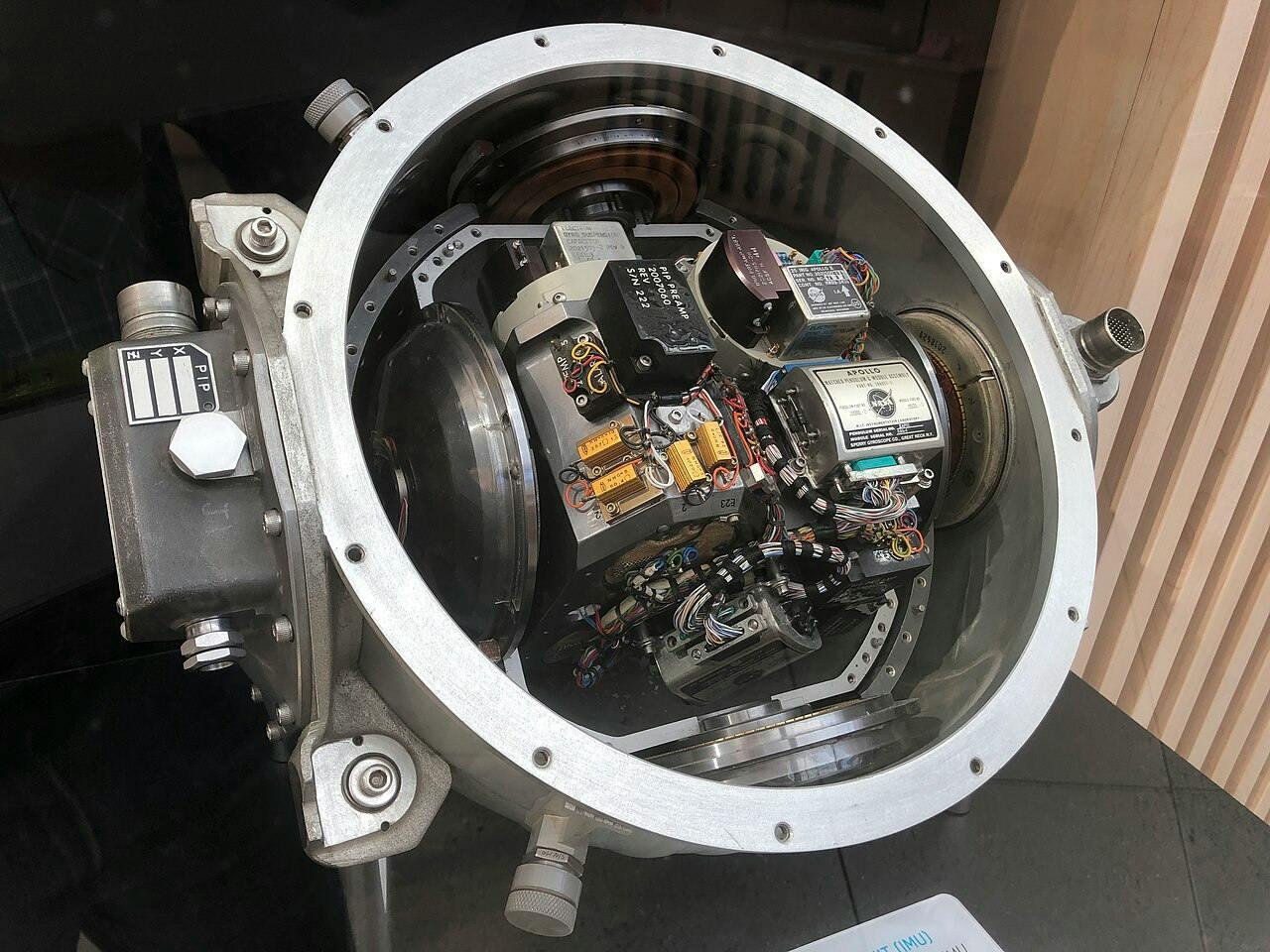
An inertial measurement unit, commonly known as an IMU, is a compact sensor system that measures movement and rotation. It provides the raw data that aircraft, spacecraft, and drones use to estimate their orientation and respond to changes in motion.
IMUs are fundamental to modern flight control. On a drone, their measurements help the flight controller determine whether the aircraft is level, banking, pitching, turning, accelerating, or being disturbed by wind. The controller can then adjust motors or control surfaces to maintain the commanded flight path.
Gyroscopes and accelerometers
The two core elements of an IMU are gyroscopes and accelerometers. A typical six-axis IMU includes three gyroscope axes and three accelerometer axes, allowing it to measure motion around and along the X, Y, and Z axes.
Gyroscopes measure angular velocity: how quickly the platform rotates around each axis. In aviation terms, these rotations correspond to roll, pitch, and yaw. By processing angular-rate measurements over time, the navigation or flight-control system can estimate changes in attitude.
Accelerometers measure specific force along each axis. Their readings can indicate acceleration caused by vehicle movement, but they also reflect gravity and vibration. When a stationary drone tilts, for example, the direction of gravity relative to the sensor changes. The flight controller can use that information to help estimate the aircraft's orientation.
Neither sensor provides a perfect answer on its own. Gyroscopes respond quickly and capture short-term rotational movement well, but small measurement errors accumulate during integration and cause drift. Accelerometers offer a useful gravity reference, yet their readings can be disrupted by motor vibration, rapid maneuvering, turbulence, and impacts.
Sensor fusion turns measurements into flight data
Flight-control software combines gyroscope and accelerometer measurements through sensor-fusion algorithms. This process balances the strengths and weaknesses of the sensors to produce a more stable estimate of attitude and motion.
Depending on the platform, IMU data may also be combined with measurements from GNSS receivers, magnetometers, barometers, cameras, LiDAR, radar, or other navigation sensors. GNSS can correct position and velocity errors over time, while visual or LiDAR-based navigation may support operations where satellite signals are weak, obstructed, or unavailable.
The resulting navigation estimate is sent to the flight-control system. In a multirotor drone, the controller continuously changes individual motor speeds to maintain stability or execute a maneuver. A fixed-wing aircraft instead uses the estimate to command control surfaces, propulsion, or an autopilot system. Spacecraft can apply the same basic motion data within more specialized guidance, navigation, and control architectures.
Why IMU quality matters
IMU performance depends on factors including sensor noise, bias stability, temperature sensitivity, sampling rate, vibration resistance, calibration, and software implementation. Small commercial drones commonly use compact microelectromechanical systems, or MEMS, sensors because they offer low weight, low power consumption, and economical production. Higher-end aerospace and defense platforms may require more accurate inertial sensors, redundant units, tighter calibration, or greater environmental tolerance.
Installation is also important. An IMU mounted near strong vibration sources can produce degraded measurements unless the aircraft uses suitable mechanical isolation and digital filtering. Incorrect alignment, poor calibration, or changes caused by temperature can likewise affect flight performance.
For drone operators, the IMU often works invisibly until a warning appears or the aircraft behaves unexpectedly. Calibration requests, abnormal attitude readings, unstable hovering, or inconsistent heading behavior can indicate a sensor, mounting, vibration, or data-fusion problem. Operators should follow the manufacturer's procedures rather than treating repeated calibration as a substitute for inspection.
Ultimately, an IMU does not navigate an aircraft by itself. It supplies high-rate motion and rotation measurements that other systems interpret. Combined with flight-control software and complementary navigation sensors, those measurements enable aircraft, spacecraft, and drones to maintain stability, estimate attitude, and move safely through their operating environment.
What it means for Taiwan
For Taiwan's drone manufacturers, component suppliers, and industry associations, IMU performance is directly tied to flight-controller reliability and product competitiveness. Procurement teams should compare bias stability, vibration tolerance, temperature range, calibration requirements, and supply-chain availability before locking in a design. Local suppliers can also develop test fixtures and validation services for domestically produced flight-control systems. Operators providing infrastructure inspection, exterior cleaning, or agricultural spraying should verify IMU calibration during pre-deployment checks and review vibration or attitude warnings after hard landings. During aircraft acceptance, they should test hover stability and positioning under representative payloads, because pumps, cleaning equipment, and cameras can alter vibration patterns. Maintenance schedules should include mounting, connector, and flight-log inspections rather than relying only on software calibration prompts.
FAQ
Reviewed and published by the LAETimes editorial desk ·