Czech-Built Sub-250g Drone Shatters World Speed Record at 351 MPH
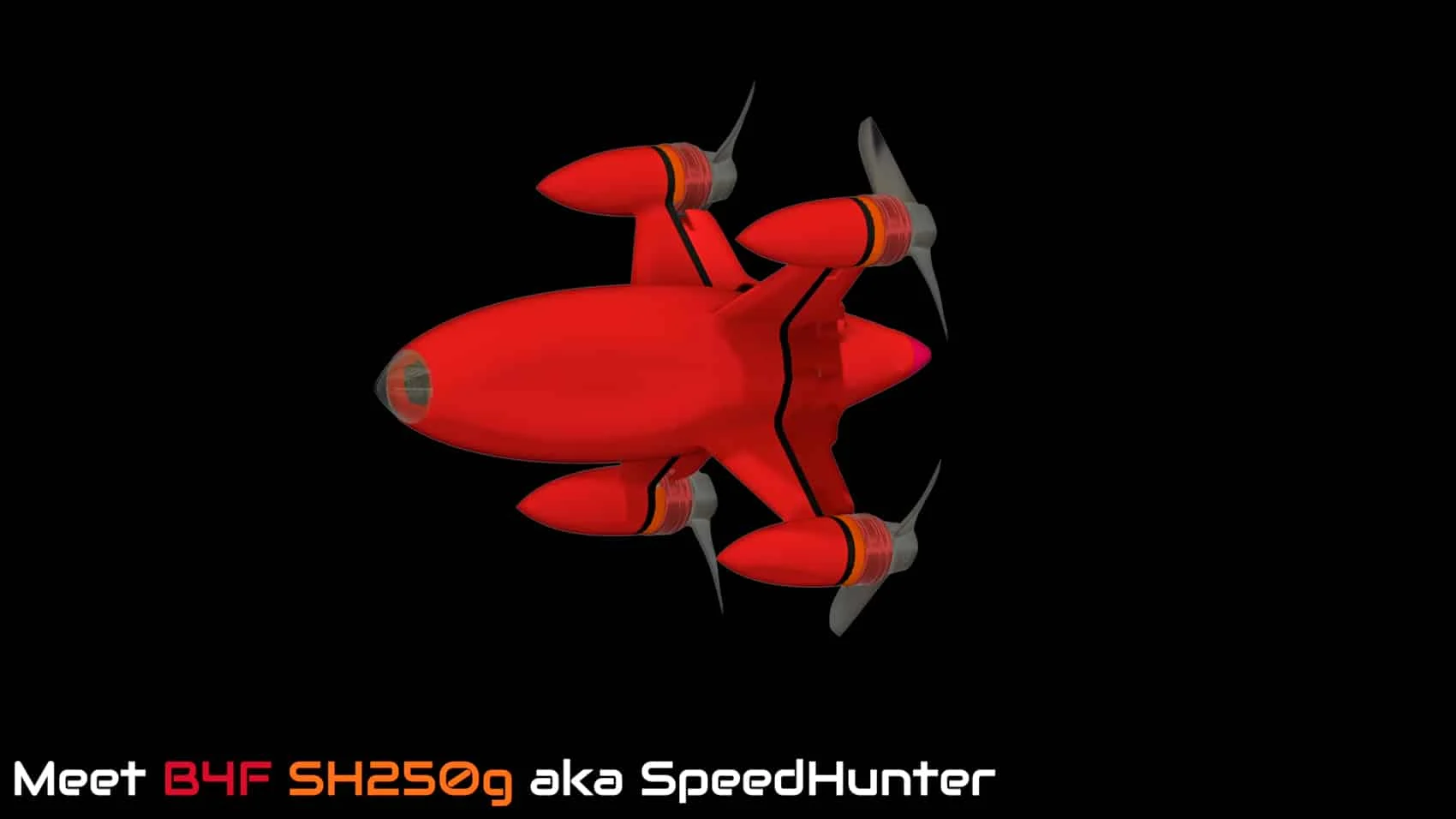
Czech engineering team Born4Flight has claimed a world speed record for sub-250g drones with its SH250G SpeedHunter, achieving a two-way average of 351.4 mph (565.4 km/h) on May 28. Piloted by founder Jakub Espandr, the run surpassed the previous record of 222.7 mph set in Tianjin, China, by nearly 58%. The attempt was not officially certified by Guinness World Records but followed its standard methodology.

Highlights
- Born4Flight's SH250G SpeedHunter recorded a two-way average speed of 351.4 mph (565.4 km/h) on May 28, surpassing the previous sub-250g world record of 222.7 mph by nearly 58%.
- The SH250G weighs under 250 grams yet is powered by a 2,500-watt drivetrain — more than ten times the motor power of a DJI Mini 4 Pro in the same weight class.
- The record attempt was not officially certified by Guinness World Records, as no adjudicator was present, though Guinness timing methodology was followed throughout.
- Born4Flight developed all core systems in-house, including the B4F CREST flight controller, B4F SURGE ESC, B4F:FL1GHT firmware with AI tuning (AYRA), custom propellers, and the A3ROFLOW aerodynamic simulation lab.
- The SH250G hit a one-way peak of 406.8 mph (654.7 km/h) during the run, raising questions about how regulators at the FAA, EASA, and UK CAA will address speed limits in the sub-250g category.
351 MPH Is Not a Typo
A drone weighing less than 250 grams (approximately 8.8 oz), built by a Czech engineering team, has stunned the drone racing world by posting a two-way average speed of 351.4 mph (565.4 km/h) — setting a new world record in its weight class.
Born4Flight's SH250G SpeedHunter, piloted by company founder Jakub Espandr on May 28, eclipsed the previous record of 222.7 mph (358.36 km/h) held by a competitor from Tianjin, China, by nearly 58%. Notably, the run was not officially certified by Guinness World Records, though it adhered to Guinness methodology — but the number itself remains the headline.
For context, a consumer-grade DJI Mini 4 Pro tops out at roughly 35 to 47 mph depending on flight mode and wind conditions. The SH250G's peak speed is approximately ten times that figure — yet the aircraft falls within the FAA's lightest civil drone category: sub-250g.
This weight class is also the one many recreational pilots choose specifically to avoid Remote ID and Part 107 registration requirements. Nothing in those regulations, however, restricts how fast such an aircraft can accelerate.
Born4Flight's reported speed represents the average two-way ground speed across a 100-metre (328 ft) trap — the standard Guinness methodology used to cancel out tailwind effects. The team states that the full timing procedure followed Guinness rules; a Guinness-appointed adjudicator was simply not present on the day.
During the run, the SH250G also recorded a one-way peak of 406.8 mph (654.7 km/h) — and this may only be the opening salvo in a drone speed war.
How the SH250G Breaks 351 MPH
The SH250G is powered by a 2,500-watt (approximately 3.35 hp) electric drivetrain — a power-to-weight ratio that dwarfs any production consumer drone on the market. By comparison, the DJI Mini 4 Pro draws roughly 200 watts of combined motor power under load. Born4Flight has pushed more than ten times that electrical power into an airframe that weighs the same.
The propellers are custom-designed B4F blades, designated "2.72xB4F mk28rev22PROgen8v7" — a naming convention that reflects the team's painstaking iteration process. These are not catalogue parts; they are the product of 28 revision cycles before being flown in anger.
Born4Flight's broader engineering philosophy underpins everything: the airframe, flight controller (B4F CREST), modular ESC (B4F SURGE), firmware (B4F:FL1GHT, which includes an AI-assisted tuning system called AYRA), and aerodynamic simulation lab (A3ROFLOW) are all developed in-house as an integrated stack. At this power density, vibration coupling, electromagnetic interference (EMI) between ESC and flight controller, and propeller wash over carbon-fibre arms can all become catastrophic failure modes. Born4Flight maintains that they engineered the entire system, not individual components.
The Certification Gap
Born4Flight has been transparent about the absence of a Guinness adjudicator. Their public statement clearly notes that while the speed run followed Guinness rules, the record is not Guinness-certified. The burden of verification therefore falls on third-party video footage, telemetry logs, and any future official attempt.
In practice, this gap is less decisive than it might appear. Speed records in the sub-250g class have never been a standing Guinness category. Available public records suggest the previous Chinese record was similarly uncertified. Community validation in this space typically rests on telemetry data, on-site witnesses, video documentation, and reproducibility. Born4Flight's footage is now publicly available, and the next 90 days will be the critical window for the FPV and drone racing community to assess the timing protocol.
Who Is Born4Flight?
Born4Flight is a Czech engineering company with a full product line spanning multiple weight classes and use cases. The current portfolio includes the X series (X850, X450, X840, X430), S series (S430, S435), C series (C300, C300P), H series (HC440, H435), D series (D440), E series (E440), HS series (HS500), and the new SH series led by the SH250G SpeedHunter.
The throughline is Born4Flight's treatment of airframe, electronics, and software as a single integrated platform rather than an assembly of off-the-shelf parts. For a small European manufacturer competing against consumer-end Chinese hardware giants on one side and premium-end US defence contractors on the other, this degree of vertical integration was the only path to this record. You cannot stack third-party components and achieve 565 km/h.
Editorial Perspective
565 km/h is the number that grabs headlines, but the real story is this: a small European engineering firm just demonstrated full-stack drone engineering capability at record-breaking level — airframe, flight controller, ESC, firmware, propellers, and aerodynamic simulation, all developed in-house. That degree of vertical integration is a path the consumer drone market largely abandoned a decade ago.
Sub-250g is simultaneously the most widely flown and least technically restricted weight class in the United States. The speed potential now demonstrated in this category will push policy conversations at the FAA, EASA, and the UK CAA from "what are sub-250g drones allowed to do" toward "how fast can they actually go." That conversation is overdue.
The next move belongs to Guinness World Records, the FPV racing community, and the previous record holders in Tianjin. If China responds within six months with 380 mph, today's figure becomes a footnote; if Born4Flight repeats the run past 600 km/h with independent observers present, it becomes a European engineering landmark the entire drone industry will have to reckon with.
Image credit: Born4Flight
原文來源: 查看原文
FAQ
Newsletter
Subscribe to our Low-Altitude Industry Newsletter
Daily curated news on low-altitude economy and drone industry, delivered to your inbox.