Boeing Unveils MQ-28 Ghost Bat Block 3 at ILA Berlin: First Combat Drone with Internal AIM-120 AMRAAM Missiles
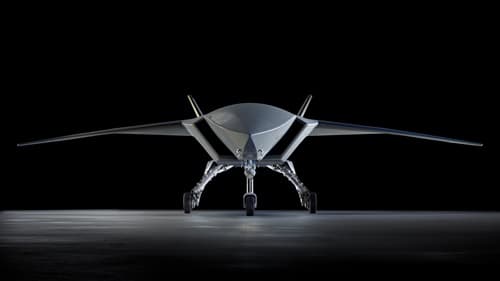
Boeing has unveiled the MQ-28 Ghost Bat Block 3 at ILA Berlin Air Show, marking the first time the Collaborative Combat Aircraft will feature an internal weapons bay capable of carrying two AIM-120 AMRAAM air-to-air missiles or four Small Diameter Bombs. Announced jointly by Boeing Australia and Rheinmetall, Block 3 features a 25% larger wingspan, thrust increased to 12,000 lbs, and BLOS control capability. Australia targets initial operational capability by 2028.

Highlights
- Boeing unveiled the MQ-28 Ghost Bat Block 3 at ILA Berlin 2026, featuring the world's first internal weapons bay on this platform, capable of carrying two AIM-120 AMRAAM missiles or four Small Diameter Bombs.
- Block 3's wingspan grows 25% to 7.3 metres, adding 2,000 lbs of payload capacity and increasing thrust from 10,000 to 12,000 lbs.
- Rheinmetall and Boeing Australia jointly announced in March 2026 to offer the MQ-28 to Germany's Luftwaffe, with Rheinmetall projecting three-digit million euro revenues as system integrator.
- Boeing completed the Ghost Bat's first live-fire AIM-120 AMRAAM test at Woomera Range Complex in December 2025, successfully destroying a Phoenix jet target drone with RAAF support.
- Australia targets MQ-28 initial operational capability around 2028; Germany aims for CCA IOC by 2029, facing competition from the Airbus/Kratos XQ-58A Valkyrie and Airbus U760 Ravenstorm.
Boeing Unveils MQ-28 Ghost Bat Block 3 at ILA Berlin, Integrating Internal AIM-120 Missiles for the First Time
Boeing has officially unveiled a major upgrade to its MQ-28 Ghost Bat Collaborative Combat Aircraft (CCA) at the ILA Berlin Air Show in Germany, with the standout feature being a newly integrated internal weapons bay capable of carrying AIM-120 AMRAAM air-to-air missiles. The upgraded variant — Block 3 — was jointly revealed by officials from Boeing Australia and Rheinmetall, Germany's largest defence manufacturer.
The announcement comes just months after Boeing Australia and Rheinmetall formally partnered in March 2026 to offer the MQ-28 Ghost Bat to the German Air Force (Luftwaffe).
"This is the aircraft we're offering to Germany," said Glen Ferguson, MQ-28 Global Program Director, at the Block 3 unveiling. "This is the third design iteration, and we expect to begin building the first aircraft next year."
MQ-28 Block 3: Key Upgrades at a Glance
The MQ-28 is a stealth-capable, AI-driven unmanned aircraft designed for intelligence, surveillance and reconnaissance (ISR), electronic warfare (EW), and strike missions. Australia has already received eight Block 1 pre-production MQ-28s and plans to acquire subsequent Block 2 and Block 3 production variants. Combined flight testing of Block 1 and Block 2 in Australia and the United States has surpassed 150 sorties, making the Ghost Bat one of the most mature CCA platforms in the world.
Expanded Wingspan and Increased Payload Capacity
According to Boeing, the Block 3's wingspan has grown by approximately 25% compared to the previous variant, expanding from roughly 6 metres to 7.3 metres. This change allows the MQ-28 to carry an additional 2,000 lbs of fuel, stores, and mission payload.
"The additional payload capacity gives operators the flexibility to trade off between payload and endurance — whether carrying more fuel for longer-range missions, more weapons, or a combination of both," Ferguson said. The aircraft's thrust will also increase from 10,000 lbs to 12,000 lbs, though the specific means of achieving this have not yet been disclosed.
Internal Weapons Bay: From Loyal Wingman to Combat Aircraft
The most significant upgrade in Block 3 is the addition of an internal weapons bay capable of carrying two AIM-120 AMRAAM missiles or four Small Diameter Bombs (SDBs). This development transforms the MQ-28 from a traditional "loyal wingman" escort drone into a genuine CCA with air-to-air combat capability.
The weapons bays are positioned on either side of the fuselage and are internally housed to preserve the aircraft's low-observable characteristics. Just days before the Block 3 announcement, Boeing completed radar cross-section (RCS) validation for the Ghost Bat, confirming its high degree of stealth and survivability in contested airspace.
"The combination of a high-performance platform, low-observable characteristics, and advanced autonomous capabilities gives air forces an unprecedented extension of mission effectiveness and operational flexibility," said Brad Thompson, Director of Boeing Phantom Works Australia.
Notably, Boeing conducted the MQ-28 Ghost Bat's first live-fire weapons test in December 2025 at the Woomera Range Complex (WRC) in South Australia, successfully launching an AIM-120 AMRAAM that destroyed an Australian-manufactured Phoenix jet target drone. The exercise was conducted in coordination with the Royal Australian Air Force's (RAAF) E-7A Wedgetail airborne early warning aircraft and F/A-18F Super Hornet fighters.
Interchangeable Nose Sections and Sensor Payloads
Boeing is understood to be developing three to four sensor payload options for Block 3, enabled by a fully interchangeable nose section design. This allows operators to rapidly reconfigure the aircraft with an infrared search and track (IRST) system or an electronic warfare suite depending on mission requirements.
Beyond Line-of-Sight (BLOS) Control
Another key new capability in Block 3 is beyond line-of-sight (BLOS) control, enabling the aircraft to be operated from manned aircraft, naval vessels, or ground stations. BLOS capability allows the drone to operate autonomously when not under direct control from a crewed aircraft, and enhances resilience against electronic warfare jamming.
"The inclusion of capabilities like BLOS comes directly from what we have learned so far, and from air forces' understanding and feedback on the CCA role and how it integrates," Ferguson said. "These capabilities, co-developed with the RAAF, will be progressively released to the fleet through a spiral upgrade programme and made available to partner nations."
"The maturity of the MQ-28 system allows us to continue adapting to the evolving operational environment and minimise risk as we transition to operational service," said Amy List, Vice President and General Manager of Boeing Defence Australia. "Combined with confirmed low-observable characteristics and survivability upgrades, these enhancements support more flexible mission concepts and allow defence customers to further distribute operational risk."
Strategic Push into Germany
Rheinmetall announced its agreement with Boeing Australia on 31 March 2026 to jointly offer the MQ-28 to the German military. "As system integrator, we ensure that integration, operation, and further development come from a single source, while establishing industrial hubs in Germany and Europe to strengthen domestic industrial value creation," said Rheinmetall CEO Armin Papperger. "We estimate Rheinmetall's potential revenue from this at a three-digit million euro figure."
Under this partnership framework, Rheinmetall will serve as the "system custodian" within Germany, responsible for integrating the MQ-28 with existing and future Bundeswehr command-and-control and weapons systems, as well as providing in-country maintenance, logistics, and operational support.
Germany plans to procure hundreds of CCAs across different weight classes to augment its current fleet — primarily Eurofighter Typhoons and Panavia Tornados, with F-35 stealth fighters on the way. With the Franco-German FCAS next-generation fighter programme now formally terminated, Germany is actively seeking to strengthen its air combat capabilities through loyal wingman integration, targeting initial operational capability by 2029.
Fierce Market Competition
The MQ-28 Ghost Bat faces stiff competition in Germany. A consortium of Airbus and Kratos has put forward the XQ-58A Valkyrie, while General Atomics Aeronautical Systems (GA-ASI) has expressed interest in offering a European variant of the YFQ-42A prototype. Airbus also made its move at ILA Berlin 2026, unveiling the new U760 Ravenstorm CCA — designed for air-to-air, air-to-ground, and electronic warfare missions — just days before the MQ-28 Block 3 reveal.
The MQ-28's Core Competitive Advantages
The MQ-28 Ghost Bat offers a range of approximately 3,700 km and an endurance of more than 10 hours, extending the sensor reach of crewed fighters and enhancing their survivability in contested airspace. A key selling point is that it costs a fraction of a manned combat aircraft to manufacture and can be employed in an attritable role in conflict zones if necessary — allowing prospective customers to rapidly field relevant combat capability without starting from scratch.
Block 3 is expected to reach operational capability in Australia around 2028, and Boeing's high-profile reveal in Berlin signals its strong ambition to secure the German contract.
原文來源: 查看原文
FAQ
Newsletter
Subscribe to our Low-Altitude Industry Newsletter
Daily curated news on low-altitude economy and drone industry, delivered to your inbox.