Airbus Launches Ravenstorm Combat Drone to Lead Revamped Unmanned Portfolio Amid FCAS Turmoil
As Europe's Next Generation Fighter (NGF) programme collapses, Airbus has unveiled the U760 Ravenstorm combat drone at ILA Berlin, headlining a comprehensive new unmanned portfolio that includes a European Valkyrie variant, MALE platforms, and counter-drone systems — all targeting early 2030s service entry.

Highlights
- Airbus unveiled the U760 Ravenstorm at ILA Berlin — a stealthy UCCA approximately 43 feet long and 33 feet in wingspan designed for air-to-air, strike, and electronic warfare missions, targeting early 2030s service entry.
- The Ravenstorm launch coincides with the collapse of the Franco-German Next Generation Fighter (NGF) programme under the pan-European FCAS initiative, signalling a potential pivot in European combat aviation strategy.
- Airbus simultaneously introduced the U740 Valkyrie — a European XQ-58A variant combining the Kratos airframe with Airbus's MARS mission system — with first delivery to the German Luftwaffe planned for 2029.
- The MARS (Multi-platform Autonomous Reconfigurable and Secure) AI-assisted mission system will be deployed across Airbus's entire unmanned portfolio, including the U950 Eurodrone MALE platform targeting a 2029 first flight.
- Airbus's new unmanned product line draws on experience from the EADS Barracuda demonstrator (2003) and the classified LOUT stealth test platform (revealed publicly in 2019).
Airbus Unveils Ravenstorm to Lead Sweeping Unmanned Portfolio Overhaul
Airbus has officially revealed the U760 Ravenstorm combat drone, a platform designed to operate alongside crewed fighters in air-to-air combat, strike, and electronic warfare roles. The Ravenstorm sits at the centre of a comprehensive revamp of Airbus's unmanned product line, which also encompasses a European-adapted version of the stealthy XQ-58A Valkyrie, a Medium Altitude Long Endurance (MALE) platform, various tactical solutions, counter-drone systems, and the U145 unmanned helicopter.
A Timely Announcement
The timing of the announcement is particularly significant. The crewed Next Generation Fighter (NGF) programme — led by France and Germany as part of the pan-European Future Combat Air System (FCAS) initiative — has recently collapsed. On the eve of the ILA Berlin Airshow, Airbus presented what it describes as "Europe's most comprehensive drone portfolio." All products now carry a "U" prefix denoting unmanned systems, mirroring the "A" prefix for crewed fixed-wing aircraft and "H" for crewed helicopters.
Mike Schoellhorn, CEO of Airbus Defence and Space, said in a press release: "Whatever drone or 'uncrewed vehicle' capability our customers need to strengthen sovereign airpower, we can provide. Our portfolio ranges from fast-reaction drone interceptors and tactical drones of all kinds, to autonomous cargo helicopters and Unmanned Collaborative Combat Aircraft (UCCA) operating alongside crewed fighters."
U760 Ravenstorm: Specifications and Design
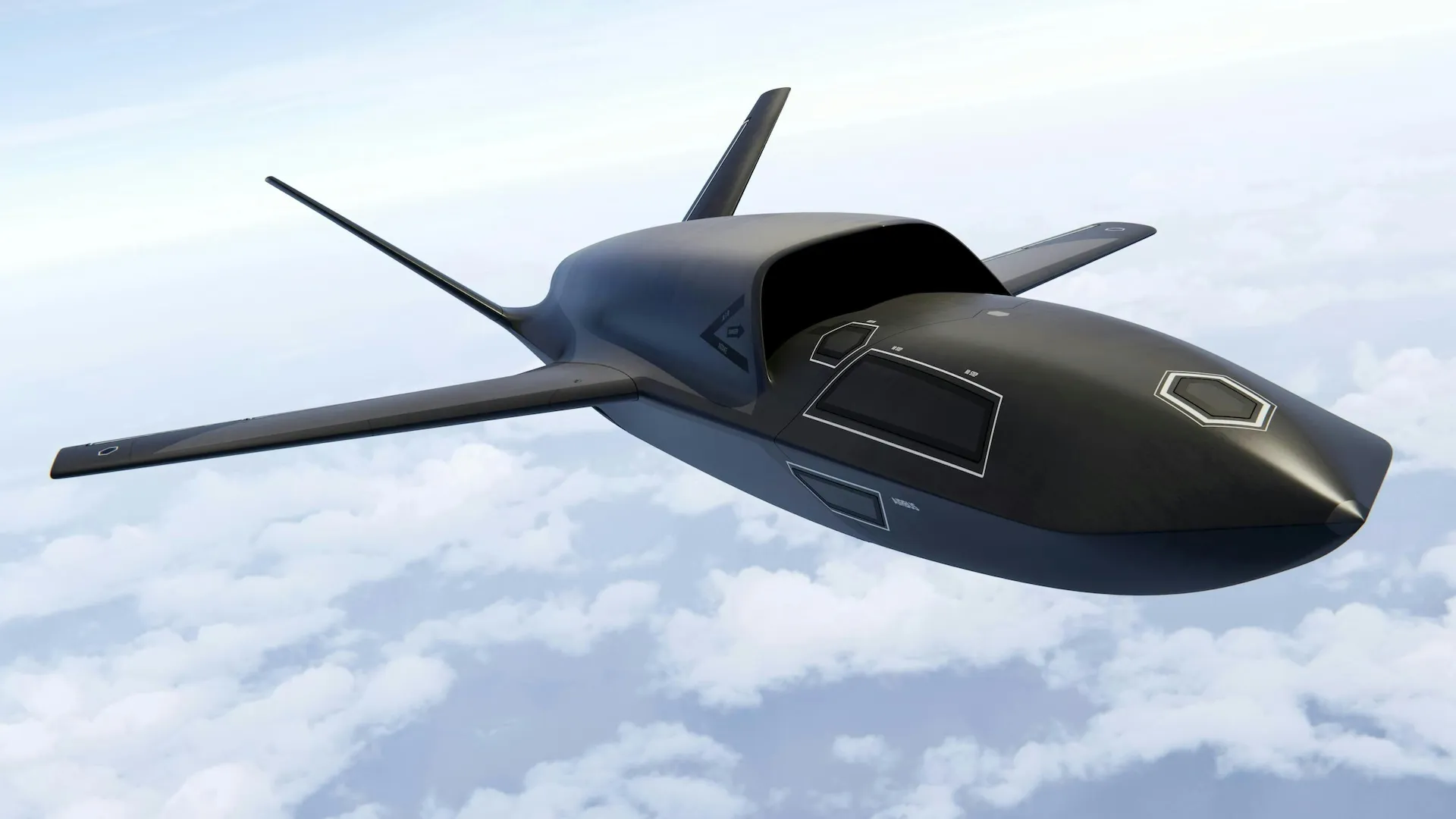
As the most prominent new addition to the "U" family, a 1:1 scale model of the Ravenstorm will be displayed at ILA. The aircraft measures approximately 43 feet (13.1 metres) in length with a wingspan of roughly 33 feet (10 metres). In overall dimensions and appearance, the Ravenstorm bears a strong resemblance to General Atomics' YFQ-42A "combat drone" prototype, currently undergoing flight testing in the first increment of the U.S. Air Force's Collaborative Combat Aircraft (CCA) programme.
Like the U.S. CCA contenders, the Ravenstorm features a swept mid-wing configuration optimised for stealth and manoeuvrability, paired with a twin-tail design. Its dorsal air intake bears some similarity to the EADS Barracuda demonstrator, which first flew two decades ago. Overall, the aircraft is clearly optimised for low-observable (stealth) characteristics, though its intake is notably larger and does not adopt the trapezoidal inlet geometry of the YFQ-42.
Diverse Mission Roles
Airbus positions the Ravenstorm as the "next evolutionary step" toward a "scalable family of Unmanned Collaborative Combat Aircraft." The company has outlined the following mission types:
- Air-to-ground strike: Using precision-guided munitions
- Air-to-air defence: Armed with medium- and long-range air-to-air missiles
- Electronic warfare: Suppression of enemy air defences
- Offensive counter-air operations: Providing non-kinetic jamming capabilities
Airbus plans for the Ravenstorm to enter service in the early 2030s.
U740 Valkyrie: The European XQ-58
Alongside the Ravenstorm, Airbus is also offering a European version of the XQ-58. Designated U740 in the Airbus naming system, the Valkyrie pairs the Kratos-designed airframe with Airbus's internally developed MARS (Multi-platform Autonomous Reconfigurable and Secure) mission system.
Airbus has provided a notably precise service timeline for the U740: first delivery to the German Air Force (Luftwaffe) in 2029. While it remains unclear whether the Valkyrie has been formally selected by the Luftwaffe, Airbus anticipates the U740 will participate in formation flight experiments with Eurofighter jets, including demonstrations of initial air-to-ground capabilities.
The Logic Behind a Dual-Track Strategy
Analysts note that the simultaneous introduction of both the U740 Valkyrie and the U760 Ravenstorm — two broadly similar-sized UCCA platforms — reflects distinct cost positioning. The Valkyrie was designed from the outset as a low-cost vehicle, with the original version requiring no runway (using a launch rail for take-off). The Ravenstorm, by contrast, is positioned as a higher-performance, higher-cost platform more closely aligned with U.S. Air Force CCA Increment 1 standards.
Airbus's likely strategy is to use the Valkyrie for early operational experimentation with UCCA concepts before transitioning focus to the fully indigenous Ravenstorm, which could be scaled up, performance-enhanced, and fitted with more advanced stealth features.
MARS Mission System and Eurodrone
MARS is Airbus's sovereign autonomous mission system, leveraging an AI-assisted software core to deliver platform autonomy across the entire Airbus unmanned portfolio. The system is also planned for integration on the U950 Eurodrone — the new designation for the Eurodrone MALE platform. This twin-turboprop UAS is under development for Intelligence, Surveillance, Target Acquisition and Reconnaissance (ISTAR), early warning, and anti-submarine warfare missions, with a first flight targeted for 2029.
The Future of European Combat Aviation
Against the backdrop of the effective demise of the FCAS crewed NGF programme, Airbus's new unmanned portfolio signals a potential redirection of European combat aviation ambitions. Collaborative combat drones were originally conceived as force multipliers for both current and next-generation crewed fighters. With the NGF cancelled, this class of combat drone may face significantly higher demand across Europe, where nations urgently need to expand tactical combat air fleets with limited resources.
At the same time, CCA-type drones promise to make existing fourth- and fifth-generation fighters considerably more capable — a factor that will further stimulate demand across European and global markets. The experience Airbus accumulated through the Barracuda technology demonstrator programme (begun in 2003) and the highly classified LOUT stealth test platform (not publicly revealed until 2019) provides the technological foundation underpinning these new products.
原文來源: 查看原文