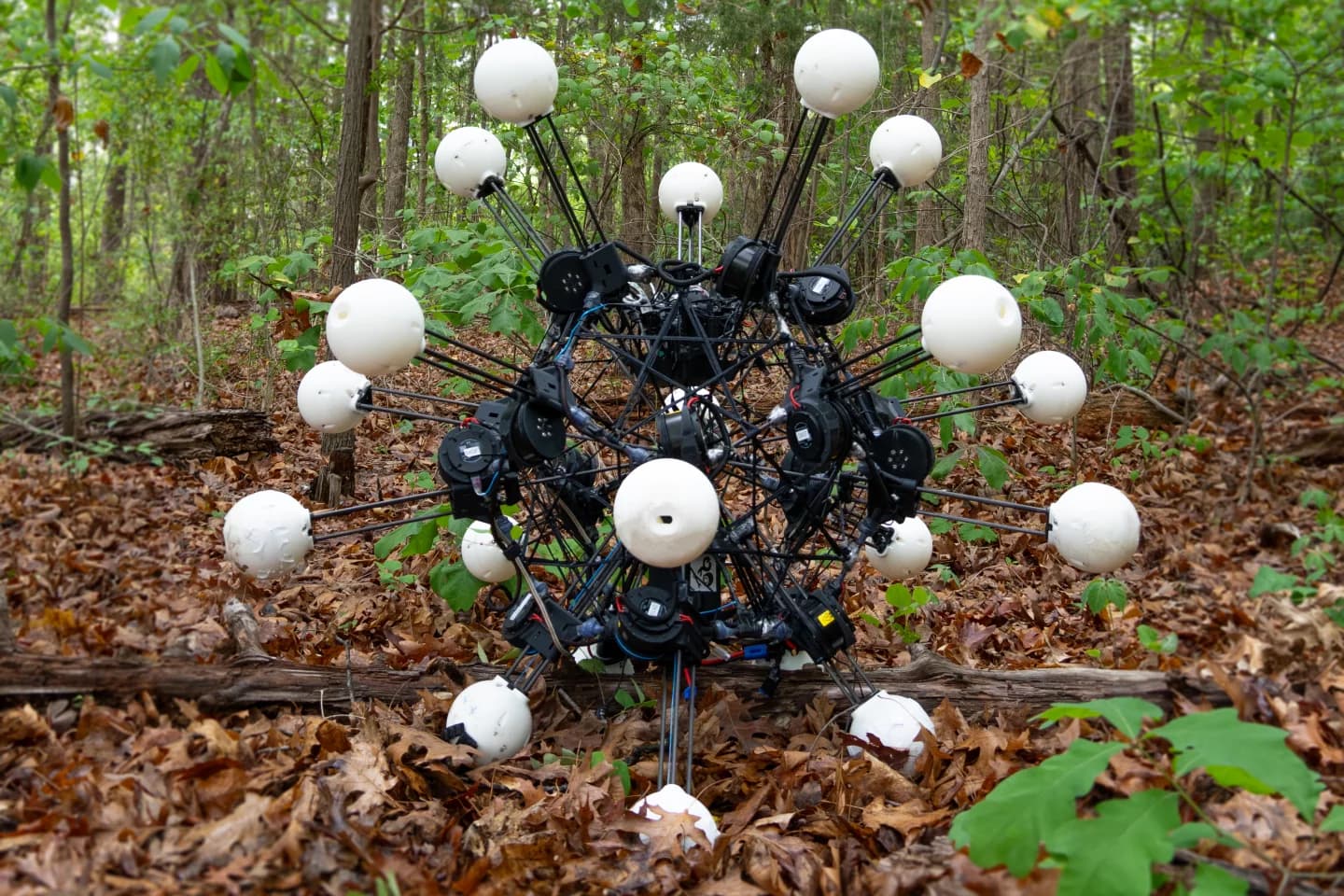
Duke University Builds Sea Urchin-Inspired Robot 'Argus': 20 Eyes, 20 Legs, Free Movement in Any Direction
Researchers at Duke University have developed Argus, a sea urchin-inspired robot featuring 20 sensory eyes and 20 independently actuated legs. Breaking away from conventional symmetric design, Argus can move in any direction with equal efficiency, establishing a new design paradigm for omnidirectional mobile robotics.

Highlights
- Duke University's Argus robot features 20 sensory eyes and 20 independently actuated legs modeled after the sea urchin.
- Argus uses an asymmetric body layout that allows omnidirectional movement with equal efficiency in any direction.
- The design challenges the long-held industry assumption that symmetric robot structures are inherently optimal.
- Omnidirectional locomotion technology like Argus could be applied to search and rescue, confined-space exploration, and drone-robot hybrid missions.
Breaking the Symmetry Myth: Meet Argus, the Sea Urchin Robot
Most living creatures — humans included — share a symmetrical body plan. Because designers tend to reflect their own nature in their creations, the majority of today's robots follow the same principle, and the industry has long operated under the assumption that symmetry equals optimal design. A research team at Duke University is now challenging that assumption head-on with a radical new robot called Argus.
Omnidirectional Mobility Inspired by the Sea Urchin
Argus draws its form from the sea urchin, equipped with 20 sensory 'eyes' and 20 independently actuated leg structures, dispensing entirely with traditional symmetric architecture. This asymmetric layout gives Argus a distinctive advantage: it can move in any direction with equal efficiency and agility, no longer constrained by the directional bias — front-to-back or side-to-side — that limits conventional robots.
Implications for Robot Design
The research carries significant implications for the field of robot locomotion. Mainstream robot designs have historically favored symmetric configurations — bipedal, quadrupedal, or hexapedal — which perform well along preferred axes but remain limited in truly omnidirectional scenarios. Argus demonstrates that asymmetric design may deliver superior performance in tasks requiring a high degree of omnidirectional mobility.
Omnidirectional locomotion technology of this kind could find future applications in search and rescue operations, confined-space exploration, and even hybrid ground-air collaboration missions alongside drones — opening an entirely new avenue of thinking for the robotics industry.
原文來源: 查看原文