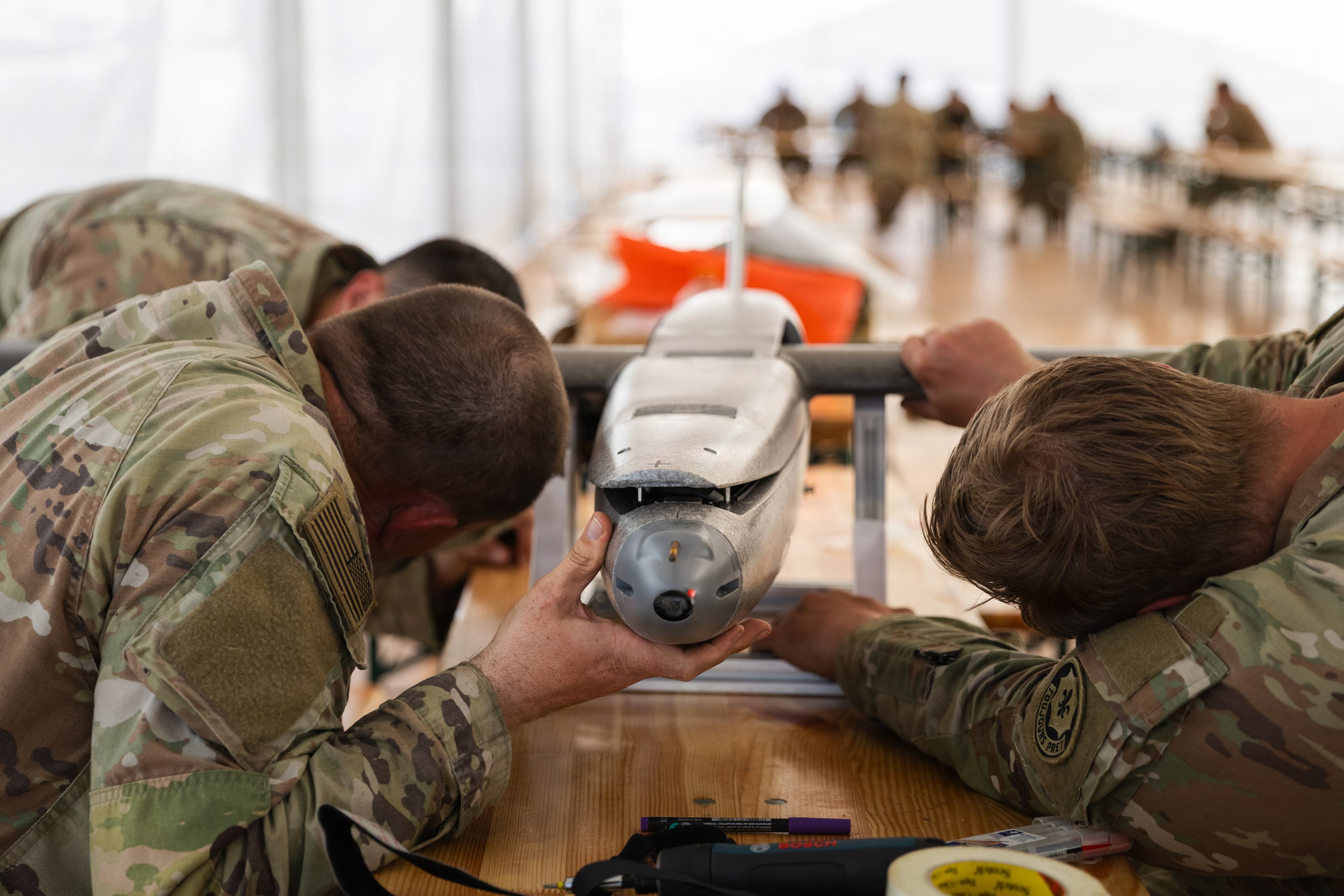
Pentagon Announces 'Preferred Munitions' List for Suicide Drones — Northrop Grumman and Multiple Startups Selected
The U.S. Department of Defense's Drone Dominance program has revealed the winners of its Lethality Prize Challenge. Northrop Grumman and four startups were selected for developing low-cost payloads to serve as preferred munitions for one-way attack drones, as the Pentagon aims to procure approximately 300,000 drones by 2028 while driving per-unit costs down from $5,000 to $2,300.

Highlights
- The Pentagon's $1.1B Drone Dominance program selected Northrop Grumman and four startups as Lethality Prize Challenge winners for one-way attack drone munitions.
- The DoD aims to procure approximately 300,000 military drones by 2028, reducing per-unit cost from $5,000 to $2,300.
- Northrop Grumman's Common UAS Payload is designed as a plug-and-play system, backed by over $2 billion in prior investment in related technologies.
- Israeli startup Kela Technologies has raised roughly $100 million in funding with a $1.2 billion valuation, partnering with Autonomous Guard for the challenge.
- Phase 2 is currently evaluating 79 drone models from 49 companies, with Phase 3 expected to begin around November 2026.
Pentagon Reveals Preferred Munitions Suppliers for Suicide Drones
The U.S. Department of Defense has announced the winners of the Lethality Prize Challenge under its Drone Dominance program. The program carries a total budget of $1.1 billion and is designed to scale up domestic drone production while reducing the cost of military commercial-off-the-shelf (COTS) drones.
The Defense Innovation Unit (DIU) announced last month via LinkedIn that the winners include Bravo Ordnance, Kela Technologies, Kraken Kinetics, Mountain Horse Solutions, and Northrop Grumman — all of which developed "cost-effective, mass-producible, and easily integrable lethal payloads for small drones."
17 Competitors, 5 Winners
According to the program's Industry Day briefing, a military review panel evaluated proposals from 17 companies. The assessment covered payload performance, interface integration with various Electronic Safe/Arm Devices (ESADs), and compatibility with the candidate drone platforms in the program.
Although the prize money was a modest $10,000 — negligible compared to the Pentagon's massive investment scope — the selected designs will be recommended as "preferred munitions" to participating companies for use in one-way attack (OWA) drones.
Northrop Grumman: A Plug-and-Play Universal Payload
Northrop Grumman's winning entry, called the Common UAS Payload, was described by Tanya Santers, director of the company's fuzes and warheads division, as a system designed to require "no redesign" and to be "immediately deployable upon integration."
The company added that it has invested over $2 billion in related technologies and manufacturing facilities over recent years to meet program requirements and accelerate delivery timelines.
Startups Race into the Military Drone Munitions Market
Unlike Northrop Grumman, which boasts a mature defense industrial base and decades of munitions production experience, the other winners are relatively young companies aggressively pursuing the military's growing demand for drone warfare technology.
Bravo Ordnance, headquartered in Texas, was founded in 2025 and has secured $3.5 million in venture capital funding. The company claims it can build custom warheads "in two weeks or less." Founder Devan Plantamura, a veteran of the U.S. Navy and Army, told GQ magazine that his experience working in military-tech startups made him realize the industry was overly focused on drone platforms while neglecting the weapons they carry. An attack drone without a warhead, he said, "is just a flying object."
Kela Technologies is an Israeli defense startup founded in July 2024, shortly after the October 7 attacks. It was initially positioned as a software company focused on helping Western militaries rapidly integrate commercial technologies into existing military systems. The company quickly attracted backing from Silicon Valley investors and IQT, the CIA's venture capital arm. Within just two years, Kela raised approximately $100 million in funding plus an additional $200 million in financing, with a reported valuation of $1.2 billion. While software integration remains its core business, Kela also won the Lethality Prize Challenge, reportedly partnering with fellow Israeli defense firm Autonomous Guard for the competition.
Kraken Kinetics, headquartered in North Carolina, was founded in 2023 and specializes in manufacturing warheads for drone warfare. The company has been actively promoting its Terminus payload system — a warhead specifically designed for first-person-view (FPV) attack drones. Kraken has demonstrated the system to Army Rangers, the Marine Corps, and other military units, emphasizing its rapid installation on COTS drone platforms via ESAD interfaces.
Mountain Horse Solutions, headquartered in Colorado, is the most established among the selected companies. Founded in 2014, its parent company Global Ordnance was established roughly a year earlier. Originally focused on personal protective equipment, Mountain Horse expanded into military drones in 2025. That same year, Mountain Horse and its partner Rotron Aerospace were added to the DoD's Blue UAS approved drone systems list. For the challenge, Mountain Horse collaborated with several partner companies to develop a payload system compatible with "any drone on the market."
The Full Picture: 300,000 Drones by 2028
The U.S. Department of Defense launched the Drone Dominance program in July 2025 and unveiled a three-phase procurement framework in December of the same year, with a target of procuring approximately 300,000 drones by 2028.
In Phase 1, the Pentagon invited 26 companies to demonstrate their systems. In the currently ongoing Phase 2, the military is evaluating 79 drone models from 49 companies, covering both long-range and close-range missions.
In subsequent phases, the Pentagon plans to progressively narrow the field to a select few suppliers. According to DoD officials, the goal is to reduce the average cost of military drones from approximately $5,000 to $2,300.
Phase 3 is expected to launch around November 2026, with final testing to follow approximately six months later.
原文來源: 查看原文