SwRI Develops Impact Flash Spectroscopy Tech With Applications in Missile Defense and Asteroid Science
Scientists at Southwest Research Institute (SwRI) have achieved a breakthrough in analyzing impact flashes generated by hypervelocity collisions, capturing spectral data within 100 nanoseconds. The technology could help missile defense systems identify intercepted missile and warhead compositions, and assist scientists in determining the origins of meteorites or asteroids that strike planetary surfaces.

Highlights
- SwRI researchers captured hypervelocity impact flash spectral data within 100 nanoseconds using a custom laser-triggered system.
- Two-stage light-gas guns at SwRI simulate collision velocities of up to 7 km/s (15,660 mph) across a 22-meter facility.
- Aluminum emission doublet near 396 nm and copper triplet near 515 nm were measured to within ±2 nm of published reference values.
- The technology could enable missile defense systems to identify warhead and missile material composition in real time.
- Atmospheric pressure, atmospheric composition, and projectile velocity were all found to affect emission line amplitude and width in impact flash spectra.
SwRI Impact Flash Spectroscopy Advances Missile Defense and Space Science
Researchers at Southwest Research Institute (SwRI) are making significant strides in understanding the impact flashes produced by hypervelocity collisions. The team reports that breakthroughs in the analysis of optical impact flashes could have major implications for missile defense systems — enabling real-time identification of the material composition of intercepted missiles and warheads. The technology also holds promise for planetary science, helping researchers determine the origin of meteorites or asteroids based on compositional analysis following a surface impact.
Collision Energy Generates Analyzable Flash Signatures
Dr. Pablo Bueno, a principal engineer in SwRI's Mechanical Engineering Division, explained: "When a meteorite strikes the surface of the Moon or a planet, the collision energy generates a flash that releases enormous energy, making the chemical signatures of its constituent materials visible across different wavelengths."
The researchers note that impact flashes are a physical phenomenon common to both conventional-velocity and hypervelocity impacts. Because a flash's emission characteristics are linked to the composition of the target material, spectral data obtained via spectrometer measurements can be used to identify the materials involved in a collision.
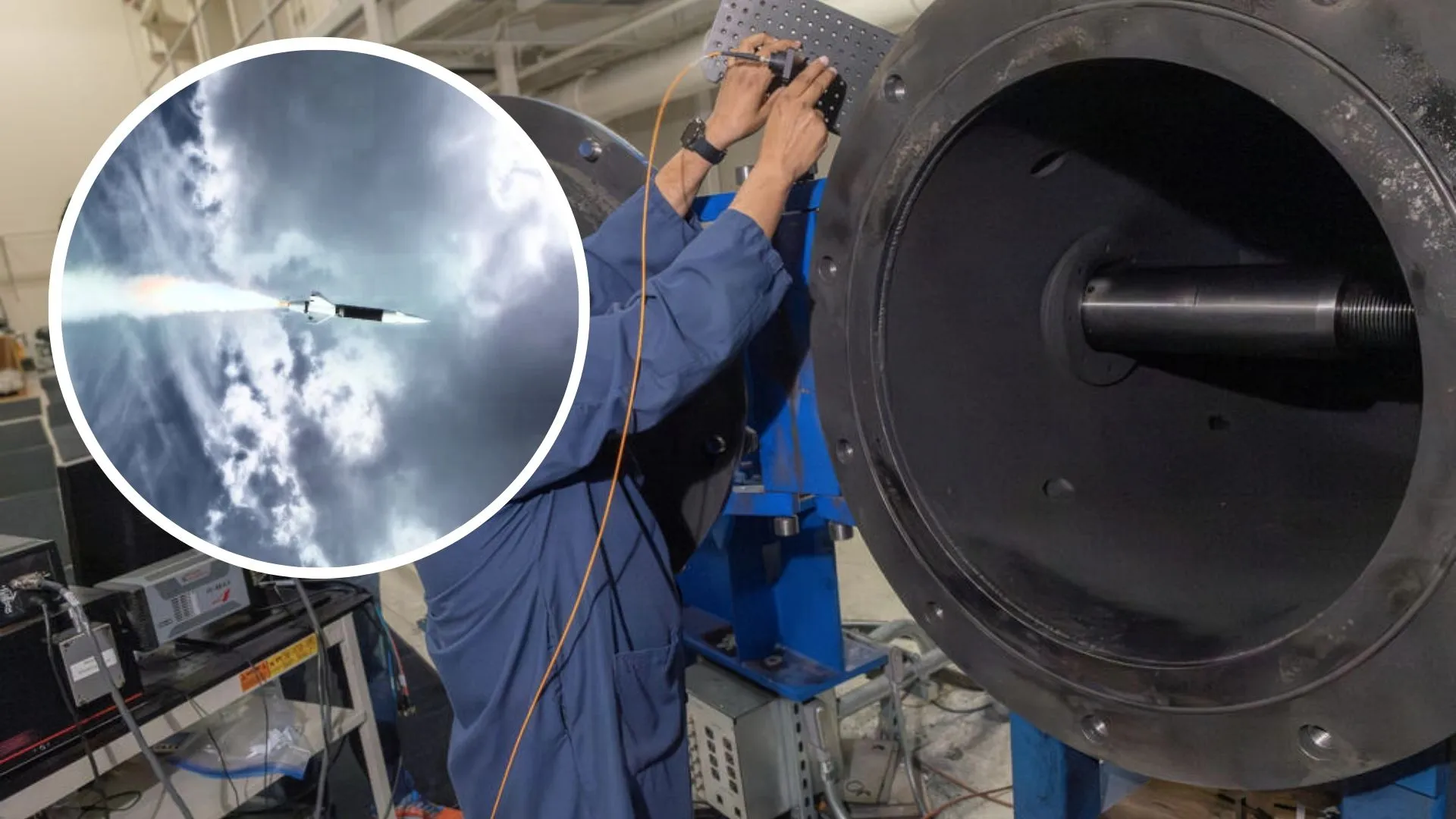
Bueno and SwRI senior research engineer Roberto Enriquez-Vargas recently completed an internally funded project to develop and refine methods for analyzing light emissions from hypervelocity impacts using high-speed spectroscopy. Since flashes from hypervelocity impacts typically last only a few microseconds, the team needed to capture spectral data rapidly and precisely within an extremely narrow time window.
Laser-Triggered System Achieves Nanosecond-Level Timing Precision
Bueno and Enriquez-Vargas used two of SwRI's two-stage light-gas guns to simulate the hypervelocity collisions characteristic of missile strikes or asteroid impacts. The larger gun system can generate projectile velocities of up to 7 kilometers per second (15,660 mph) and spans 22 meters (72 feet) in total length — a platform traditionally used for ballistics research.
Because impacts occur almost instantaneously and flash decay is extremely rapid, the team developed a laser-triggered system capable of detecting the precise moment of impact, achieving timing accuracy within 100 nanoseconds (one hundred-millionth of a second).
"Thicker targets produce brighter and longer-duration flashes," Bueno noted. "Higher atmospheric pressure generates broader and more intense emission lines in the spectrum, and in many cases, materials at elevated temperatures behave very differently than when struck at room temperature."
Aluminum and Copper Spectral Lines Successfully Characterized
The team successfully developed and tested the laser-triggering approach, demonstrating precise timing capability within 100 nanoseconds post-impact. Strong emission lines for aluminum and copper were measured and characterized with an accuracy within ±2 nanometers of their published reference values. The aluminum doublet near 396 nm and the copper triplet near 515 nm were identified as the optimal analytical lines for subsequent experimental test matrices.
The team also documented the effects of projectile velocity, atmospheric pressure, and atmospheric composition on spectral results, finding that these parameters influence both the amplitude and width of emission lines. Some of these findings have already satisfied the project's third milestone requirements.
This research not only provides missile defense systems with a powerful new real-time analytical capability, but also opens new avenues for identifying the composition of meteorites and asteroids in space science — demonstrating the dual-use potential of high-speed spectroscopy across defense and scientific domains.
原文來源: 查看原文
FAQ
Newsletter
Subscribe to our Low-Altitude Industry Newsletter
Daily curated news on low-altitude economy and drone industry, delivered to your inbox.