U.S. Army Landing Craft Launches High-Altitude Balloons Capable of Deploying Drones
During last month's African Lion 26 exercise off the coast of Morocco, the U.S. Army launched six low-observable micro high-altitude balloons from a landing craft. Developed by Mach Industries, the systems carried satellite communications equipment and one-way attack drones, testing long-range communications and precision strike capabilities for U.S. Special Operations Command.

Highlights
- The U.S. Army launched six micro high-altitude balloons (μHABs) from the vessel Maj. Gen. Charles P. Gross during the African Lion 26 exercise off Morocco.
- The balloons, developed with Mach Industries, operated at altitudes of 60,000 feet or higher, carrying one-way attack drones, satellite comms, and ISR payloads for USSOCOM.
- During the exercise, balloons successfully released one-way attack munitions that accurately struck designated targets, demonstrating a precision strike capability.
- The Army's Capability Program Executive Office for Intelligence and Spectrum Operations — overseeing 80+ active programs — supported the exercise to rapidly field low-cost capabilities.
- This test follows accelerated U.S. DoD balloon deployment efforts since the 2023 Chinese balloon incident, including large-scale trials during Valiant Shield 2024 in the Indo-Pacific.
U.S. Army Landing Craft Launches High-Altitude Balloons Capable of Deploying Drones
During exercises conducted last month off the coast of Morocco, the U.S. Army launched several low-observable micro high-altitude balloons from a landing craft to test new Launched Effects and satellite communications capabilities developed by Mach Industries. The tests were designed to validate long-range communications and the ability to conduct precision strikes using one-way attack drones.
The exercise, dubbed African Lion 26, focused on evaluating emerging technologies required by U.S. Special Operations Command (USSOCOM), with the aim of enhancing intelligence, surveillance, and reconnaissance (ISR) capabilities across echelons. The balloons carried a combination of drones, communications relay nodes, and satellite communications equipment.
"These systems operate in the stratosphere, at 60,000 feet or higher, providing persistent local situational awareness, communications extension, and the ability to deploy Launched Effects (LE) using dedicated sensor payloads." — U.S. Army press release
A total of six balloons were launched during the exercise. Support was provided by the Army's Capability Program Executive Office for Intelligence and Spectrum Operations, which is responsible for rapidly fielding low-cost capabilities and currently oversees more than 80 active programs.
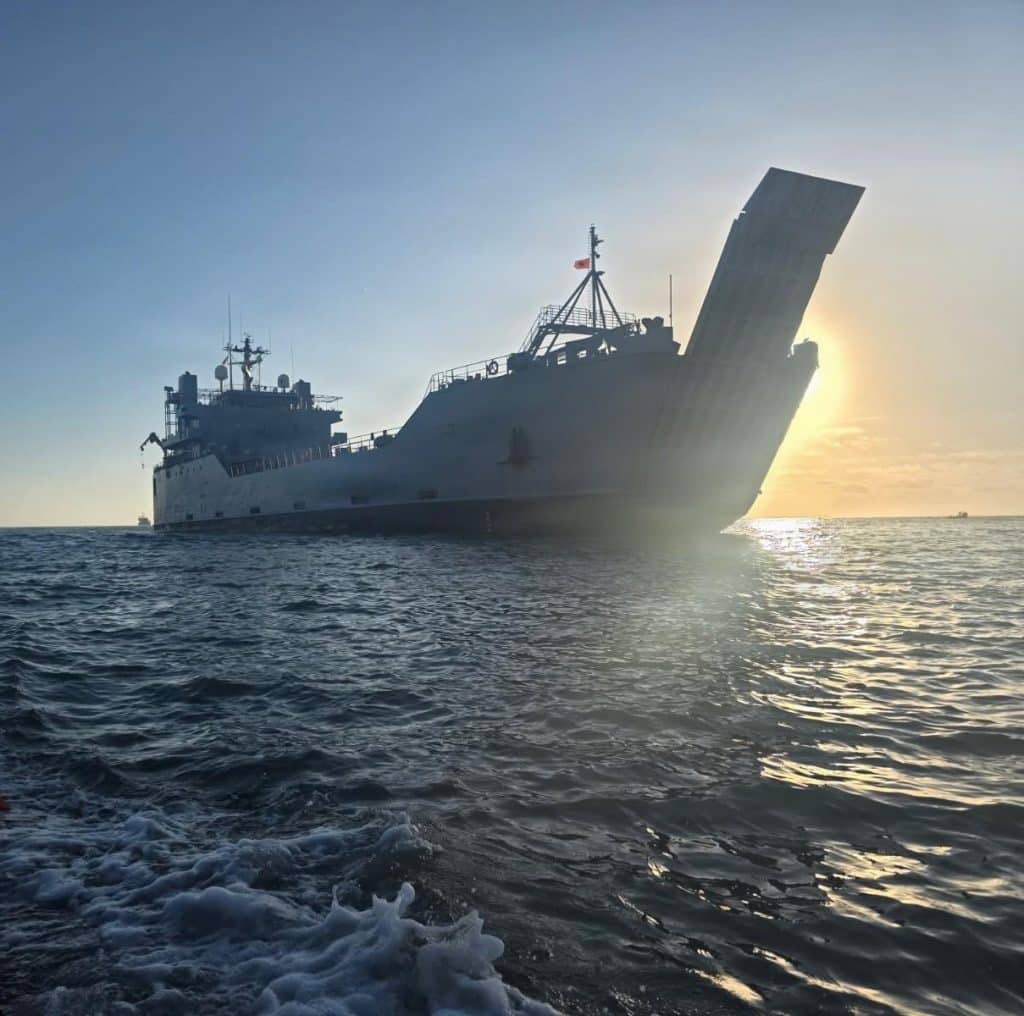
The U.S. Army Vessel Maj. Gen. Charles P. Gross served as the launch platform for the micro high-altitude balloon (μHAB) maritime trials off the coast of Morocco. (Photo: Zachary Pickard)
High-Altitude Balloons Return to U.S. Military Focus
High-altitude balloons attracted widespread attention in 2023, when a Chinese balloon traversed the continental United States for nearly a week — passing over multiple military installations — before being shot down by a U.S. Air Force F-22 off the coast of South Carolina.
Following that incident, the Department of Defense accelerated its testing and deployment of high-altitude balloon systems, trialing various configurations and types across the Indo-Pacific region. This included large-scale testing during the Valiant Shield 2024 field training exercise, where balloons supported maritime surveillance missions and live-fire drills. Naval News previously reported on balloon support during that exercise's culminating SINKEX (sinking exercise) event.
Compact Design Suited for Front-Line Units
The balloons used during African Lion differ from the large, hardened balloons typically employed for transoceanic missions. These micro balloons can be deployed by small units in the field, giving ground forces greater operational flexibility and additional options in contested environments — including what the U.S. Army describes as "exquisite kinetic effects." During the exercise, the balloons successfully released one-way attack munitions that accurately struck their targets.
Establishing secure and reliable communications has historically proven extremely difficult for ground forces operating across vast terrain such as the Pacific or the Middle East, as demonstrated during Operation Epic Fury.
The range of missions that Army units are expected to execute in contested environments is rapidly evolving to meet the new operational demands revealed by combat operations in the Middle East. Equipping high-altitude balloons with diverse sensor and payload options — including drones — has the potential to fill several critical gaps in the existing Army communications and effects toolkit.
原文來源: 查看原文
FAQ
Newsletter
Subscribe to our Low-Altitude Industry Newsletter
Daily curated news on low-altitude economy and drone industry, delivered to your inbox.