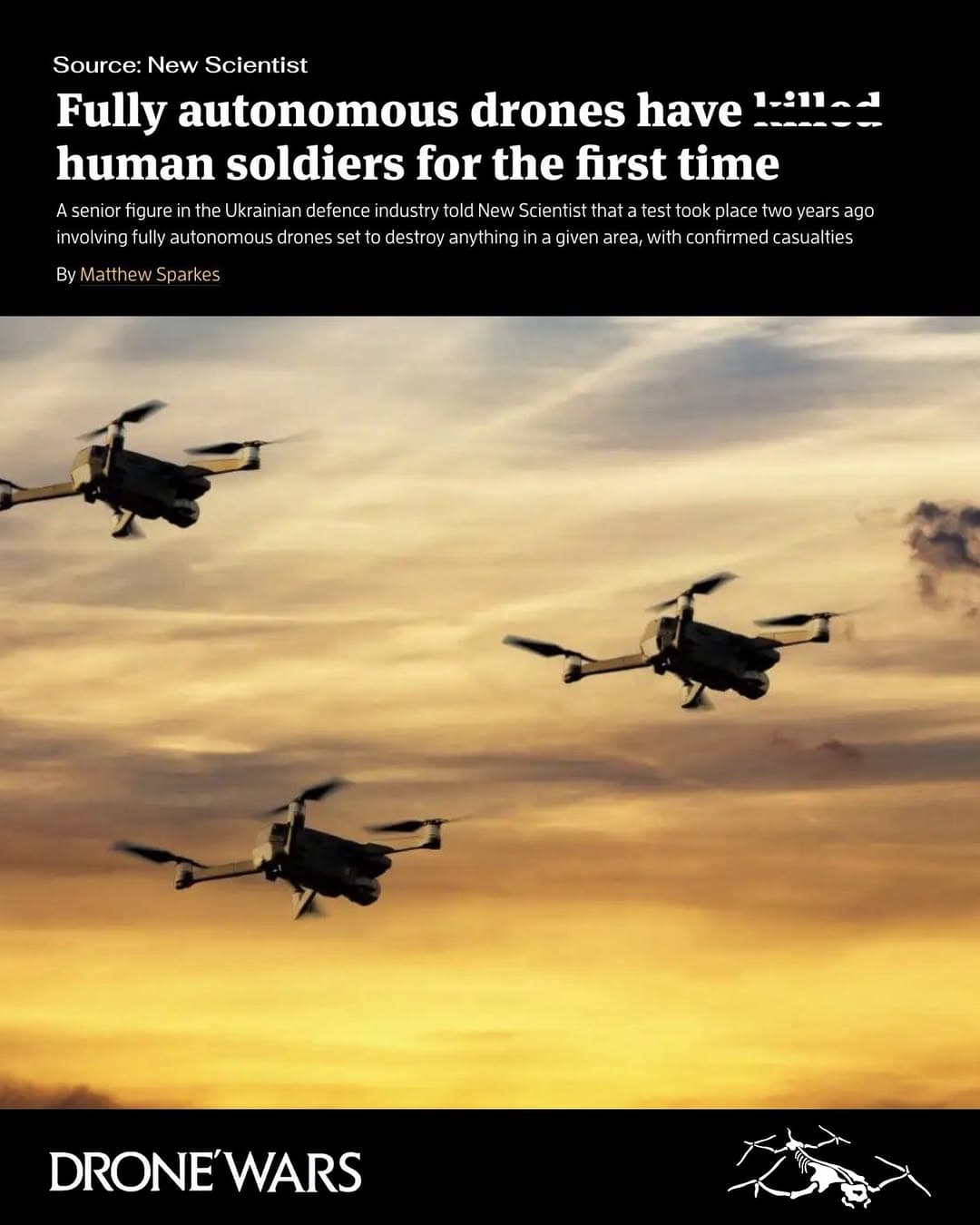
Ukrainian Developer Reveals AI Autonomous Attack Drone 'Terminator' Was Combat-Tested Near Bakhmut Two Years Ago
Ukrainian drone developer Alexander Kokhanovskyy has disclosed that a fully autonomous AI-controlled attack drone, dubbed 'Terminator,' was covertly tested in combat conditions near Bakhmut and Chasiv Yar approximately two years ago. Ten drones engaged targets without any human intervention in the terminal attack phase, resulting in confirmed losses of several soldiers and a military truck — in apparent violation of Ukraine's own regulations requiring human-in-the-loop oversight.

Highlights
- Ukrainian developer Alexander Kokhanovskyy disclosed that ten autonomous AI attack drones called 'Terminator' conducted a live combat trial near Bakhmut and Chasiv Yar approximately two years ago.
- The drones operated without any human intervention during the terminal attack phase, confirming kills of several soldiers and one military truck.
- The trial appears to violate Ukraine's own regulations, which explicitly require Human-in-the-Loop (HITL) oversight before any lethal strike is executed.
- The Ukrainian government is actively discussing whether to relax or revise its restrictions on fully autonomous weapons systems in response to battlefield pressures.
- No binding international treaty currently governs the use of fully autonomous lethal weapons systems (LAWS), leaving a significant regulatory gap highlighted by this disclosure.
Ukrainian Developer Reveals AI Autonomous Attack Drone 'Terminator' Was Combat-Tested Near Bakhmut Two Years Ago
Ukrainian drone developer Alexander Kokhanovskyy has publicly disclosed that a covert combat trial of a fully autonomous, AI-controlled attack drone was conducted approximately two years ago near the eastern front-line cities of Bakhmut and Chasiv Yar, according to a report by New Scientist.
Ten 'Terminator' Drones Participated in a Single Trial
Kokhanovskyy stated that the test was a one-time trial involving ten autonomous drones referred to as 'Terminators.' Throughout the engagement, no human intervention occurred at the terminal attack phase — the AI system independently carried out target identification and engagement. According to his account, the confirmed losses resulting from the test included several soldiers and one military truck.
Test Appears to Contradict Ukrainian Regulations
The disclosure has drawn significant attention because Ukrainian regulations explicitly prohibit fully autonomous engagement at the terminal strike phase. Current rules require human oversight and decision-making prior to executing an attack — a principle commonly referred to as 'Human-in-the-Loop' (HITL).
If the account is accurate, it would indicate that the trial was conducted outside the established regulatory framework, raising serious concerns under international humanitarian law and the broader ethics surrounding autonomous weapons systems.
Ukrainian Government Is Already Discussing Regulatory Revisions
New Scientist also noted that, as autonomous systems technology continues to advance, discussions are already underway within the Ukrainian government regarding whether to relax or revise the existing restrictions. This suggests that Ukraine, under the intense pressure of sustained high-intensity urban warfare, is reassessing the practical boundaries for deploying Lethal Autonomous Weapons Systems (LAWS).
The incident once again highlights the international community's concerns over regulatory gaps surrounding so-called 'killer robots.' To date, no legally binding international treaty specifically governs the use of fully autonomous lethal weapons.
Source: New Scientist
原文來源: 查看原文
FAQ
Newsletter
Subscribe to our Low-Altitude Industry Newsletter
Daily curated news on low-altitude economy and drone industry, delivered to your inbox.