DIY Humanoid Robot Actuator: Design, Testing, and Lessons Learned
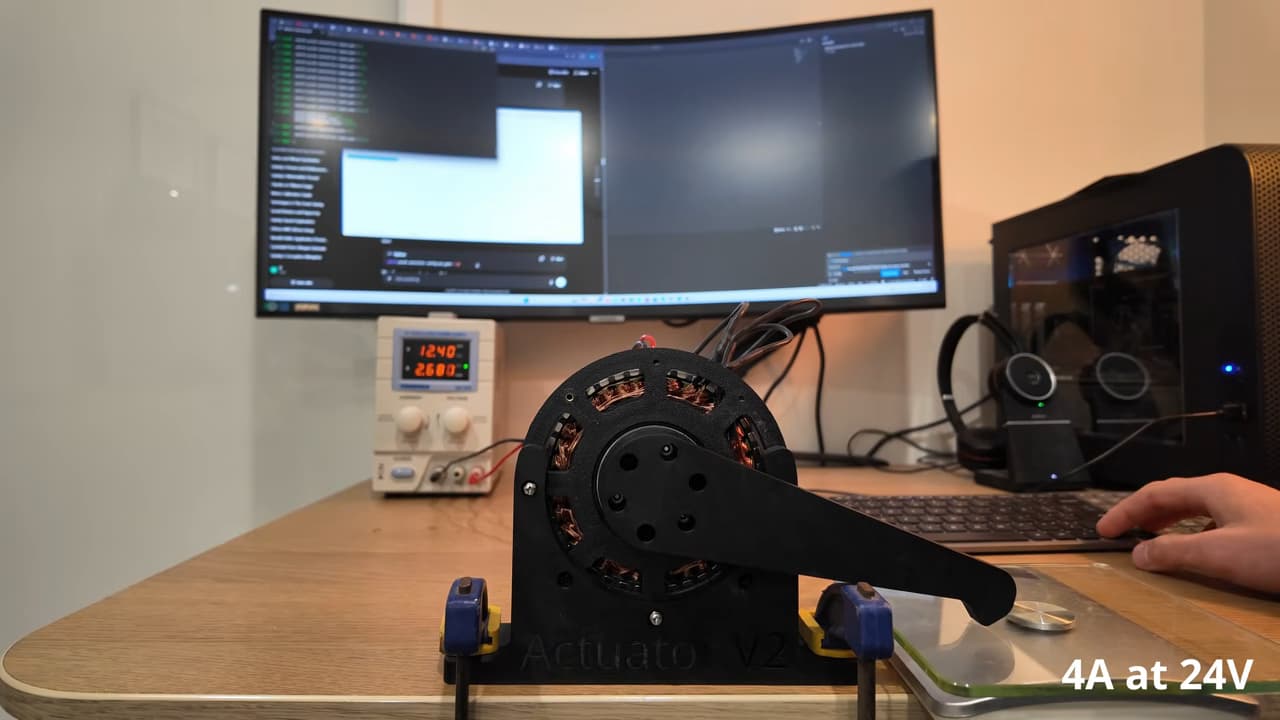
Maker Brandon Lai designed and built a custom actuator for his humanoid robot project, targeting 40–60 rpm and 20 Nm of continuous torque for one hour. Inspired by an MIT research paper, the design features a cycloidal gearbox, hand-wound stator, and CNC plus 3D-printed components. Testing revealed the actuator achieved only 7 Nm due to power supply current limitations, with additional challenges including excessive gear backlash and a high build cost of approximately USD $400. CAD files have been released publicly.

Highlights
- Brandon Lai's DIY humanoid robot actuator targets 40–60 rpm and 20 Nm of continuous torque for one hour, inspired by an MIT research paper.
- The actuator uses a cycloidal gearbox instead of a planetary gearbox, paired with a hand-wound stator and CNC plus 3D-printed housing components.
- Bench testing produced only 7 Nm of torque due to insufficient current from the benchtop power supply, falling far short of the 20 Nm goal.
- Excessive backlash from imprecise machining tolerances and a build cost of approximately USD $400 are identified as key issues for future revisions.
- CAD files for the second-generation prototype have been publicly released for the maker and robotics community.
DIY Humanoid Robot Actuator: Design, Testing, and Lessons Learned
Maker Brandon Lai is actively developing a humanoid robot and recognized that high-performance actuators are essential for fluid, responsive movement. Rather than sourcing off-the-shelf components, he chose to design his own — and his second-generation prototype has yielded promising results alongside a clear set of challenges to address.
Design Goals and Inspiration
Brandon set an ambitious performance target: the actuator must sustain 40–60 rpm while delivering a continuous 20 Nm of torque for up to one hour of operation.
The design draws inspiration from an MIT research paper, which Brandon adapted to suit his specific requirements. Where the MIT design incorporated a planetary gearbox, Brandon substituted a cycloidal gearbox, aiming to reduce backlash while improving torque capacity.
The assembly is built around a hand-wound stator using off-the-shelf silicon steel laminations, with the motor housing combining custom CNC-machined parts and 3D-printed components.
Test Results and Current Limitations
Bench testing exposed several constraints:
- Insufficient torque: When powered by a benchtop power supply with limited current output, the motor produced only 7 Nm — well short of the 20 Nm target. Brandon believes upgrading to a higher-rated power source should substantially improve this figure.
- Excessive backlash: Machining tolerances in the cycloidal gearbox were not tight enough, resulting in noticeable backlash that reduces transmission accuracy.
- Cost overrun: Total build cost came in at approximately USD $400 (roughly NTD 13,000), significantly exceeding the original budget.
Next Steps
Despite these hurdles, Brandon has committed to addressing each issue in future iterations. In the meantime, he has publicly released the CAD design files, giving fellow makers and engineers the opportunity to study, modify, and build upon his work.
This project offers a candid look at the possibilities — and practical limitations — of developing high-performance custom electromechanical systems on a constrained budget, making it a valuable reference for anyone pursuing similar actuator development.
原文來源: 查看原文
FAQ
Newsletter
Subscribe to our Low-Altitude Industry Newsletter
Daily curated news on low-altitude economy and drone industry, delivered to your inbox.