Automakers Return to Defense: GM Partners with Lockheed Martin, Renault Teams Up with Thales to Accelerate Missile and Drone Production
On June 16, General Motors (GM) and Lockheed Martin announced a partnership to scale up PAC-3 and THAAD interceptor missile production. The same day, France's Renault and Thales signed an agreement to jointly mass-produce the Toutatis loitering munition, targeting output of 1,000 units per month. Both deals echo WWII-era automotive-to-defense industrial pivots, and reflect the growing urgency of replenishing munitions stocks depleted by ongoing global conflicts.

Highlights
- On June 16, Lockheed Martin and GM Defense announced a partnership — facilitated by the US DoD — to increase PAC-3 MSE and THAAD interceptor missile production by 3–4x over coming years.
- The same day, Renault and Thales signed an agreement to jointly industrialize the Toutatis loitering munition, targeting 1,000 units per month by 2027, up from fewer than 10 per month currently.
- President Trump invoked the Defense Production Act of 1950 on June 16, citing systemic limitations in the US ammunition industrial base as a direct threat to national defense.
- A CSIS report estimates that during the ~40-day US-Iran conflict (Operation Epic Fury), the US expended over 1,000 Tomahawk missiles (~one-third of stockpile) and 1,060–1,430 Patriot interceptors.
- Renault also announced the Chorus program with Turgis Gaillard to develop a long-range loitering munition, targeting ~600 units per month in production by next year.
Automakers Return to Defense: GM Partners with Lockheed Martin, Renault Teams Up with Thales to Accelerate Missile and Drone Production
"What does a THAAD missile interceptor have in common with a Corvette?" asked Lockheed Martin Chief Operating Officer Frank St. John.
"They are both highly sophisticated engineering products, they both require precision manufacturing, they both rely on large and diverse supply chains, and they are both produced in volume."
With those words, Lockheed formally announced General Motors' entry into defense manufacturing.
Across the Atlantic, Renault — one of France's oldest and most iconic automotive brands — simultaneously announced a partnership with defense technology company Thales. Renault will manufacture Thales's Toutatis remotely piloted loitering munition at its own facilities, targeting a production rate of 1,000 units per month as early as next year, primarily for export markets.
The return of both automakers to defense production strongly evokes memories of World War II, when many of today's globally recognized automotive brands pivoted from producing passenger cars to manufacturing tanks, armored vehicles, and munitions.
The Automotive Industry's Deep Defense Production Legacy
Automakers have a long history of involvement in defense production. During WWII, Japan's Mitsubishi and Toyota, Germany's Volkswagen and Daimler-Benz, France's Renault, Britain's Rolls-Royce, Italy's Fiat, and America's Ford, General Motors, and Chrysler all participated extensively in defense manufacturing — producing tanks, aircraft engines, armored vehicles, ammunition, and military trucks.
Following the war, most companies returned to civilian vehicle production, though some — such as Britain's Rolls-Royce — maintained dedicated defense divisions.
The Russia-Ukraine War and US-Iran Conflict Expose Critical Munitions Stockpile Gaps
Russia's invasion of Ukraine and the recent US-Iran conflict have once again confronted governments with a sobering reality: the peacetime defense production capacity maintained since the end of the Cold War is wholly inadequate for sustained, high-intensity armed conflict.
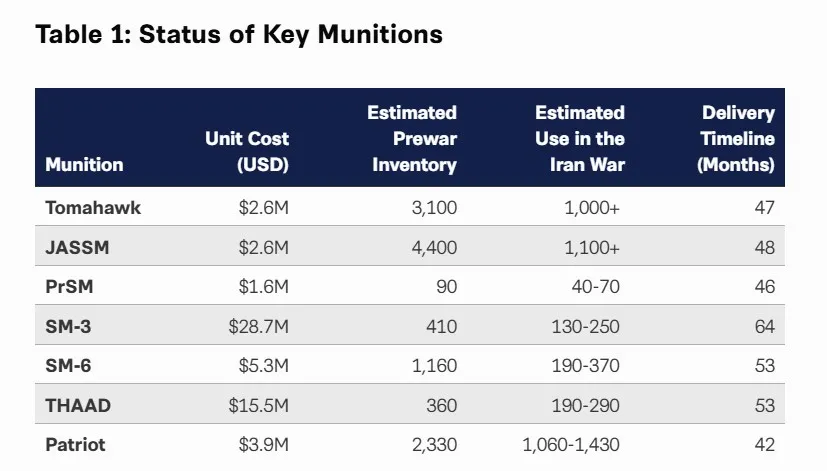
Take the approximately 40-day US-Iran war as an example. According to a report by the Center for Strategic and International Studies (CSIS), prior to the launch of Operation Epic Fury on February 28, 2026, US stockpiles of key munitions stood as follows — and the post-conflict consumption figures are striking:
- Tomahawk Land Attack Missiles (TLAM): ~3,100 in stock; over 1,000 expended (approximately one-third)
- THAAD Interceptors: ~400 in stock; 190–290 expended
- Patriot Interceptors: ~2,500 in stock; 1,060–1,430 expended
- SM-3 and SM-6 Missiles: Heavy usage (over 250 of ~400 SM-3s expended; 190–370 SM-6s expended)
- JASSM Cruise Missiles: Over 1,100 of 4,000+ expended
- PrSM Precision Strike Missiles: Fewer than 100 pre-war; 40–70 expended
If the world's most powerful military expended between one-third and nearly half of its precision munitions inventory in just 40 days — in a conflict that involved no ground invasion — a deeply unsettling question arises: can the United States sustain a prolonged, high-intensity war against a peer adversary such as China or Russia?
It is precisely this concern, nearly 80 years after the end of WWII, that has prompted governments to once again look to the automotive industry to rapidly scale up defense manufacturing capacity.
Lockheed Martin and GM Announce Partnership to Strengthen US Defense Industrial Base
On June 16, Lockheed Martin and GM Defense announced a new partnership aimed at strengthening the United States' manufacturing base and defense industrial base. The agreement was facilitated by the US Department of Defense (DoD).
The collaboration will combine Lockheed Martin's defense production expertise as the world's largest defense contractor with General Motors' advanced industrial capabilities in high-velocity commercial manufacturing and engineering.
The partnership will focus on three key areas: strengthening the defense supply chain, enhancing manufacturing and design capabilities, and evaluating opportunities to expand production capacity through commercial manufacturing expertise and infrastructure.
While both companies disclosed limited details, the Wall Street Journal reported that the two sides are in negotiations over GM producing "common components" to help Lockheed expand its munitions production capacity.
Notably, the partnership was announced on the same day that President Trump invoked the Defense Production Act of 1950 to address constraints on ammunition production.
The presidential memorandum stated: "I hereby determine that the current situation may pose a direct threat to the national defense or preparedness programs of the United States. Systemic limitations in the ammunition industrial base — including constrained production capacity, supply chain vulnerabilities, long lead-time dependencies, and associated production bottlenecks — could undermine the ability of the United States to produce, sustain, and expand the munitions, missiles, and materiel required for national defense."
Lockheed Martin COO Frank St. John commented: "America's security depends not only on developing advanced technologies, but on our ability to produce them rapidly, reliably, and at scale."
"This partnership brings together two leaders in American manufacturing and innovation to explore new pathways to strengthen the defense industrial base, expand capacity, and accelerate the delivery of critical capabilities to the United States and its allies."
St. John indicated that the partnership will help Lockheed meet Pentagon requirements to triple or quadruple production of PAC-3 Missile Segment Enhancement (MSE) and THAAD interceptors over the coming years, leveraging GM's supply chain expertise.
It is worth noting that the Munitions Acceleration Committee, established in 2025, is focused on increasing output of 12 critical weapons systems — including Patriot missiles, THAAD interceptors, and the Long Range Anti-Ship Missile (LRASM). Six of these 12 missiles and interceptors are produced by Lockheed, including the PAC-3 MSE, THAAD interceptor, PrSM, JASSM/JASSM-ER, LRASM, and AMRAAM.
GM's vast industrial base and well-developed supply chain are expected to play a significant role in helping Lockheed increase output of these critical munitions.
Renault and Thales to Drive a Quantum Leap in French Drone Industrial Capacity
Also on June 16, Renault announced a partnership with Thales to produce military drones — specifically to co-develop and industrialize mass production of Thales's TOUTATIS loitering munition.
This marks the second defense cooperation initiative between the two companies; earlier in the week, they had jointly unveiled the innovative 4-TROOP tactical vehicle.
In a statement, Renault said: "This strategic partnership combines Thales's cutting-edge defense expertise with Renault Group's industrial engineering and manufacturing capabilities, with the aim of establishing a sovereign, agile, and competitive drone industry in France — fully aligned with the demands of a wartime economy."
"Through this collaboration, production of the loitering munition could begin as early as 2027, with a monthly production capacity of 1,000 units in the first year, marking a significant leap forward in France's industrial capabilities in this strategic domain."
Thales currently produces approximately 100 Toutatis units per year. The plan therefore envisions a dramatic scale-up from fewer than 10 units per month to approximately 1,000 units per month.
The TOUTATIS is a short-range loitering munition designed for dismounted infantry deployment, capable of being launched from multiple platforms including combat vehicles, aircraft, and naval vessels. It features resistance to electromagnetic jamming and carries a mission-configurable warhead, enabling the effective neutralization of targets such as armored vehicles while maintaining human decision-making in the engagement loop.
Renault is also advancing the Chorus program in partnership with drone manufacturer Turgis Gaillard, developing a long-range variant. A demonstrator is expected to be completed before the end of this year, with monthly production reaching approximately 600 units next year.
Renault announced in June last year that it was considering re-entering defense production after an 80-year absence. In fact, during World War I, Renault produced trucks, stretchers, ambulances, artillery shells, and even the famous FT17 tank — making a decisive contribution to the Allied victory over Germany. Renault also emerged as a major supplier of aircraft engines during WWI, producing over 5,300 V12Fe engines (300–320 hp) used in bombers and reconnaissance aircraft.
From 1907 to 1944, Renault produced more than 30,000 aircraft engines, making it one of France's highest-volume manufacturers in that category.
History Repeating: Can the Auto Industry Rescue the Defense Industrial Base?
Both the United States and France are revisiting the WWII model by enlisting major automakers' high-velocity manufacturing expertise and supply chains for defense production. Whether this experiment — integrating automotive industry capabilities into defense manufacturing amid multiple simultaneous global conflicts — can meaningfully strengthen the defense industrial base and ramp up production capacity remains to be seen.
原文來源: 查看原文
FAQ
Newsletter
Subscribe to our Low-Altitude Industry Newsletter
Daily curated news on low-altitude economy and drone industry, delivered to your inbox.