U.S. Navy Tests Dual-Use Laser System Combining Wireless Power Transmission and Counter-Drone Defense
The U.S. Naval Research Laboratory (NRL) has successfully demonstrated a laser system capable of simultaneously transmitting power wirelessly and neutralizing aerial threats. Conducted in harsh weather conditions with partners including Boeing and the Army's Ground Vehicle Systems Center, the program aims to reduce battlefield dependence on fuel logistics while enhancing energy flexibility for remote operations.

Highlights
- NRL demonstrated a single trailer-mounted laser system that can wirelessly transmit electrical power across an airfield and instantly switch to counter simulated drone threats.
- The demonstration was conducted in severe winter weather — including heavy snow and high winds — to validate real-world battlefield performance rather than controlled laboratory conditions.
- Partners include Boeing and the Army's DEVCOM Ground Vehicle Systems Center, with funding from the DoD's Operational Energy Capability Improvement Fund.
- The laser platform is already in service with the U.S. Marine Corps for directed-energy missions and was integrated with solar receivers and mobile vehicle-mounted power sources.
- The next phase will place the system with Marines, soldiers, and sailors to collect operational feedback, with the Army expected to be among the first services to field the capability.
U.S. Navy Tests Dual-Use Laser System Combining Wireless Power Transmission and Counter-Drone Defense
The U.S. Naval Research Laboratory (NRL) has demonstrated a breakthrough laser system capable of performing two critical military functions simultaneously — wireless power transmission and aerial threat defense — marking a significant step toward more flexible battlefield energy solutions.
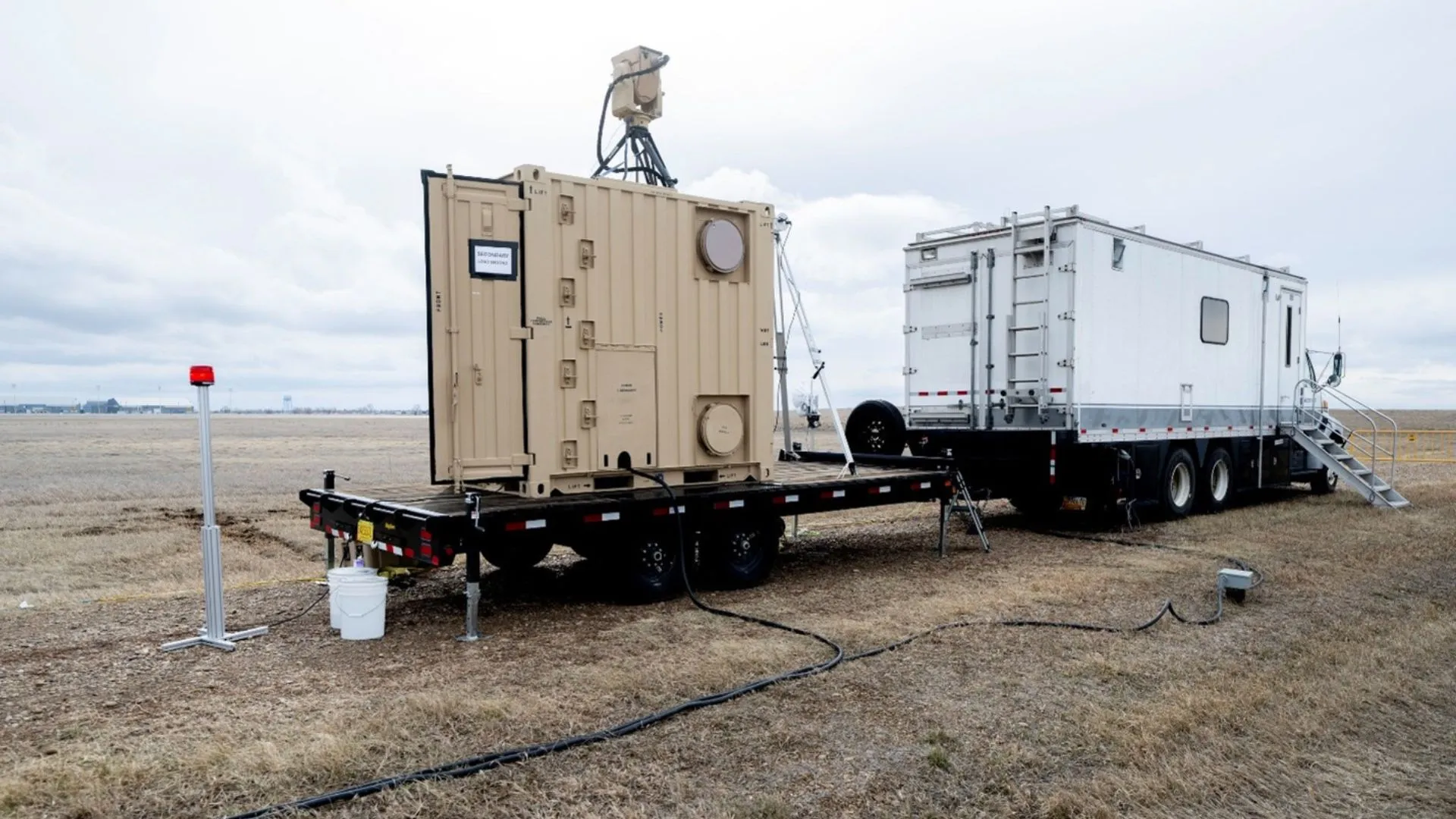
The tests confirmed that a single directed-energy platform can execute both key military missions without requiring separate, dedicated equipment. Researchers successfully transmitted electrical power via laser beam across an airfield to a remote receiver station, then rapidly switched the same system into an intercept mode to defeat a simulated drone threat.
The demonstration was supported by the Office of the Under Secretary of Defense for Acquisition and Sustainment and the Operational Energy Capability Improvement Fund. NRL collaborated with Boeing, the Army's DEVCOM Ground Vehicle Systems Center, and units from the Navy, Marine Corps, and Army.
The program is designed to reduce dependence on fuel-powered systems while extending the operational reach of forward-deployed forces.
Fuel-Free Power Delivery
During the demonstration, a trailer-mounted laser unit transmitted electrical power from a standard military vehicle to a dedicated receiver at a remote location — entirely without physical cables or conventional fuel logistics.
Researchers deliberately replicated real-world battlefield conditions rather than conducting tests in a controlled laboratory environment. The demonstration included severe weather, including high winds and heavy snowfall.
NRL electrical engineer Alex Grede said the goal of the test was to evaluate the technology's viability for actual military operations. "We demonstrated that the same laser system used for long-range power beaming can be immediately switched to counter a drone threat," Grede said.
The long-range power transmission capability could eventually help military units operate in remote areas while significantly reducing reliance on fuel convoys and diesel generators.
Built for the Battlefield
Unlike previous power-beaming demonstrations conducted under ideal conditions, the NRL team intentionally exposed the system to demanding environmental challenges.
Researchers collected data throughout severe winter weather and near-zero visibility conditions. The results will help engineers further refine the technology in preparation for future operational deployment. NRL research physicist Justin Lorentzen noted that real-world environmental testing yields invaluable data that cannot be replicated in a laboratory.
The research team sought to better understand how atmospheric interference affects system performance. The data gathered will guide future improvements and increase reliability in combat environments.
During the demonstration, engineers also validated the system's field maintenance capabilities — the team successfully repaired a critical component on-site and rapidly restored the system to full operation.
Navy Lieutenant Commander Brian Di Salvo, Military Deputy Director of NRL's Radar Division, emphasized that military systems must be easy to operate and maintain, describing both qualities as essential for deployment in high-intensity environments.
Expanding Military Applications
The laser platform used in the tests is already fielded by the U.S. Marine Corps for directed-energy missions. Researchers integrated it with high-efficiency solar receivers and mobile vehicle-mounted power sources to build a distributed energy network.
Army requirements shaped a number of the design specifications for the field demonstration. Officials believe the technology holds considerable potential for rapid-deployment missions, as reducing fuel consumption simultaneously improves logistics efficiency and force survivability.
Grede noted that cross-service collaboration will accelerate the technology's adoption. While NRL continues to advance naval applications, the Army is expected to be among the first services to field the capability.
The next phase of the program will place the system directly in the hands of Marines, soldiers, and sailors. Researchers will collect hands-on operational feedback and continue refining the technology based on how troops use it in field conditions.
The program is part of NRL's broader strategy to develop scalable directed-energy systems aimed at strengthening battlefield resilience and extending the operational reach of U.S. forces.
原文來源: 查看原文
FAQ
Newsletter
Subscribe to our Low-Altitude Industry Newsletter
Daily curated news on low-altitude economy and drone industry, delivered to your inbox.