U.S. Military Tests Autonomous Unmanned Surface Vessels During Philippines Exercise, Expanding Maritime Drone Capabilities
During the joint 'Salaknib 2026' exercise in the Philippines, soldiers from the U.S. Army's 125th Military Intelligence and Electronic Warfare Battalion deployed autonomous Unmanned Surface Vessels (USVs) in Casiguran Sound to escort a Logistics Support Vessel, demonstrating the real-world combat potential of autonomous maritime systems in the Indo-Pacific.

Highlights
- During the Salaknib 2026 joint exercise in the Philippines, the U.S. Army's 125th MI & EW Battalion deployed autonomous USVs in Casiguran Sound to escort a Logistics Support Vessel approaching Casiguran port.
- The USV escort mission supported the sea transport of Philippine Army personnel and armored vehicles over 260 miles (approximately 418 km).
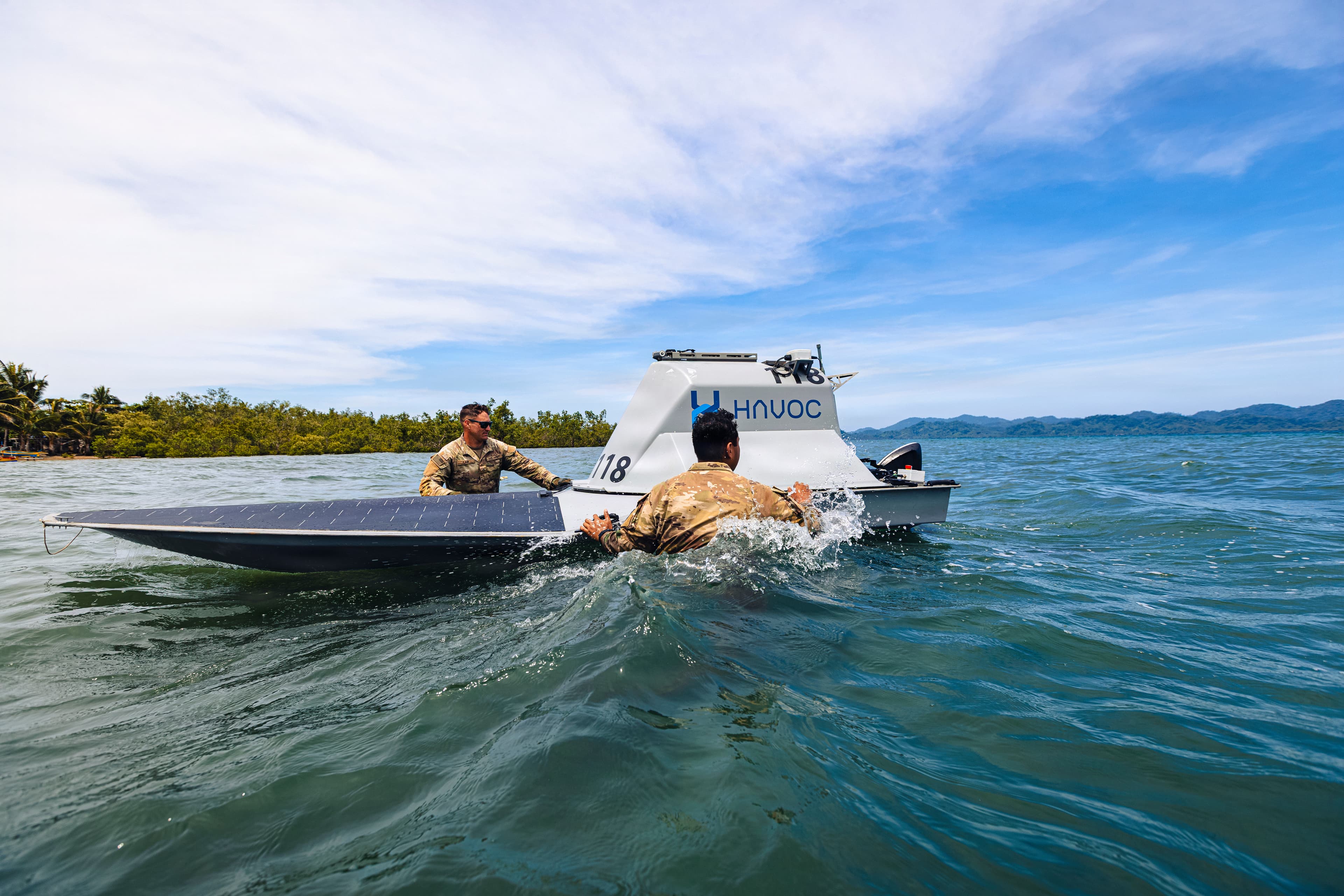
- A USV hull marked 'HAVOC' — belonging to a defense autonomous systems company — was photographed being recovered by U.S. soldiers during the exercise.
- The U.S. Navy plans to expand its medium-sized USV fleet from approximately 4 vessels in April 2025 to more than 30 by 2030, plus thousands of smaller unmanned systems.
- The Navy Corsair USV, operated by Task Force 59, participated in rescuing two U.S. Army soldiers following a helicopter crash off Oman's coast, demonstrating USV search-and-rescue capability.
U.S. Military Tests Autonomous Unmanned Surface Vessels During Philippines Exercise
The U.S. Army has announced that autonomous Unmanned Surface Vessels (USVs) successfully provided escort for a U.S. military Logistics Support Vessel (LSV) during a joint exercise with the Philippine Army, showcasing how unmanned autonomous systems are reshaping modern maritime operations.
Exercise Mission Overview
Soldiers from the 125th Military Intelligence and Electronic Warfare Battalion, part of the 25th Infantry Division, deployed multiple USVs in Casiguran Sound, Philippines. According to a U.S. Army statement released in June, the unmanned vessels were positioned ahead of a Logistics Support Vessel as it approached Casiguran port, conducting reconnaissance of the surrounding environment and relaying real-time intelligence to shore-based commanders.
The operation was conducted as part of the Salaknib 2026 exercise, supporting the sea transport of Philippine Army personnel and vehicles — including armored personnel carriers — over a distance of more than 260 miles (approximately 418 kilometers) to Casiguran port.
Autonomous Navigation and Intelligence Gathering
The USVs navigated autonomously using onboard sensors, identifying potential threats and continuously providing commanders with a real-time operational picture of the surrounding environment.
Pvt. Caleb Hannah of the 125th Military Intelligence and Electronic Warfare Battalion stated: "We deployed autonomous intelligence, surveillance, and reconnaissance vessels today to provide a security escort for the landing craft. They escorted the LSV into port from about 6 miles out, allowing Philippine vehicles to successfully drive onto the dock."
Photos released by the U.S. Army show soldiers wading chest-deep in water to recover a USV marked with the name "HAVOC" — a defense technology company specializing in the development of autonomous systems.
U.S. Unmanned Maritime Fleet Continues to Expand
The exercise comes as the U.S. military significantly expands its unmanned maritime fleet across the Indo-Pacific. Earlier this year, a U.S. Navy official stated that the number of medium-sized USVs is expected to grow from approximately 4 vessels in April to more than 30 by 2030, supplemented by thousands of smaller USVs and unmanned aerial systems.
Industry partner representative Ben Outlaw noted in the U.S. Army statement: "These vessels provide commanders with situational awareness through the full kill chain — find, fix, target, engage, and assess. With the information provided by the USVs, a commander's decision-making timeline is compressed from hours to seconds."
Extended Applications: USVs in Search and Rescue Operations
The U.S. military also demonstrated the versatility of USVs in a separate incident, where a USV assisted in rescuing two Army soldiers after a helicopter crashed off the coast of Oman. In that operation, the Navy Corsair unmanned vessel, operated by Task Force 59 of U.S. Naval Forces Central Command (Fifth Fleet), participated in the rescue effort. Capt. Tim Hawkins, spokesperson for U.S. Central Command, confirmed that the task force had begun deploying such unmanned systems in the region as of late March.
As autonomous technology continues to mature, the role of USVs in intelligence gathering, escort security, and personnel rescue missions is expected to grow significantly, with far-reaching implications for the future of maritime warfare.
原文來源: 查看原文
FAQ
Newsletter
Subscribe to our Low-Altitude Industry Newsletter
Daily curated news on low-altitude economy and drone industry, delivered to your inbox.