New Coherent LiDAR System Simultaneously Measures Depth, Velocity, and Polarization in a Single Scan
Researchers from the University of Toronto, Vector Institute, Ciena, and POSTECH have developed a polarimetric full-wavefield coherent LiDAR system that captures depth, velocity, and polarization data in a single measurement. Published in Optica, the breakthrough significantly enriches 3D sensing data density and promises more reliable environmental perception for drones, autonomous vehicles, and industrial inspection applications.

Highlights
- Researchers from the University of Toronto, Vector Institute, Ciena, and POSTECH published a polarimetric full-wavefield coherent LiDAR system in the journal Optica.
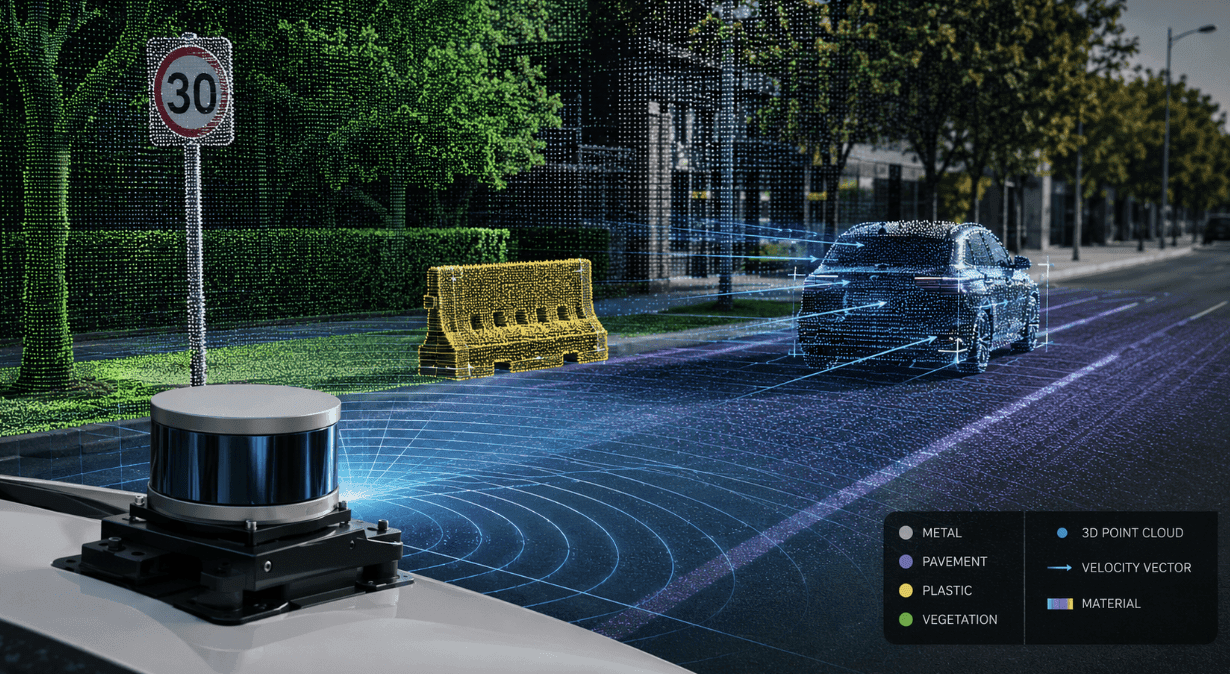
- The system captures depth, velocity, and polarization data simultaneously in a single scan — a capability not available in conventional LiDAR.
- Polarization sensing enables material-type identification, improving accuracy on glass, water, and metal surfaces that typically cause errors in traditional LiDAR.
- Coherent LiDAR analyzes light-wave phase changes, offering inherent advantages over time-of-flight LiDAR in noise suppression and velocity measurement.
- Key applications include drone low-altitude navigation, autonomous vehicle sensing in adverse weather, industrial surface inspection, and environmental monitoring.
New Coherent LiDAR System Simultaneously Measures Depth, Velocity, and Polarization in a Single Scan
A collaborative research team from the University of Toronto, the Vector Institute, optical communications company Ciena, and South Korea's Pohang University of Science and Technology (POSTECH) has achieved a substantive breakthrough in 3D sensing — a LiDAR system capable of extracting richer information from every single measurement.
Research Overview
The system has been published in the academic journal Optica under the title "Polarimetric Full-Wavefield Coherent Lidar." Unlike conventional LiDAR systems that capture only range data, this new system simultaneously measures three parameters in a single scan:
- Depth: The three-dimensional distance to a target object
- Velocity: The speed and direction of a moving target
- Polarization: Changes in the polarization state of light after interacting with an object's surface
Technical Significance
The addition of polarization data represents the most critical breakthrough in this research. Conventional LiDAR systems often produce measurement errors or data gaps when dealing with highly reflective or semi-transparent materials such as glass, water surfaces, and metals. By analyzing polarization characteristics, the new system can further identify material type and distinguish the physical properties of different surfaces, lending greater semantic value to sensing results.
The use of coherent technology is also a core advantage. Coherent LiDAR extracts information by analyzing phase changes in light waves, giving it inherent advantages over traditional time-of-flight (ToF) LiDAR in noise suppression and velocity measurement.
Application Potential
This technology holds significant implications across multiple sectors:
- Drone navigation: More precise identification of ground materials and obstacle characteristics, enhancing low-altitude flight safety
- Autonomous driving: Improved sensing reliability in rain, wet road surfaces, or environments with glass-curtain-wall buildings
- Industrial inspection: Non-contact optical analysis of surface quality for manufacturing components
- Environmental monitoring: More accurate differentiation between vegetation, bodies of water, and man-made structures
Research Background
Led by the University of Toronto, the project combines the Vector Institute's expertise in artificial intelligence, Ciena's industry experience in optical communications technology, and POSTECH's strength in photonics research — exemplifying a cross-disciplinary collaboration between academia and industry.
The research remains at the academic publication stage, and commercialization and mass production are still some time away. Nevertheless, the technical pathway it demonstrates has attracted broad attention from the industry and is expected to inform the development direction of next-generation sensing chips and modules.
Source: Optica journal paper — "Polarimetric Full-Wavefield Coherent Lidar"
原文來源: 查看原文
FAQ
Newsletter
Subscribe to our Low-Altitude Industry Newsletter
Daily curated news on low-altitude economy and drone industry, delivered to your inbox.