No Trace Left Behind: McKim & Creed Sets a New Standard for Survey-Grade Precision in Zero-Disruption Operations
U.S. civil engineering and surveying firm McKim & Creed has developed a 'virtual control alignment' workflow combining static and mobile LiDAR to achieve centimeter-level accuracy on North Carolina's Cape Fear Memorial Bridge—without lane closures or operational disruptions. The methodology is now being extended to nighttime airport runway pavement inspection using a dual-scanner mobile mapping system capable of 2 mm pixel resolution, a workflow the firm believes has never been executed before.

Highlights
- McKim & Creed's 'virtual control alignment' workflow achieved centimeter-level NCDOT Type A Terrestrial Mobile LiDAR accuracy on the Cape Fear Memorial Bridge without any lane closures or operational disruptions.
- The methodology uses large rigid planar surfaces—concrete railings, curbs, and deck panels—as geometric anchors in a least-squares adjustment framework, replacing conventional physical survey targets entirely.
- Variable pulse repetition rates (140 kHz to 1,200 kHz) and an IMU-based vibration notification system keep structural vibration effects within filterable noise rather than systematic point cloud error.
- McKim & Creed is extending the technology to nighttime airport runway pavement inspection using a dual-scanner mobile mapping system capable of 2 mm pixel resolution, with primary data collection commencing June 2026.
- The virtual control alignment methodology has been codified into McKim & Creed's standard operating procedures and is considered replicable across high-traffic corridors, urban environments, and any site where physical control placement is impractical or unsafe.
No Trace Left Behind: McKim & Creed Sets a New Standard for Survey-Grade Precision in Zero-Disruption Operations
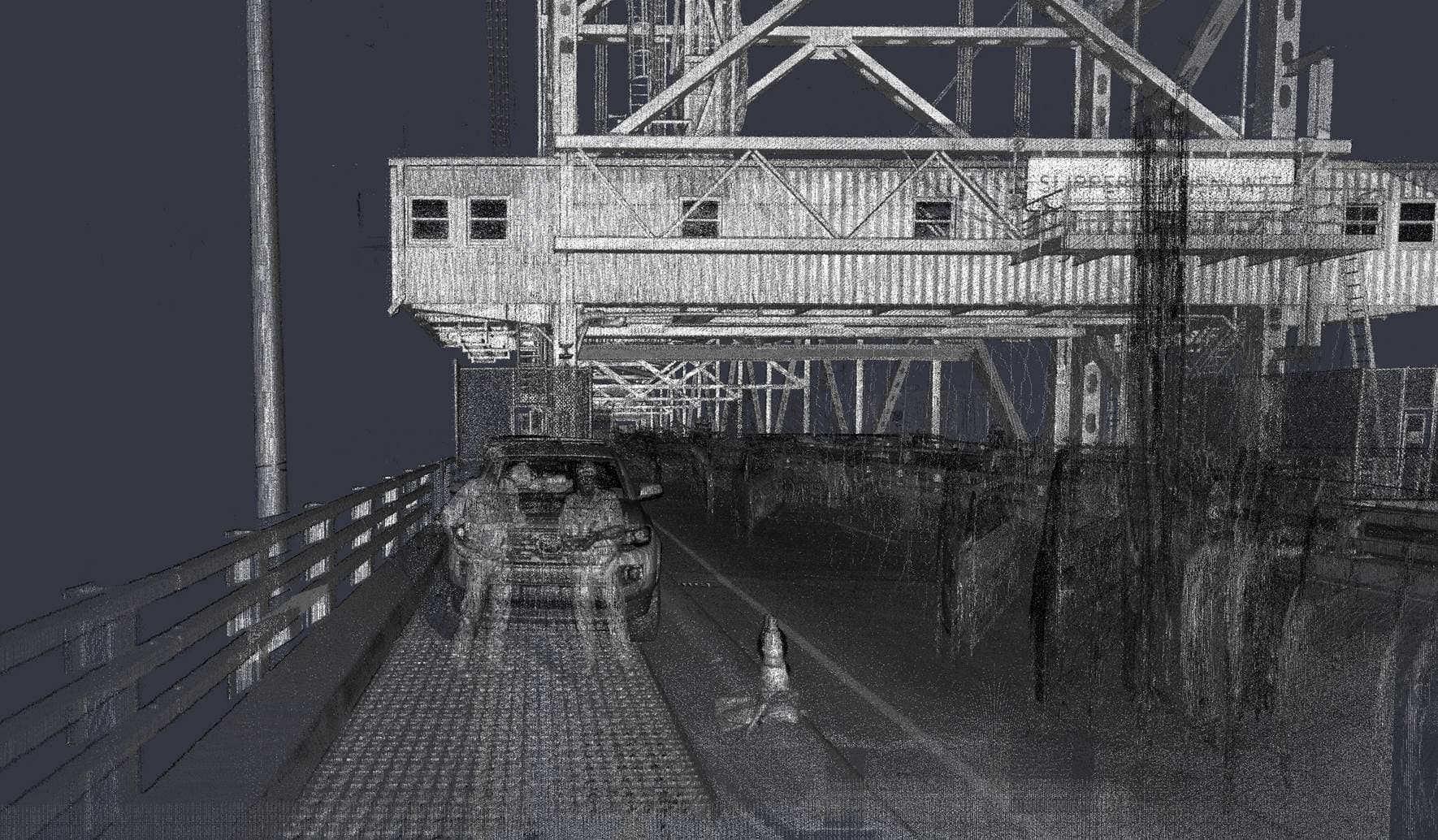
Colorized LiDAR point cloud of the Cape Fear Memorial Bridge in Wilmington, North Carolina, showing the vertical lift span, towers, and surrounding structures—the output of McKim & Creed's survey-grade 3D modeling project. Image: McKim & Creed.
The perfect survey is one no one ever knew happened.
No lane closures. No night crews in high-visibility vests. No targets drilled into bridge decks. No personnel standing on live structures. Vessels and taxiing aircraft continue uninterrupted. Infrastructure operates exactly as it did before the survey team arrived—and after they leave—while the data delivered is verified, survey-grade, and complete.
Whether on highways, railways, or airports, infrastructure owners are increasingly demanding exactly this, and that demand is quietly forcing a fundamental shift in how top-tier surveying firms build their workflows. The question is no longer simply "Can you meet the accuracy specification?" It is: "Can you meet it without leaving a trace?"
Civil engineering and surveying firm McKim & Creed has been working toward that answer for years. Its LiDAR team developed a hybrid static-plus-mobile workflow capable of producing survey-grade point clouds on operationally constrained infrastructure—while eliminating the disruptions that conventional target-based control methods require. The methodology was stress-tested on one of the more demanding structures available: a four-lane vertical lift bridge built in 1969 in Wilmington, North Carolina, spanning an actively navigated waterway.
Now that methodology is moving to an even more demanding arena.
McKim & Creed deploying static terrestrial LiDAR from safe positions near the Cape Fear Memorial Bridge tender house, while mobile LiDAR captured the main span and approach corridors—all without lane closures or interference with bridge operations. Image: McKim & Creed.
The Geometry of Constraints
The Cape Fear Memorial Bridge presented McKim & Creed's team with a clearly defined problem. The North Carolina Department of Transportation (NCDOT) required a centimeter-accurate, survey-grade 3D model of the entire structure—including the lift span, abutments, adjacent structures, and approach corridors. The constraints were equally clear: no lane closures, no interference with vessel traffic or bridge lift operations. The bridge carries four lanes of continuous traffic, has no shoulders or bike lanes, and exhibits measurable vibration under load. There was simply no safe location on the deck to set and occupy conventional survey targets.
"Conventional target-based mobile LiDAR operations would have required extensive lane closures and nighttime work to safely set and level targets on the bridge deck," said Matt LaLuzerne, McKim & Creed's Director of National Business Development and Geospatial Services. "Given the safety risks and operational disruption, we explored alternative control strategies collaboratively during planning before committing to a final field approach."
Rather than seeking workarounds, the team built a workflow that rendered the constraints irrelevant.
Point cloud view of the Cape Fear Memorial Bridge deck, showing pavement, railings, and structural geometry used in McKim & Creed's virtual control alignment workflow, substituting existing rigid surfaces for physical survey targets. Image: McKim & Creed.
Virtual Control
The solution McKim & Creed developed centers on what the team calls "virtual control alignment"—a methodology that substitutes the structure's own existing geometry for discrete physical targets.
The workflow combines two complementary collection modes. High-resolution static terrestrial LiDAR was deployed from safe positions at the east approach end—near the tender house and adjacent facilities. These static scans were tied directly to NCDOT datum control via GNSS and conventional leveling. Simultaneously, a mobile LiDAR system traversed the full bridge and approach corridors, with the west end tied to NCDOT datum control by conventional means.
In post-processing, the structure itself serves as the control. Large planar surfaces captured in the static point cloud—concrete railings, curbs, parapets, and deck panels—replace physical targets, providing the geometric anchors needed to calibrate and adjust the mobile dataset.
"We prioritized large, continuous, structurally rigid surfaces," LaLuzerne said. "The goal was to maximize geometric leverage and redundancy in the least-squares adjustment."
The same least-squares adjustment framework applied to conventional control-point-based corridor surveys was then applied. Residual analysis, horizontal cross-section comparisons, and vertical face-to-face differencing validated compliance with NCDOT Type A Terrestrial Mobile LiDAR accuracy requirements. The methodology achieved centimeter-level specifications.
Mobile LiDAR point cloud capturing the Cape Fear Memorial Bridge approach and lift tower structure, part of the hybrid static-plus-mobile workflow developed to meet NCDOT Type A Terrestrial Mobile LiDAR accuracy requirements under live-traffic conditions. Image: McKim & Creed.
Scan Stability
What virtual control alone cannot solve is vibration—the subtle movement of a structure under live traffic load that can blur point clouds if scanner selection and operation are not carefully managed.
The team addressed this through variable pulse repetition rates and an onboard IMU with a built-in vibration notification system. Near the tender house—where structural vibration from traffic loading is most pronounced—the team operated at 1,200 kHz repetition rate. That rate minimizes dwell time at any single scan position, keeping vibration effects in the domain of high-frequency noise rather than coherent geometric distortion. On approach spans and drop-in panels, where vibration risk decreases but distances to bridge features increase, the team reduced repetition rates to between 140 kHz and 600 kHz to ensure sufficient time-of-flight for accurate returns at range.
When vibration levels exceeded acceptable thresholds, the IMU flagged the condition automatically. Through overlapping scan positions, appropriate repetition rate selection, and point-cloud-to-point-cloud adjustment, vibration effects were kept within filterable noise rather than systematic error.
The methodology achieved NCDOT Type A Terrestrial Mobile LiDAR accuracy requirements at centimeter-level precision.
No lane closures. No nighttime operations. No interference with vessel traffic or bridge lift operations. Full-structure centimeter accuracy. No trace left behind. Survey delivered.
The methodology that emerged from Cape Fear is now McKim & Creed's standard operating procedure, codified in internal checklists and processing guides that any team can implement without having participated in the original project.
"If a structure is visible in the static scans and visible in the mobile scans with good control, the workflow can execute," LaLuzerne said. "It is driven by safety requirements, speed, and accuracy." The firm views the technique as replicable across high-traffic corridors, constrained urban environments, and any infrastructure setting where placing physical control is impractical or unsafe.
And the evolution of that methodology into its next application may be the most compelling demonstration yet of where the industry is headed.
Two Millimeters at Midnight
McKim & Creed has recently launched a project that pushes this commitment into genuinely uncharted territory: high-resolution pavement inspection of an operational commercial airport runway, conducted at night. The challenge here is not control strategy—it is imagery, lighting, and a workflow no one has verified before.
Conventional runway pavement inspection requires closing a runway during daytime and deploying specialized inspection personnel to walk or drive the surface under controlled conditions. McKim & Creed's approach is different: data collection takes place during brief scheduled nighttime windows, minimizing impact on airport operations and revenue—while producing higher-resolution data.
The team uses a dual-scanner mobile mapping system pairing LiDAR with nadir-facing cameras calibrated to the point cloud, capable of 2 mm pixel resolution—sufficient to detect pavement cracking. The system's dedicated pavement camera mount is optimized for near-vertical downward imaging of road surfaces. But only in daylight conditions.
"We needed to collect at night, so we needed to illuminate the surface for the cameras," LaLuzerne explained. "Our challenge was calibrating the cameras to the LiDAR and building a workflow around that."
To illuminate the runway surface, the team installed light bars at varying heights and angles, adjusted camera gain settings, and calibrated vehicle speed precisely to optimize image quality under nighttime conditions. Multiple test runs were conducted on comparable surfaces and conditions as part of project preparation.
The resulting data has direct value for airport rehabilitation planning. Two-millimeter resolution is sufficient to detect and characterize cracking, spalling, and joint distress across the full runway length, giving design teams the information needed to differentiate repair from reconstruction decisions on a segment-by-segment basis—decisions that can translate to significant differences in construction cost.
"We believe this will be transformational for the airport rehabilitation industry," LaLuzerne said, "providing high-resolution orthoimagery and topographic data for desktop review and analysis, saving design teams significant field time while keeping the airport operational and revenue-generating."
To LaLuzerne's knowledge, this specific combination—high-resolution orthoimagery collected at night from mobile LiDAR on an active runway—has never been done before. Testing and calibration work began in spring 2026, with primary data collection commencing in June.
In both projects, the measure of success is the same: survey-grade data, delivered without requiring a pause in operations. The bridge did not close. The runway kept operating. No one noticed the survey team had been there.
The Real Value of a Virtual Method
The value of any innovative methodology ultimately comes down to a simple question: how well does it actually work, and how do you know?
On the Cape Fear Memorial Bridge project, McKim & Creed validated the virtual control approach through three parallel checks: least-squares adjustment residual analysis, horizontal cross-section comparisons between static and mobile datasets, and vertical face-to-face differencing in overlap zones.
The least-squares adjustment provided the first layer of evidence. Residuals in the unadjusted mobile solution—raw point cloud before planar control was applied—were significantly larger than in the final calibrated result. The adjustment substantially reduced those residuals and, critically, the pattern of residual distribution was random and uniform rather than systematic.
Consistent directional offsets or position-correlated residuals would have indicated poorly conditioned planar networks or unresolved calibration errors. Neither was present.
Horizontal consistency was checked by running cross-sections through linear features—railings, curb lines, parapet faces—that appear independently in both the static and mobile datasets. The sections showed tight lateral agreement, confirming that planar-based control constrained the mobile dataset horizontally to a degree comparable to physical targets.
The vertical check was the most direct test—verifying that geometric redundancy between two independently controlled datasets could substitute for conventionally leveled elevation transfer across the waterway. Face-to-face differencing between the final static and mobile point clouds in the east approach overlap zone showed consistent vertical agreement at centimeter level, meeting NCDOT Type A Terrestrial Mobile LiDAR accuracy requirements.
Taken together, these checks provided something no single method can deliver alone: independent confirmation from multiple directions that the adjustment is valid and the deliverable is reliable enough to be delivered as survey-grade data.
原文來源: 查看原文
FAQ
Newsletter
Subscribe to our Low-Altitude Industry Newsletter
Daily curated news on low-altitude economy and drone industry, delivered to your inbox.