DJI Osmo Pocket 4P Officially Announced: Dual Lenses, 17-Stop Dynamic Range, and 103GB Internal Storage — But U.S. Buyers Still Left Out
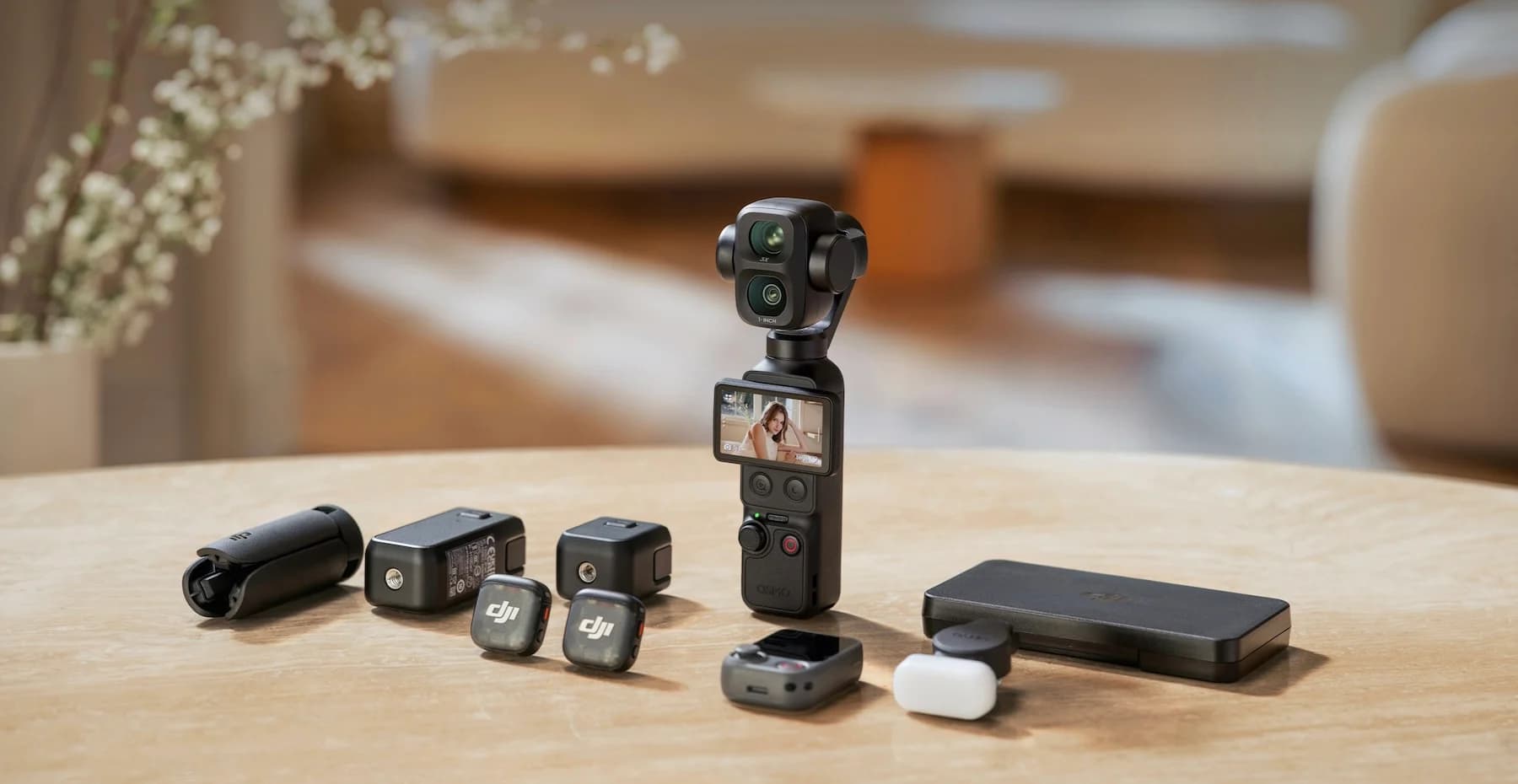
DJI has officially unveiled the Osmo Pocket 4P with a dual-lens system featuring a 1-inch wide-angle main sensor and a 60mm-equivalent telephoto lens. Key specs include 17-stop dynamic range, 10-bit D-Log2, 4K/240fps video, and 103GB internal storage in a 230g body. Chinese pricing starts at RMB 3,799 (approx. USD 525). However, due to DJI's placement on the FCC Covered List, U.S. buyers have no official path to purchase.

Highlights
- DJI Osmo Pocket 4P 配備1英吋廣角主鏡(20mm等效、f/2.0)與60mm等效長焦鏡(f/1.8),是首款搭載雙鏡頭的Pocket系列機型。
- 主感光元件動態範圍達17級,支援10-bit D-Log2、4K/240fps錄影及103GB內建儲存,機身重量230克。
- 中國市場標準套裝起售價3,799元人民幣(約525美元),長焦鏡頭使用1/1.28英吋感光元件,動態範圍14級,遜於主鏡頭。
- DJI自2025年12月22日起被列入美國FCC管制名單,Osmo Pocket 4P無法在美國官方管道銷售,法院挑戰案件仍在審理中。
- DJI未在4P加入6K錄影或原生4K豎拍模式,對主攻手機平台的創作者而言是明顯缺口。
DJI Osmo Pocket 4P Officially Announced: Dual Lenses, 17-Stop Dynamic Range, 103GB Storage — U.S. Market Still Out of Reach
DJI has published the full specifications for the Osmo Pocket 4P, converting a vague teaser shown at this year's Cannes Film Festival into a concrete product. The pocket gimbal camera features a brand-new 1-inch wide-angle primary lens alongside a dedicated 60mm-equivalent telephoto lens — a dual-lens configuration never before seen on any Pocket model. Core specifications are now confirmed: 17-stop dynamic range on the main sensor, 10-bit D-Log2 color, 4K/240fps video recording, 103GB internal storage, and a body weight of 230g. The standard kit starts at RMB 3,799 (approximately USD 525) in China.
However, that impressive spec sheet offers little comfort to U.S. buyers. DJI was added to the FCC Covered List on December 22, 2025, preventing new DJI hardware from obtaining the FCC authorization required for legal sale in the United States. The standard Osmo Pocket 4 already launched in April without U.S. availability for the same reason. The Pocket 4P's official China launch does nothing to reopen the American market.
Two Lenses, Two Different Sensor Specs
The Osmo Pocket 4P uses a true dual-lens module, though the two lenses are not equal in specification. The wide-angle primary lens employs a new 1-inch CMOS sensor with a 20mm-equivalent focal length and f/2.0 aperture — the same sensor class as the single-lens Osmo Pocket 4. DJI applies LOFIC technology to push the main sensor's dynamic range to 17 stops, a significant jump from the standard Pocket 4's 14 stops.
The telephoto lens is an entirely new addition, offering a 60mm-equivalent focal length at f/1.8. DJI positions this as a "golden portrait focal length," where the 60mm field of view delivers less facial distortion and stronger background separation. Optical specifications support 3x optical zoom, 6x lossless zoom (via sensor crop), and up to 12x digital zoom. However, according to DJI's official comparison chart, the telephoto lens uses a smaller 1/1.28-inch sensor rated at 14 stops of dynamic range — notably behind the primary lens's 17-stop, 1-inch sensor. The two lenses do not deliver identical image quality, and DJI is transparent about this in the spec sheet.
This also clarifies months of leaked rumors. Earlier reports suggested a 70mm, f/2.8 telephoto with a 1/1.5-inch sensor; the shipping specification is 60mm, f/1.8, with a 1/1.28-inch sensor — a wider aperture and a marginally larger sensor than previously reported.
An Imaging System Built for Post-Production Workflows
DJI positions color performance and dynamic range as the 4P's primary selling points, and the specs support that claim. The main sensor's 17-stop dynamic range is competitive with typical full-frame mirrorless cameras and cinema cameras, while the 10-bit D-Log2 color mode provides a flatter, more flexible grading starting point than the standard Pocket 4's 10-bit D-Log.
DJI states that 10-bit color depth renders over one billion colors, and positions D-Log2 as a primary-camera tool that directors of photography can trust rather than merely tolerate. Maximum video resolution is 4K/240fps (matching the Pocket 4), with a still photo resolution of 37 megapixels. Six built-in cinematic color profiles and in-camera skin tone enhancement cater to social media creators who prefer straight-from-camera results, while advanced beauty controls are available through the DJI Mimo app.
Two notable omissions remain in this update: DJI did not add 6K video recording and did not include a native 4K vertical shooting mode — both meaningful gaps for creators producing primarily for mobile platforms. For a camera DJI markets as "cinema-grade," these are the first questions professional shooters will ask.
Hardware Designed for Full-Day Shooting
The hardware specification reads like a direct response to complaints from Pocket 3 and Pocket 4 users. Internal storage has been increased to 103GB, eliminating the need for a memory card in most shooting scenarios. Battery life reaches 210 minutes, with an 18-minute charge delivering 80% capacity. The body weighs 230g, retains a three-axis mechanical gimbal, and integrates ActiveTrack 8.0 (marketed as Smart Tracking 8.0 in China), supporting subject tracking across the full zoom range.
Connectivity is upgraded to USB 3.1 with wired transfer speeds up to 800MB/s, and Wi-Fi 6 wireless transfer at up to 90MB/s. DJI adds 4K Live Photos, gesture control, built-in timecode (less than one frame of drift over 8 hours), and a webcam streaming mode. The camera is available in black and Pearl White. Accessories include ND filter sets, a fill light, a beauty diffuser lens, and the Osmo FrameTap viewfinder remote.
Pocket 4P Costs RMB 800 More Than Pocket 4
DJI's official comparison page lists pricing for three current Pocket models: the Osmo Pocket 4P standard kit starts at RMB 3,799, the single-lens Osmo Pocket 4 at RMB 2,999, and the older Osmo Pocket 3 at a reduced RMB 2,299. The RMB 800 premium over the standard Pocket 4 adds a second lens, higher dynamic range, D-Log2 color, and upgraded subject tracking.
According to Italian outlet Quadricottero, a Vlog Kit is also available at RMB 4,299, bundling a mini remote controller with an integrated screen, a mini tripod, and a DJI Mic wireless microphone. This bundle has not yet been confirmed on DJI's official comparison page and remains unverified until DJI publishes a complete kit configuration list.
All pricing listed is for the Chinese market. DJI has not announced U.S. or European pricing, and given current regulatory barriers, U.S. pricing may never be announced. For reference, the standard Pocket 4 is priced from EUR 499 for the base kit in markets where it is available.
The U.S. Ban: The Critical Factor No Spec Sheet Can Resolve
The most consequential fact about the Osmo Pocket 4P does not appear in any spec sheet. Under Section 1709 of the FY2025 National Defense Authorization Act, relevant U.S. national security agencies were required to complete a security review of DJI by December 23, 2025. No agency completed that review. A White House-convened interagency determination was issued on December 21, and the FCC added all foreign-manufactured drones to its Covered List on December 22.
The practical outcome is that new DJI hardware cannot obtain FCC authorization for legal sale in the United States. DJI has filed a challenge with the U.S. Ninth Circuit Court of Appeals, arguing that the relevant agencies never demonstrated a security threat and exceeded their authority. The case remains pending. Until a ruling is issued or DJI secures a specific exemption, the Pocket 4P joins the standard Pocket 4, Osmo Nano, and Osmo Mobile 8 on the list of new DJI products unavailable through any official U.S. channel.
Editor's Perspective
On May 8th, before DJI had published any official data, I compared the Pocket 4P to a handheld DJI Air 3S, because the dual-lens design philosophy mirrors the Air 3S exactly. The full spec sheet now allows me to validate that comparison. The Air 3S pairs a 24mm-equivalent wide-angle primary with a 70mm-equivalent telephoto; the Pocket 4P pairs a 20mm-equivalent wide-angle primary with a 60mm-equivalent telephoto, with a smaller secondary sensor. The design logic holds, though the execution falls slightly short of the drone version — which is a reasonable expectation for a device one-third the size.
The detail that will define this camera's real-world performance is the gap between the telephoto lens's 1/1.28-inch, 14-stop sensor and the primary's 17-stop specification. That difference is the line between a true dual-lens cinema tool and "an excellent wide-angle camera with a useful zoom." A director of photography cutting between the two lenses in the same scene will see that gap immediately in the color grading timeline. DJI deserves credit for disclosing the specs honestly, but the "cinematic excellence" marketing language does obscure an imaging gap that is very real.
The biggest unknown is not in the camera itself — it is at the U.S. Ninth Circuit Court of Appeals. DJI's Covered List appeal is what determines whether this camera ever reaches the U.S. market, and the Pentagon has cited classified intelligence in opposing DJI's petition. Whatever the court decides will determine the Pocket 4P's fate in America. No spec sheet can change that outcome. Watch the court docket, not the comparison chart.
Sources: DJI, Quadricottero
原文來源: 查看原文
FAQ
Newsletter
Subscribe to our Low-Altitude Industry Newsletter
Daily curated news on low-altitude economy and drone industry, delivered to your inbox.