U.S. Air Force Awards Split CCA Contracts to General Atomics and Anduril, Applying Hard Lessons from the F-35
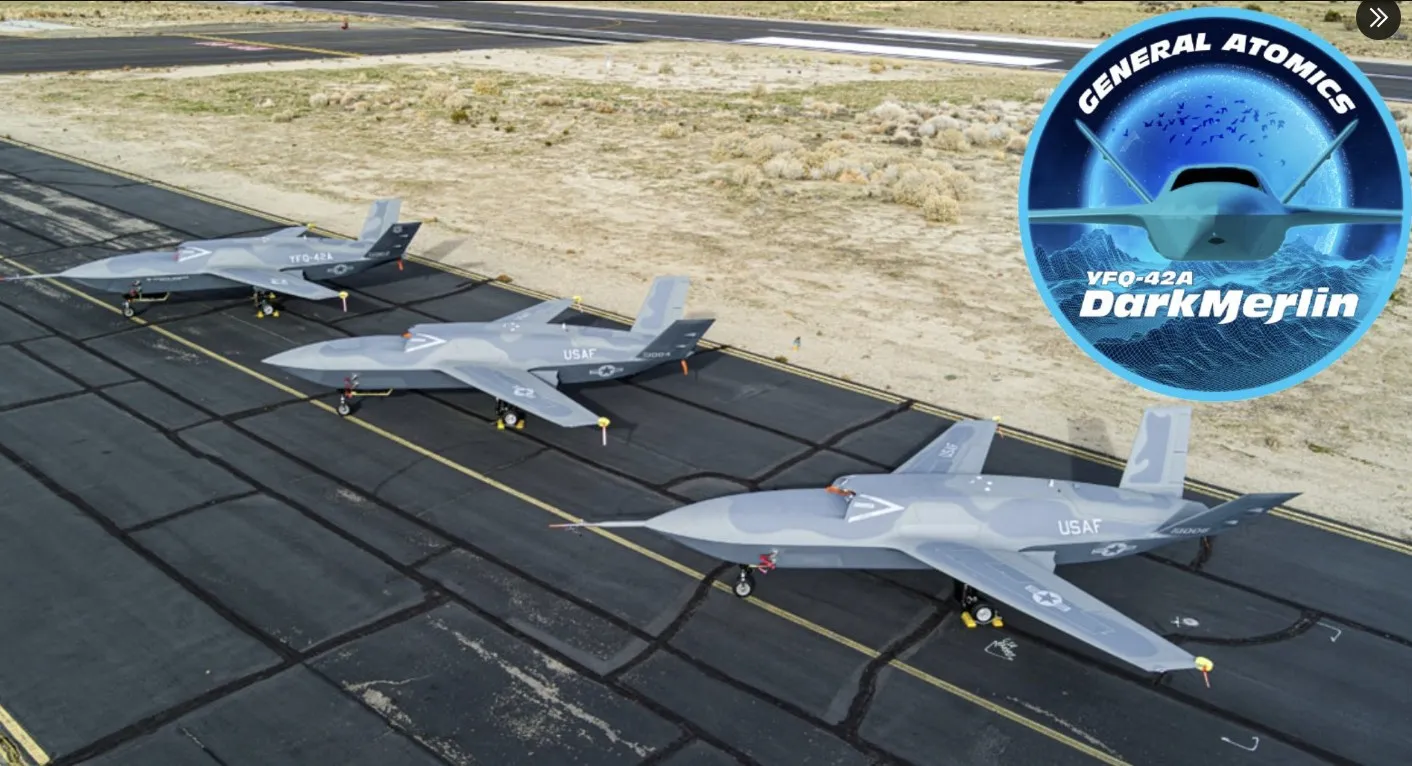
The U.S. Air Force has awarded Collaborative Combat Aircraft (CCA) production contracts to General Atomics (FQ-42A Dark Merlin) and Anduril (FQ-44A Fury). The deliberate split-award strategy, alongside the previously announced F-47 sixth-generation fighter, is designed to avoid repeating the costly mistakes of the F-35 program—including poor data rights, contractor lock-in, and lack of open architecture.

Highlights
- The U.S. Air Force awarded CCA production contracts to General Atomics (FQ-42A Dark Merlin) and Anduril (FQ-44A Fury) as a deliberate split-award to prevent contractor monopoly.
- Boeing's F-47 NGAD contract, finalized in March 2025, makes the F-47 America's first sixth-generation fighter aircraft.
- The F-35 program's total projected lifecycle cost through 2088 is approximately $2.1 trillion, with sustainment costs alone reaching $1.58 trillion—a 44% increase over 2018 estimates.
- CCA contracts decouple hardware from software: autonomous mission software will be competed separately among a pool of six vendors including Anduril, General Atomics, Lockheed Martin, Northrop Grumman, RTX Collins Aerospace, and Shield AI.
- Both the F-47 and CCA contracts mandate MOSA open architecture and government ownership of all data rights from day one, directly addressing the structural failures of the F-35 program.
The U.S. Air Force this week formally awarded production contracts for its Collaborative Combat Aircraft (CCA) program to General Atomics for the FQ-42A Dark Merlin and to Anduril for the FQ-44A Fury. These semi-autonomous "loyal wingman" drones represent a significant milestone in the U.S. military's push to field low-cost, attritable unmanned combat aircraft.
The split-award decision ranks among the most consequential Air Force contracts in recent years, second only to last year's selection of Boeing to develop the Next Generation Air Dominance (NGAD) platform—the crewed F-47 fighter (sometimes referred to as Phoenix)—which is the United States' first sixth-generation combat aircraft.
CCAs to Fly Alongside the F-47 and Existing Fighter Fleets
In the coming years, these CCA drones will fly in formation with the F-47 as well as crewed fighters such as the F-35 and F-22. They will share sensor data, serve as force multipliers, conduct strike missions, act as decoys, and suppress enemy air defenses—ushering in a new era of manned-unmanned teaming that significantly expands operational scale, reduces pilot risk, and reshapes the nature of aerial warfare.
Although the contracts have been split among General Atomics, Anduril, and Boeing, the long shadow of the F-35 Joint Strike Fighter (JSF) contract—awarded to Lockheed Martin in 2001—continues to shape U.S. defense acquisition culture.
The F-35 Cautionary Tale: Lessons Still Felt 25 Years Later
On October 26, 2001, the U.S. Department of Defense awarded Lockheed Martin the F-35 JSF System Development and Demonstration (SDD) contract, formally launching full-scale engineering development of the F-35 Lightning II. The aircraft's first variant entered service in 2015, and more than 1,300 are now in service globally—over 850 with U.S. forces alone—outnumbering all other stealth fighters combined, including the F-22 Raptor, J-20, J-35A, and Su-57.
However, the original F-35 contract contained significant gaps in sustainment, technical data rights, and long-term support responsibilities, causing maintenance, reliability, and upgrade costs to spiral. The total projected spend by the United States and international partners over the program's full lifecycle—through 2088—is approximately $2.1 trillion, covering development, procurement of roughly 2,470 aircraft, and decades of operations and sustainment.
A Government Accountability Office (GAO) report published in April 2024 found that fleet sustainment costs through 2088 are projected to reach $1.58 trillion—a 44% increase compared to 2018 estimates.
Lockheed Martin holds significant intellectual property (IP) rights over a large body of F-35 software and technical data, creating long-term dependency. For example, Lockheed and the F-35 Joint Program Office (JPO) were locked in a five-year legal dispute over IP rights to critical algorithms in the F-35 Integration and Avionics Bench (FIAB) software, a dispute that was only settled in 2024.
In 2022, senior F-35 program officials publicly stated that the Pentagon would need to pay Lockheed Martin approximately $500 million to obtain the technical data required to properly manage F-35 parts and sustainment.
Then-Secretary Kendall: We Will Not Repeat the F-35 Mistake
In 2023, then-Secretary of the Air Force Frank Kendall publicly stated that the Air Force was committed to avoiding the mistakes of the F-35 program and ensuring all sustainment data could be obtained from contractors.
"We're not going to repeat what I think was frankly a serious mistake in the F-35 program of not getting the rights to all of Lockheed's sustainment data," Kendall said. He criticized the Total System Performance Responsibility (TSPR) model as having effectively created a "permanent monopoly" for the contractor.
Structural Reforms Built Into the F-47 and CCA Contracts
The F-47 NGAD contract, finalized and awarded to Boeing in March 2025, explicitly incorporates numerous lessons drawn from the F-35 experience:
- Government-owned intellectual property and data rights: Whereas IP and data rights on the F-35 were held by Lockheed Martin, the corresponding rights on the F-47 will be owned by the government, eliminating permanent reliance on the prime contractor.
- Modular Open Systems Approach (MOSA): The F-47 contract mandates a Modular Open Systems Approach, using standardized interfaces to allow competitive bidding on subsystems and software—preventing the monopoly Lockheed Martin held over F-35 upgrades.
- Distributed responsibility to prevent over-concentration: Boeing is developing the crewed F-47, while Anduril and General Atomics are separately building the loyal wingman drones, preventing any single company from achieving complete dominance and control over a critical platform.
The CCA contracts follow the same principles:
- Hardware/software decoupling: The CCA contracts treat autonomous software as a separately competed item. The contracts awarded to Anduril and General Atomics cover hardware only.
- Competitive software pool: The Pentagon has established a pool of six companies eligible to compete for the software component, including Anduril, General Atomics, Lockheed Martin, Northrop Grumman, RTX Collins Aerospace, and Shield AI. Autonomy and mission software will be competed separately and openly.
- Mandatory MOSA open interfaces: No single company will own the core autonomous "brain," and multiple vendors will be able to develop cross-platform algorithms.
- Full government data rights from day one: This eliminates the legal disputes and additional expenditure that arose from data access issues in the F-35 program.
The message is clear: the Pentagon has absorbed the expensive lessons of the F-35 contract, and is determined not to repeat them.
原文來源: 查看原文
FAQ
Newsletter
Subscribe to our Low-Altitude Industry Newsletter
Daily curated news on low-altitude economy and drone industry, delivered to your inbox.