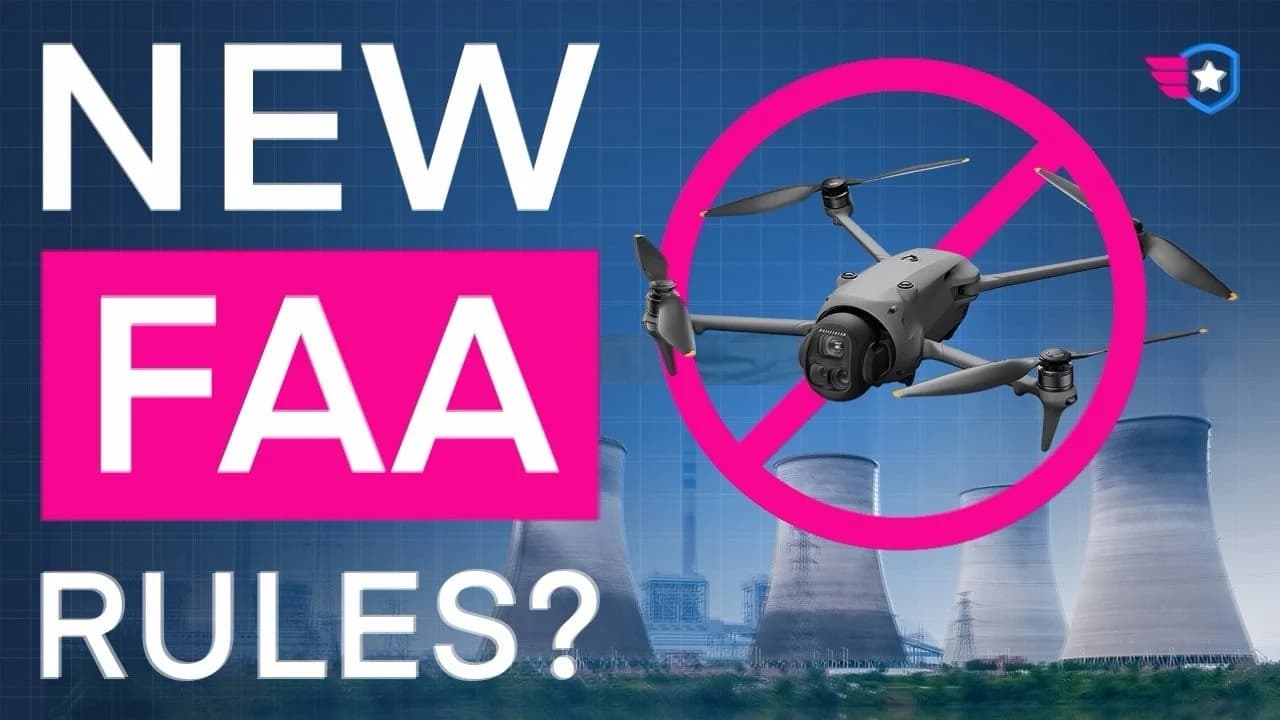
FAA's Section 2209 Drone Rule Is Finally Here — You Have Until August 5 to Comment
After nearly a decade, the FAA has published its proposed Section 2209 rule establishing Unmanned Aircraft Flight Restrictions (UAFRs) over critical infrastructure. The rule creates two tiers of restrictions, allows licensed commercial pilots to transit with prior notice, and completely bars recreational flyers. The public comment deadline has been extended to August 5, 2025.

Highlights
- The FAA published its Section 2209 proposed rule nearly 10 years after Congress mandated it in 2016, introducing UAFRs (Unmanned Aircraft Flight Restrictions) over critical infrastructure.
- Standard UAFRs are capped at a facility's property boundary with a 400-foot AGL ceiling; Special UAFRs are available only to federal security, intelligence, or military facilities for five-year terms.
- Recreational flyers are entirely prohibited from UAFRs, while Part 107 and other licensed commercial pilots may transit with prior notification to the facility — no permission required.
- The FAA estimates 125,000 facilities could qualify for a UAFR nationwide, but expects only around 9,000 applications in the first five years under the proposed standards.
- The public comment deadline for docket FAA-2026-4558 has been extended to August 5, 2025; comments can be submitted at regulations.gov.
FAA's Section 2209 Drone Rule Is Finally Here — You Have Until August 5 to Comment
After nearly ten years of waiting, the FAA has finally published its proposed Section 2209 rule. Whether you fly recreationally or commercially, this rule affects you. The public comment deadline was originally July 6, but has been extended to August 5. Here's what you need to know — and how to submit a comment that will actually be read.
What Is Section 2209?
In 2016, Congress directed the FAA to establish a process allowing certain critical infrastructure facilities nationwide to apply for restrictions on drone flights over their sites. Nearly a decade later — after two congressional reauthorizations and an executive order — the FAA has finally published its proposed rule. These restricted zones will be designated UAFRs (Unmanned Aircraft Flight Restrictions). The full proposal is available in the Federal Register.
Important caveat: this is only a proposed rule — it is not yet law. No UAFRs currently exist. The rule establishes an application process; it does not immediately restrict any airspace upon adoption. Each facility must apply individually and demonstrate necessity.
Two Tiers: Standard UAFRs and Special UAFRs
The rule creates two levels of restriction:
Standard UAFRs are the default category. The horizontal boundary is limited to the footprint of the applying facility, with a default vertical ceiling of 400 feet AGL (approximately 122 meters). Restrictions cannot extend beyond the facility's property boundary — they will not create massive no-fly bubbles blanketing entire communities.
Crucially, this is not a blanket prohibition like a Temporary Flight Restriction (TFR) or prohibited area. Most pilots may still qualify for transit authorization (see below).
Special UAFRs represent a stricter tier, available only to facilities owned, operated, or sponsored by federal security or intelligence agencies, or the military. They are designated for a five-year term. Operating within a Special UAFR requires both authorization from the sponsoring agency and approval from the FAA Administrator (or a delegated official). Where established for national security or homeland security purposes, the airspace will be designated National Defense Airspace, and violations will carry criminal penalties.
Who Can Apply?
Not everyone qualifies. Facilities must belong to one of 16 critical infrastructure sectors, including energy, chemicals, water, nuclear, transportation, defense, and healthcare, among others.
Applicants must also meet a burden of proof, demonstrating:
- Documented drone traffic in the area
- Specific security vulnerabilities
- Existing security measures (access controls, security personnel, surveillance systems)
- The capability to receive and log Remote ID broadcasts from nearby drones
The FAA estimates approximately 125,000 fixed facilities nationwide could potentially qualify for a UAFR, but under the proposed application standards, expects only around 9,000 applications over the first five years — far fewer than the total eligible pool.
What Does This Mean for You?
Recreational flyers (operating under 49 U.S.C. § 44809): Prohibited from flying within any UAFR, with no exceptions.
Commercial pilots (operating under Part 91, Part 107, the forthcoming Part 108, Part 135, or Part 137): May apply for a transit corridor, subject to the following conditions:
- Compliance with Remote ID requirements under 14 CFR Part 89 (most pilots already meet this)
- Prior notification to the facility
Key distinction: notification is not the same as requesting permission. You are simply informing the facility that you intend to transit its airspace — the facility cannot deny you. The FAA's documentation does not specify how far in advance notice must be given. Importantly, airspace authority remains with the FAA, not the facility — a critical point.
How Does the Facility Application Process Work?
Facilities applying for a UAFR must follow these steps:
- Each facility must be authorized individually; a single company cannot designate an entire campus as a UAFR in one application
- The application must document: security vulnerabilities, potential consequences of drone incidents, a drone response plan, existing security measures, and other FAA-required information
- If the FAA grants conditional approval, it will publish a 30-day NPRM notice specific to that facility, during which the public may object
- The FAA retains the authority to bypass the NPRM process and establish a UAFR directly when justified
- Approved UAFRs are valid for a maximum term of five years
Pros and Concerns
Strengths of the proposed rule:
- Facilities must prove necessity; the threshold for restriction is clearly defined
- Restrictions are scoped as narrowly as possible
- Licensed commercial pilots retain transit access
- The FAA — not the facility — retains airspace authority
Issues worth watching:
- The rule explicitly does not authorize geofencing, jamming, drone capture, or any counter-UAS technology. Facilities can identify who is flying nearby but cannot stop a bad actor
- The "notify and fly" model protects compliant operators but offers limited deterrence against deliberate violators
- The proposed rule does not preempt state or local regulations, meaning states may still enact their own rules — limiting the effectiveness of a unified federal standard
- If the FAA chooses to bypass the NPRM process to implement a UAFR urgently, transparency and due-process protections are weakened
What the FAA Wants to Hear
The FAA is specifically seeking public input on the following questions:
- Is the 16-sector framework appropriately scoped (should sectors be added or removed)?
- What additional flight operations should be permitted within UAFRs?
- Should recreational flyers be eligible for transit authorization? (They are currently excluded, likely because Part 107 pilots undergo TSA vetting while recreational flyers do not)
- What is the economic impact on commercial operators if transit is restricted?
How to Submit a Comment That Will Actually Be Read
The process takes about five minutes:
- Go to regulations.gov
- Search for docket number: FAA-2026-4558
- Deadline: August 5, 2025
Tips for an effective comment:
- All comments are public record — do not include personal information you would not want published
- Avoid generic statements like "I don't like this rule." Instead, explain specifically how the rule affects your flight operations, business model, planned routes, or costs
- The FAA is legally required to read and respond to every substantive comment. Concrete, real-world examples carry far more weight than form letters
This article is adapted from a video by Greg Reverdiau of the Pilot Institute YouTube channel. Watch the full breakdown at the Pilot Institute YouTube channel.
原文來源: 查看原文
FAQ
Newsletter
Subscribe to our Low-Altitude Industry Newsletter
Daily curated news on low-altitude economy and drone industry, delivered to your inbox.