FCC Cracks Open the Door for Chinese Toy Drones — But the Gap Is Too Narrow Even for the DJI Neo
The FCC has announced a limited exemption allowing certain Chinese toy drones to be imported into the US, but the qualifying criteria are so restrictive — under 150g, no camera, no connectivity, 100m range, 10-minute flight time — that even DJI's lightest model, the 135g Neo, fails to qualify. In practice, all current and future DJI and Autel models remain locked out of the US market.

Highlights
- The FCC issued Public Notice DA 26-588 on June 15, 2025, exempting Chinese-made toy drones from the Covered List ban based on a June 12 DoD determination.
- Qualifying drones must weigh under 150g, carry no camera or GPS, have no wireless connectivity, stay within 100 meters, and fly for no more than 10 minutes per charge.
- The DJI Neo (135g) falls below the weight limit but fails on camera, GPS, brushless motors, connectivity, and flight time — and DJI's NDAA Section 1709 listing blocks it regardless.
- All new DJI and Autel models released after December 22, 2024 remain banned from the US market; previously authorized models can still be sold and flown.
- DJI is challenging the Covered List determination in the Ninth Circuit Court of Appeals (Case 26-1029), arguing the FCC has not produced evidence that DJI products pose the claimed national security threat.
FCC Cracks Open the Door for Chinese Toy Drones — But the Gap Is Too Narrow Even for the DJI Neo
The Federal Communications Commission (FCC) announced Tuesday that it will allow certain new Chinese toy drones to be imported into the United States — the latest crack to appear since a sweeping ban froze DJI and Autel out of the US market last December. On the surface it looks like a concession. Read the fine print, and the actual opening is vanishingly small.
The exemption applies only to drones the FCC classifies as "toys," and that definition is strict enough to exclude virtually every model any serious pilot would actually want to buy. Qualifying drones must: weigh no more than 150 grams (5.29 oz); fly no farther than 100 meters (328 ft) within visual line of sight; carry no internet connectivity; be equipped with no cameras or sensors capable of surveillance or data collection; and offer no more than 10 minutes of flight time per charge. Having flown DJI's smallest models for years, this reporter can say plainly: what meets these conditions is something you would never specifically seek out.
The ruling was issued by the FCC's Public Safety and Homeland Security Bureau on June 15 as Public Notice DA 26-588, acting on a determination made by the Department of Defense on June 12. Reuters reporter David Shepardson first reported the news on Tuesday. In the narrowest possible sense this is good news — and yet another reminder that every other door remains firmly shut.
The FCC's Definition of a Toy Drone Leaves Barely Any Toy Drones Standing
The formal criteria are even stricter than the headline figures suggest. Reuters cited the weight, range, and flight-time limits, but the full FCC notice adds several more: no GPS or GNSS systems (ruling out auto-return-to-home, waypoint missions, and subject tracking); no brushless motors; a maximum altitude of 300 feet (approximately 91 meters); and a top speed no greater than 10 meters per second (roughly 22 mph). Qualifying drones must also be marketed explicitly as toys and must not be manufactured by any entity listed under Section 1709 of the Fiscal Year 2025 National Defense Authorization Act (NDAA).
Under the FCC's definition, a toy drone is a sub-150g aircraft with no camera, no networked radio, a 100-meter operating radius, and a 10-minute battery life. Each restriction on its own already eliminates a large swath of popular products; stacked together, they describe a category that effectively does not exist on the 2026 market.
The FCC said the move is grounded in a DoD determination that "lower-end, low-risk toys" lacking "the autonomous capabilities and features of traditional UAS — including range, endurance, sensing, payload, connectivity, and data collection and storage" do not present a national security risk. That phrasing carries significant weight: the very reasons people buy camera drones are the camera, the range, and the flight time. Strip those away and what remains is little more than a powered foam glider.
The 150-gram weight cap illustrates just how tight these constraints are. The 250-gram threshold is already meaningful in US recreational flying — it is the FAA's cutoff below which hobbyists are exempt from mandatory registration, and an entire product segment has been engineered around that line. The FCC's toy definition shaves another 40% off that already-lightweight category and then layers on nearly a dozen additional conditions.
DJI's Lightest Model, the Neo, Fails on Almost Every Count
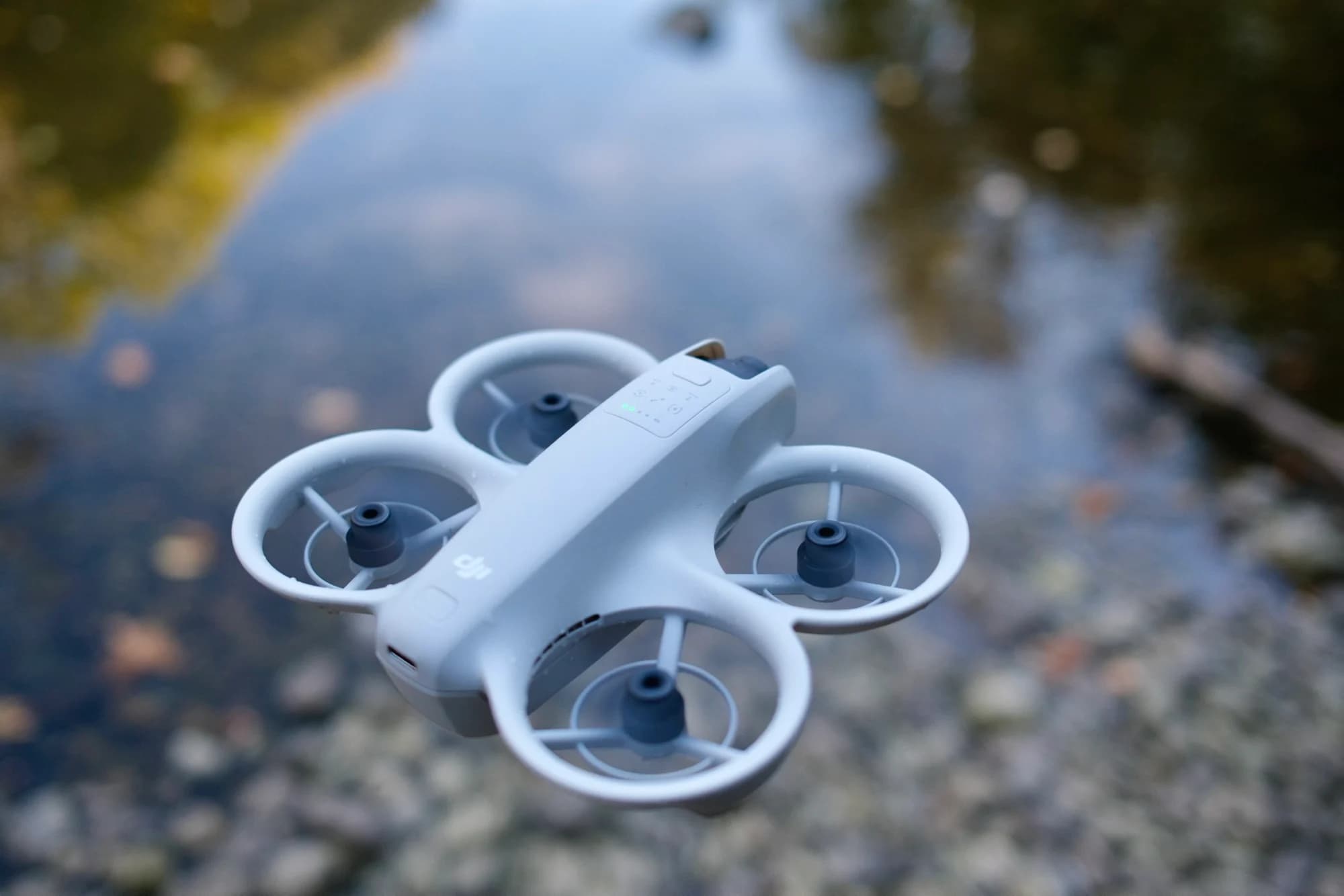
The DJI Neo weighs 135 grams bare — light enough to launch from the palm of your hand, and below the FCC's 150-gram threshold. It is the closest thing in DJI's lineup to a "toy," yet it remains barred as a new import under these rules, and by a wide margin.
Running down the checklist: weight, 135g — pass. Everything after that is a fail. The Neo carries a 12-megapixel, 1/2-inch sensor capable of 4K video, which is precisely the "camera capable of surveillance or data collection" the rule excludes. Its wireless link reaches up to 7 km, far beyond the 100-meter range limit, and violates the no-connectivity clause. It has GPS, brushless motors, and approximately 18 minutes of flight time — three separate disqualifications on their own. Even if DJI stripped out all of the above, the notice's final clause closes the door: toy drones may not be manufactured by any company listed under Section 1709 of the FY2025 NDAA, and DJI is on that list.
Step one product up and the gap widens dramatically. The DJI Mini 5 Pro weighs 249.9 grams — already 100 grams over the FCC limit on weight alone, before any other specification is considered. It carries a 1-inch sensor, a 20 km video transmission system, and a battery DJI rates at 36 minutes of flight. The Mini 5 Pro is not a toy by any definition, and the FCC's framework was never designed to reach it. The same applies to the Mini 4 Pro, Air 3S, Mavic 4 Pro, and every Avata variant. The toy exemption touches none of the drones US consumers actually want to buy.
Exemptions Continue to Favor Everyone Except DJI and Autel
Tuesday's toy-category exemption is the latest in a series of FCC carve-outs over the past six months, and the pattern has remained consistent throughout: new models from DJI and Autel stay blocked, while narrower categories and non-Chinese manufacturers get a path forward.
The sequence began on December 22, 2024, when the FCC placed foreign-manufactured drones and critical components on its Covered List after a White House-convened interagency body declared them an unacceptable national security risk. Exceptions followed within weeks: January brought an exemption for Blue UAS-listed drones and US-assembled aircraft through January 1, 2027, along with guidance opening a component-purchasing loophole for US retailers. In March, the DoD approved the first four trusted drones: the SiFly Q12, Mobilicom SkyHopper, ScoutDI Scout 137, and Verge X1 — all non-Chinese manufacturers.
The conditional review process has continued since. A June 4 Covered List update added Innovation First's VEX AIR educational platform, as well as consumer routers from Netgear, eero, and Nokia that passed the same review. Tuesday's toy-drone determination is the first exemption issued by product category rather than by individual company — yet it still manages to exclude the two companies at the center of the controversy, because the category framework was designed from the outset to do exactly that.
The Same Logic That Defined Routers Now Defines Toys
The toy exemption shares the same docket and legal basis as the broader Covered List action, meaning it operates under the Secure and Trusted Communications Networks Act authority the FCC has used throughout this year to regulate foreign hardware. The FCC cannot add or remove items from the list on its own; it must act on national security determinations submitted by the DoD or the Department of Homeland Security.
That architecture is what produced such a tightly drawn toy exemption. The DoD did not endorse toy drones out of goodwill — it issued a specific determination that aircraft lacking range, endurance, sensing, payload, and connectivity cannot perform the missions the government is worried about, and the FCC translated that determination into specific numbers. The same mechanism that placed foreign consumer routers on the Covered List in March is now drawing the line between "harmless" and "not harmless" at 150 grams and no camera.
Reuters reported that the FCC is separately evaluating whether to ban imports of equipment from a group of Chinese companies whose new devices were already prohibited from sale in 2022, indicating that the broader regulatory action continues to expand.
For pilots, the practical situation has not changed since December: every DJI or Autel drone that received FCC authorization before December 22, 2024, can still be legally imported, sold, and flown. The Air 3S, Mini 4 Pro, Mavic series, and Matrice series remain on shelves. What is blocked is the future: every new model DJI and Autel release from this point forward, regardless of size, is off-limits.
DroneXL's Take
This reporter has tracked the regulatory chain since the FCC voted in October 2024 to grant itself retroactive ban authority, covering every exemption as it has arrived. This one fits the established pattern precisely: each exemption is announced as if it offers relief, yet is structured to leave the two companies at the center of the controversy exactly where they were. The toy determination is the purest version yet, because for the first time the FCC has put in writing the specification sheet for what it considers a "safe" drone — and that specification sheet describes something almost nobody on the market is selling.
What makes this worth closer attention is the precedent embedded in the numbers. The government has now formally defined, in writing, what a "non-threatening" drone looks like: 150 grams, no meaningful camera, 100-meter range, 10-minute flight time, no GPS, no brushless motors. That document sitting in the docket is genuinely revealing, because it exposes the real security logic: the threat is not the airframe — it is the camera, the range, the radio, and any feature that enables autonomous navigation. The DJI Neo is 135 grams, below the weight threshold, yet it fails on virtually every other criterion. That tells you weight was never the actual variable. Capability was.
This is precisely the contradiction DJI is challenging in court. DJI's lawsuit contesting the Covered List determination — Case 26-1029 in the Ninth Circuit Court of Appeals — argues that the FCC never produced evidence that DJI products pose the threat the ban presupposes. A government that can precisely enumerate which capabilities are dangerous will eventually have to explain why a specific company's hardware crosses that line. Whether the Ninth Circuit demands that the government show its work in open proceedings, or retreats behind classified annexes no one can read, is a question whose outcome will determine far more than the fate of a 135-gram palm-sized aircraft. For now, the toy door is open — but the only things that can walk through it are the things you never wanted in the first place.
Sources: FCC Public Notice DA 26-588; Reuters, reporting by David Shepardson.
DroneXL uses automated tools to assist with research and data retrieval. All reporting and editorial commentary is written by Haye Kesteloo.
原文來源: 查看原文
FAQ
Newsletter
Subscribe to our Low-Altitude Industry Newsletter
Daily curated news on low-altitude economy and drone industry, delivered to your inbox.