JetBlue Near JFK: Pilot Reports Drone Strike, but No Damage Found and FAA Still Investigating
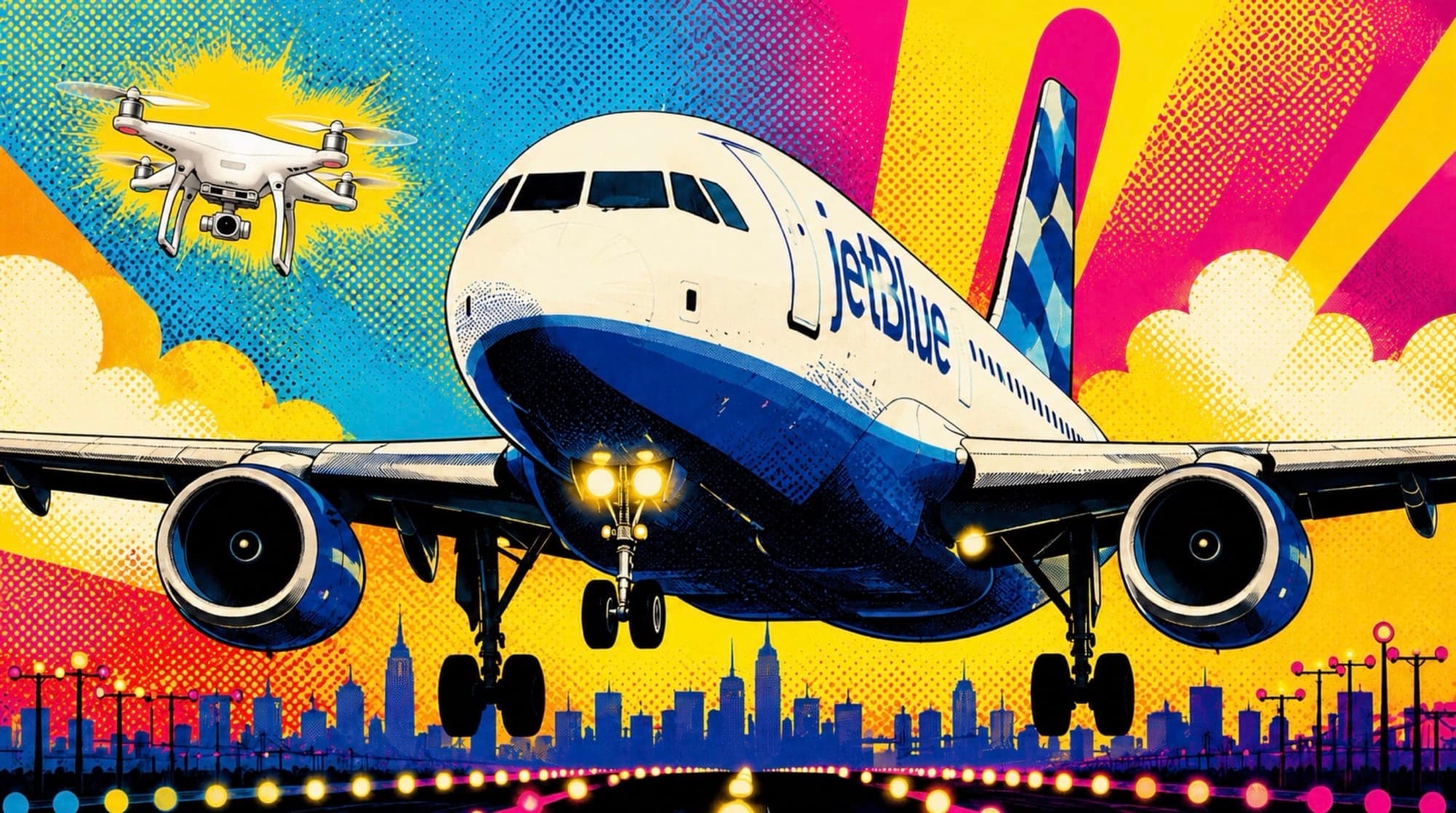
On June 29, 2025, a JetBlue flight crew reported a suspected drone strike on approach to JFK Airport at approximately 3,000 feet. After landing, technicians found zero damage to the aircraft. The FAA has not confirmed what, if anything, was struck. Media outlets rushed to headline a 'drone strike' before any evidence was established, raising serious questions about journalistic accuracy and the broader pattern of unverified drone panic.

Highlights
- 2025年6月29日,JetBlue班機在進場JFK機場3,000英尺高空時,飛行員回報疑似撞上無人機,但落地後機身檢查完全無損傷。
- FAA目前仍在調查,尚未確認機組員是否真的撞到任何物體,媒體卻在調查結果出爐前已以「無人機撞機」為題搶先報導。
- 美國約有80萬架已登記無人機,2024年飛行次數達數千萬次,至今從未有任何商業客機被無人機擊落的紀錄。
- 2018年蓋特威克機場無人機事件導致36小時關閉、1,000個航班停飛,事後英國警方確認從頭到尾可能根本沒有無人機存在。
- FAA野生動物撞擊資料庫顯示美國每年約記錄19,000起鳥擊事件,鳥類曾造成客機迫降(如2009年全美航空1549),但無人機在美國從未擊落任何客機。
JetBlue Near JFK: Pilot Reports Drone Strike, but No Damage Found
On Monday, June 29, 2025, a JetBlue flight crew reported to air traffic control that they believed they had struck a drone while on approach to John F. Kennedy International Airport at approximately 3,000 feet. Within hours, the story had spread across major media outlets — 'aircraft, drone, midair collision over New York' became the headline currency of the day.
After landing, however, maintenance technicians conducted a thorough inspection and found no damage whatsoever: leading edges intact, radome uncracked, engine cowlings unmarked, and no drone debris anywhere on the ramp. For what was being described as a midair collision between a commercial jet and a device allegedly capable of downing an airliner, the 'crime scene' was remarkably clean — because there was no evidence a crime had occurred.
The Federal Aviation Administration (FAA) is investigating and has not confirmed what the crew encountered, or whether they encountered anything at all. That has not stopped numerous outlets from rendering a verdict in their headlines.
A Damage-Free 'Strike Report' Is Not a Confirmed Strike
The facts that hold up to scrutiny are limited: the JetBlue crew informed controllers they believed they had hit a drone while crossing the coastline on approach; the aircraft landed safely; and the post-landing inspection found no damage — a detail confirmed by ASIS International's Security Management magazine citing an Associated Press report. Everything else is inference, and inference is where reporting goes wrong.
Real drone strikes leave evidence. Bird strikes leave evidence, and we have decades of forensic data to prove it. A quadcopter weighing roughly one kilogram hitting an airframe at approach speed imparts significant energy into aluminum and composite structures — it does not vanish on contact. When investigators find nothing, the most defensible explanation is usually the ordinary one that pilots have been reporting for a century: a passing bird, a plastic bag caught in a sea breeze, a balloon, another aircraft at a deceptive angle, or a startle response to something that was never there at all.
Pilots are trained observers under high workload — and they are also human. 'I think I hit a drone' is a hypothesis, not a forensic conclusion. This is not to say drones near airports are not a problem — they are, and operating an unmanned aircraft in JFK's approach corridor is both dangerous and illegal. The point is more specific and more important: a pilot's report of a drone is the beginning of an investigation, not the end of one. Conflating the two is a newsroom habit of converting an open case into a crisis.
Much of What Fills the Sky Is Not a Drone
The majority of 'mystery drone' panics collapse on serious scrutiny. The pattern repeats.
Gatwick Airport, 2018: In December 2018, drone sightings shut Gatwick Airport for approximately 36 hours during the peak Christmas travel period, grounding roughly 1,000 flights and disrupting around 140,000 passengers. Two people were arrested and released without charge. Sussex Police subsequently issued a remarkable statement: there may have been no drone at all from the start. No verified photographs, no radar tracks, no hardware. The 'worst drone incident in aviation history' almost certainly involved no drone.
Colorado and Nebraska, 2019–2020: Residents of the High Plains reported large drones flying grid patterns over rural counties at night, prompting a multi-agency task force. Investigators ultimately traced a significant share of sightings to planets, stars, commercial airliners, and ordinary lights that looked suspicious in a dark sky — because when people are primed to look for drone swarms, almost anything becomes one. No operator was ever identified, because for many sightings there was nothing to trace.
New Jersey, Late 2024: Between November and December 2024, mass sighting reports across New Jersey and the broader US Northeast triggered thousands of police calls, congressional demands for investigation, and public speculation about foreign 'motherships' offshore. A joint FBI and Department of Homeland Security (DHS) statement concluded that many reports represented misidentification of lawful manned aircraft, with no evidence of foreign activity or public safety threat. Electronic detection systems consistently failed to corroborate visual reports. The 'mothership' was Venus, large numbers of Cessnas, and commercial traffic inbound to Newark Liberty International Airport.
Europe, 2024–2025: Denmark, Norway, Belgium, and Germany all experienced airport closures and military facility sightings that generated extensive headlines, with multiple incidents ultimately failing to confirm any drone hardware. Danish authorities quietly confirmed that several high-profile sightings — ones that prompted NATO deployments and national no-fly orders — were conventional aircraft. The details vary; the script does not: report, panic, headline, then a brief uncovered correction weeks later.
Real Threats Exist — Conflating Them with 'Phantoms' Helps No One
Skepticism toward the JFK headlines is not a denial that drones can be weaponized or hazardous. Both things can be simultaneously true, and the distinction is the point.
The drone swarms conducting reconnaissance over Barksdale Air Force Base — a B-52H bomber installation — using custom, jam-resistant aircraft with active evasion documented in a leaked military briefing: that is a real threat. The explosive drone plot disrupted by the FBI ahead of a White House-area event in June of this year: that is a real case. These are confirmed incidents with evidence, suspects, or hardware.
That is precisely why reflexive attribution of any incident to drones is harmful. Every airport scare that turns out to be a bird erodes the credibility that genuine threats require. It also feeds the counter-drone panic industry. In the same week as the JFK report, ASIS cited a DroneShield industry survey showing approximately 60% of security managers reported lacking legal authority to take direct action against unauthorized drones, framing this as a crisis requiring new powers and new equipment. Some of those concerns are legitimate — but an industry that sells detection and countermeasure systems has considerable incentive to treat an unverified pilot report as proof the sky is falling.
The Numbers: Drones Are Actually Among the Safest Objects in the Sky
The FAA counts approximately 800,000 registered drones in the United States and has issued hundreds of thousands of Part 107 Remote Pilot Certificates. Drone operations numbered in the tens of millions in 2024 alone. Against that operational baseline, the number of commercial airliners brought down by a drone in the United States is zero — not 'very low,' but zero.
By comparison, the problem we actually have reliable data on: the FAA Wildlife Strike Database records approximately 19,000 wildlife strikes per year in the United States, and bird strikes have caused fatalities and hull losses. In January 2009, US Airways Flight 1549 made an emergency water landing on the Hudson River after Canada geese destroyed both engines. Birds have forced airliners down. Drones, in the United States, verifiably have not brought down a single commercial aircraft.
Manned aircraft accidents impose losses that dwarf any harm attributable to drones. The National Transportation Safety Board (NTSB) recorded 1,097 general aviation accidents in the United States in 2023, with hundreds of fatalities in a typical year. No newspaper runs a daily headline reading 'another manned aircraft has crashed' because that risk is familiar — and drones are novel. Novelty is the raw material of fear-based coverage.
DroneXL Perspective
Not everything in the sky is a drone — yet media outlets keep failing in the same direction, always toward the most alarming answer, because 'plane strikes drone over New York' is a headline and 'crew reports suspected object, aircraft lands safely, investigation ongoing' is not.
That asymmetry is the actual problem. The alarming version runs on every front page within hours; the correction, if it appears at all, runs as an unread paragraph weeks later. This is not an accident of the news cycle. Fear is a commodity, and unverified drones are cheap inventory.
If the FAA investigation ultimately confirms that a drone did strike that JetBlue aircraft, this publication will report it, name the operator, and call for the full weight of enforcement. Until then, the honest headline — the one no outlet ran — is this: Crew reported a visual contact, aircraft landed safely, no drone was found.
We will see how many of the outlets that shouted 'strike!' on Monday publish a correction if the answer turns out to be nothing. History suggests they will not.
Sources: ASIS International Security Management magazine; Federal Aviation Administration (FAA); FAA Wildlife Strike Database; National Transportation Safety Board (NTSB).
DroneXL uses automated tools to assist with research and data aggregation. All reporting and editorial perspective is written by Haye Kesteloo.
原文來源: 查看原文
FAQ
Newsletter
Subscribe to our Low-Altitude Industry Newsletter
Daily curated news on low-altitude economy and drone industry, delivered to your inbox.